Thank you for visiting SNEWPapers!
Sign up free
The Lancaster Gazette
Lancaster, Fairfield County, Ohio
What is this article about?
US official correspondence reveals diplomatic challenges during Lajos Kossuth's 1851 voyage on USS Mississippi, including crowd incidents at Spezzia, Sardinian and French objections to his landing, and his publication in a French paper straining relations. He disembarked at Marseilles for England.
Clipping
OCR Quality
Full Text
Kossuth and the Mississippi
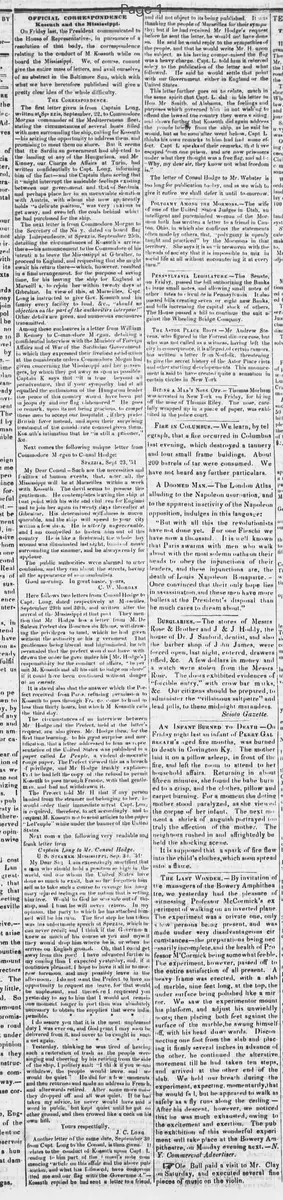
On Friday last, the President communicated to the House of Representatives, in pursuance of a resolution of that body, the correspondence relating to the conduct of M. Kossuth while on board the Mississippi. We, of course, cannot give the entire mass of letters, and avail ourselves of an abstract in the Baltimore Sun, which with what we have heretofore published will give a pretty clear idea of the whole difficulty.
THE CORRESPONDENCE.
The first letter given is from Captain Long, written at Spezzia, September 22, to Commodore Morgan, commander of the Mediterranean fleet, stating the circumstances of several boats filled with men surrounding the ship, calling for Kossuth--his seizing the opportunity to address them, and promising to meet them on shore. But it seems that the Sardinian government had objected to the landing of any of the Hungarians, and Mr. Kinney, our Charge d'Affairs at Turin, had written confidentially to Capt. Long, informing him of the fact--and the Captain then seeing that it might interrupt the amicable feelings existing between our government and that of Sardinia and perhaps place her in an unenviable situation with Austria, with whom she now apparently holds a delicate position, was very anxious to get away, and even left the coals behind which he had purchased for the ship.
The next letter is from Commodore Morgan to the Secretary of the Navy, dated on board flag ship Independence, at Spezzia, September 25th, detailing the circumstances of Kossuth's arrival there--his announcement to the Commodore of his intention to leave the Mississippi at Gibraltar, to proceed to England, and requesting that she might await his return there--which, however, resulted in a final arrangement, for the purpose of saving time, for his leaving the ship for England at Marseilles, to rejoin her within twenty days at Gibraltar. In view of this, at Marseilles, Capt. Long is instructed to give Gov. Kossuth and his family every facility to land, &c., "should no objection on the part of the authorities interpose!"
Other details are given, and numerous enclosures transmitted. Among these enclosures is a letter from William B. Kinney to Commodore Morgan, detailing a confidential interview with the Minister of Foreign Affairs and of War of the Sardinian Government, in which they expressed their liveliest satisfaction at the considerate orders Commodore Morgan had given concerning the Mississippi and her passengers, by which they got away as soon as possible. Captain K says that "it is true beyond all peradventure, that if your sympathy had at all equalled the enthusiasm of the Hungarian leader the peace of this country would have been put in jeopardy and our flag dishonored." He goes to remark, upon its not being gracious, to compel these men to accept our hospitality, if they prefer British favor instead, and upon their surprising treatment of the considerate counsel given them. Kossuth's intimation that he "is still a prisoner, &c."
Next comes the following unique letter from Commodore Morgan to Consul Hodge:
SPEZZIA, Sept 23,'51
My Dear Consul--Such are the necessities and frailties of human events, that, after all, the Mississippi will be at Marseilles within a week with Kossuth. The devil seems to possess this gentleman. He contemplates leaving the ship at that point with his wife and children for England and to join her again in twenty days thereafter at Gibraltar. His determined willfulness is unconquerable, and the ship will speed to your city within a few days. He is utterly ungovernable, and I am compelled to hasten him out of this country. He is like a firebrand; the whole bay around was illuminated last night, bands of music surrounding the steamer, and he always ready for applause. The public authorities were alarmed to utter confusion, and they ran about the streets, having all the appearance of somnambulists. Good morning. In great haste, yours,
C. W. MORGAN
Here follows two letters from Consul Hodge to Capt. Long, dated respectively at Marseilles, September 29th and 30th, and written after the arrival of the Mississippi at that port. They mention that Mr. Hodge has a letter from M. De SUSEAY, Prefect des Bonches du Rhone, withdrawing the privileges to land, which he had given without the authority of his government. That gentleman being liberal and high-minded, he felt persuaded that the prefect would not have withdrawn the order he gave under his [Mr. Hodge's] responsibility for the conduct of affairs, to permit M. Kossuth and all his suit to lodge on shore if it could have been continued without danger of an emeute.
It is stated also that the answer which the Prefect received from Paris, refusing permission to Kossuth to pass through France, came to hand some thirty hours, but which M. Kossuth calls the third day.
The circumstances of an interview between Mr. Hodge and the Prefect, held at the latter's request, are also given. Mr. Hodge then, for the first time learning, to his great surprise and mortification, that a letter addressed to him as representative of the United States was published in a paper called Le Peuple, a violent democratic rouge paper. The Prefect viewed this as a breach of privilege, and Mr. Hodge frankly explained that he had left the copy of the refusal to permit Kossuth to pass through France, with that gentleman, and had not withdrawn it.
The Prefect told Mr. H that if any person landed from the steamer not belonging to her, he would order their immediate arrest. Capt. Long is required, therefore, to act accordingly and to request M. Kossuth not to send articles to the paper "Le Peuple" while under the banner of the United States.
Next comes the following very readable and frank letter from Capt. Long to Mr. Consul Hodge.
U. S. STEAMER MISSISSIPPI. SEP. 30, '51
My Dear Sir: I am exceedingly mortified that a man who should hold a position so high in the world, and one whom the United States have done so much to exalt, has so far forgotten himself as to take such a course to revenge his imaginary injured feelings on the nation that is setting him free. Would to God he was safe out of this ship, and I trust he will never return. In my opinion, the party to which he has attached himself will be his ruin. The first step he has taken was his unfortunate speech at Spezzia, which he can never recall; and I think if the Government knew as much of his course as you and myself they would drop him where he is, or when he arrives on English ground. Oh, that I could get away from this port! I have advanced further in my coaling than I expected yesterday, and, if it continues pleasant, I hope to have it all in by to-morrow forenoon, and may possibly leave in the afternoon. I do not want the Prefect to have an opportunity to request me leave, for that would be unpleasant, and therefore I requested you yesterday to say to him that I would not remain one moment longer in port than was absolutely necessary to obtain the supplies that were indispensable.
I do assure you that it is the most unpleasant duty I was ever on, and God grant I may soon be delivered from it, and never to be caught in such a net again. Yesterday, thinking he was tired of bearing such a reiteration of trash as, the people were singing and cheering by his retiring from the side of the ship, I politely said: "I think if you would withdraw, the people would leave, and we would be quiet." He did for a few moments and then returned and made an address in French, and afterwards retired. After some more noise they dropped off and all was quiet. If he had taken my advice, he never would have said a word in public, but kept quiet until he got on other ground, and then crowed like a cock on his own hill.
Yours respectfully,
J. C. LONG.
Another letter of the same date, September 30, from Capt. Long to the Consul, is then given. It relates to the conduct of Kossuth upon Capt. L. reading to him part of the consul's note commencing "article on this affair and the above publication, and what has followed, have compromised me and our flag with the Government."--Kossuth replied he had sent letter to a friend, and did not object to its being published. It was thanking the people of Marseilles for their sympathy; but if he had received Mr. Hodge's request before he sent the letter, he would not have done so. He said he would reply to the sympathies of the people, and that he would write Mr. H. upon the subject, as his having compromised the flag was a heavy charge. Capt. L. told him it referred solely to the publication of the letter and what followed. He said he would settle that point with our Government, either in England or the United States.
This letter further goes on to relate, much in the same spirit that Capt. L. did in his letter to Hon. Mr. Smith, of Alabama, the feelings and purposes which governed him in not wishing to offend the laws of the country they were visiting, and shows further that Kossuth did again address the people briefly from the ship, as he said he would, but as he soon after went below, Capt. L. thinks his own remarks to him had had some effect. Capt. L. speaks of their remarks, that they have escaped from one prison, and are now prisoners under what they thought was a free flag, and adds: "…Why, my dear sir, they know not what freedom is."
The letter of Consul Hodge to Mr. Webster is too long for publication today, and as we wish to give it entire we shall defer it until to-morrow.
What sub-type of article is it?
What keywords are associated?
What entities or persons were involved?
Where did it happen?
Foreign News Details
Primary Location
Spezzia And Marseilles
Event Date
September 1851
Key Persons
Outcome
kossuth arranged to leave the uss mississippi at marseilles for england, rejoining at gibraltar; diplomatic tensions avoided with sardinia and france through considerate us naval actions.
Event Details
Official US correspondence details incidents during Lajos Kossuth's passage on the USS Mississippi in the Mediterranean. At Spezzia, crowds demanded Kossuth, but Sardinian objections led Captain Long to depart hastily. Commodore Morgan arranged for Kossuth to disembark at Marseilles for England. French authorities later withdrew landing permissions, citing risks of unrest. Kossuth published a letter in a French paper, compromising US relations, leading to further tensions and instructions to prevent further publications. Captain Long expressed frustration with Kossuth's willful behavior.