Thank you for visiting SNEWPapers!
Sign up free
Story
September 8, 1933
The Coolidge Examiner
Coolidge, Pinal County, Arizona
What is this article about?
Charles Francis Coe's article examines the decline of bootlegging profits with Prohibition's end, leading gangsters like Al Capone to shift to kidnapping, narcotics, and violence. It highlights federal enforcement's effectiveness against organized crime in cities like Chicago, Detroit, and New York.
Clipping
OCR Quality
98%
Excellent
Full Text
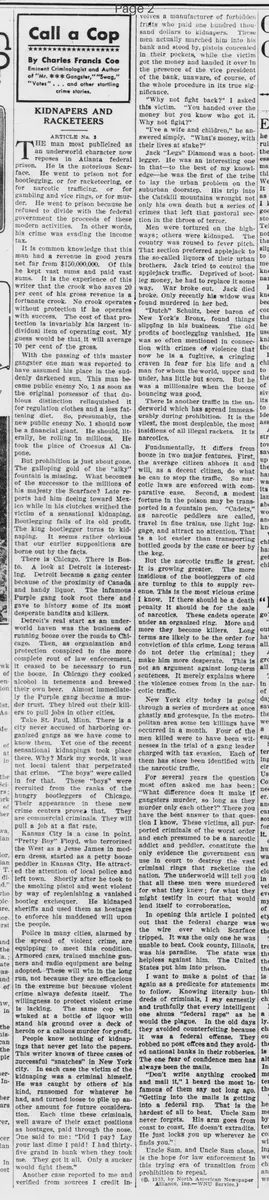
Call a Cop
By Charles Francis Coe
Eminent Criminologist and Author of "Mr. *** Gangster," "Swag," "Votes"... and other startling crime stories.
KIDNAPERS AND RACKETEERS
ARTICLE No.
The man most publicized as an underworld character now reposes in Atlanta federal prison.
He is the notorious Scarface.
He went to prison not for bootlegging, or for racketeering, or for narcotic trafficking, or for gambling and vice rings, or for murder. He went to prison because he refused to divide with the federal government the proceeds of these modern activities. In other words, his crime was evading the income tax.
It is common knowledge that this man had a revenue in good years not far from $150,000,000. Of this he kept vast sums and paid vast sums. It is the experience of this writer that the crook who saves 20 per cent of his gross revenue is a fortunate crook. No crook operates without protection if he operates with success. The cost of that protection is invariably his largest individual item of operating cost. My guess would be that it will average 70 per cent of the gross.
With the passing of this master gangster one man was reported to have assumed his place in the suddenly darkened sun. This man became public enemy No. 1 as soon as the original possessor of that dubious distinction relinquished it for regulation clothes and a less fattening diet. So, presumably, the new public enemy No. 1 should now be a financial giant. He should, literally, be rolling in millions. He took the place of Croesus Al Capone.
But prohibition is just about gone. The galloping gold of the "alky" fountain is missing. What becomes of the successor to the millions of his majesty the Scarface? Late reports had him fleeing toward Mexico while in his clutches writhed the victim of a sensational kidnapping.
Bootlegging fails of its old profit. The king bootlegger turns to kidnapping. It seems rather obvious that our earlier suppositions are borne out by the facts.
There is Chicago. There is Boston. A look at Detroit is interesting. Detroit became a gang center because of the proximity of Canada and handy liquor. The infamous Purple gang took root there and gave to history some of its most desperate bandits and killers.
Detroit's real start as an underworld haven was the business of running booze over the roads to Chicago. Then, as organization and protection conspired to the more complete rout of law enforcement, it ceased to be necessary to run the booze. In Chicago they cooked alcohol in tenements and brewed their own beer. Almost immediately the Purple gang became a murder trust. They hired out their killers to pull jobs in other cities.
Take St. Paul, Minn. There is a city never accused of harboring organized gangs as we have come to know them. Yet one of the recent sensational kidnappings took place there. Why? Mark my words, it was not local talent that perpetrated that crime.
"The boys" were called in for that.
These "boys" were recruited from the ranks of the hungry bootleggers of Chicago.
Their appearance in these new crime centers proves that. They are commercial criminals. They will pull a job at a flat rate.
Kansas City is a case in point.
"Pretty Boy" Floyd, who terrorized the West as a Jesse James in modern dress, started as a petty booze peddler in Kansas City. He attracted the attention of local police and left town. Shortly after he took to the smoking pistol and went violent by way of replenishing a vanished bootleg exchequer. He kidnapped sheriffs and used them as hostages to enforce his maddened will upon the people.
Police in many cities, alarmed by the spread of violent crime, are equipping to meet this condition. Armored cars, trained machine gunners and radio equipment are being adopted. These will win in the long run, not because they are efficacious in the extreme but because violent crime always defeats itself. The willingness to protect violent crime is lacking.
The same cop who winked at a bottle of liquor will stand his ground over a deck of heroin or a callous murder for profit.
People know nothing of kidnappings that never get into the papers. This writer knows of three cases of successful "snatches" in New York city. In each case the victim of the kidnapping was a criminal himself. He was caught by others of his kind, ransomed for whatever he had, and turned loose to pile up another amount for future consideration. Each time these criminals, well aware of their exact positions as hostages, paid through the nose.
One said to me: "Did I pay? Lay your last dime I paid! I had thirty-five grand in bank when they took me. They got it all. Only a sucker would fight them."
Another case reported to me and verified from sources I credit involves a manufacturer of forbidden fruits who paid one hundred thousand dollars to kidnappers.
These men actually marched him into his bank and stood by, pistols concealed in their pockets, while the victim got the money and handed it over in the presence of the vice president of the bank, unaware, of course, of the whole procedure in its true significance.
"Why not fight back?" I asked this victim.
"You handed over the money but you know who got it. Why not fight?"
"I've a wife and children," he answered simply. "What's money, with their lives at stake?"
Jack "Legs" Diamond was a bootlegger. He was an interesting one in that-to the best of my knowledge-he was the first of the tribe to lay the urban problem on the suburban doorstep. His trip into the Catskill mountains wrought not only his own death but a series of crimes that left that pastoral section in the throes of terror.
Men were tortured on the highways; others were kidnapped. The country was roused to fever pitch.
That section preferred applejack to the so-called liquors of their urban brothers. Jack tried to control the applejack traffic. Deprived of bootleg money, he had to replace it some way.
War broke out. Jack died broke. Only recently his widow was found murdered in her bed.
"Dutch" Schultz, beer baron of New York's Bronx, found things slipping in his business.
The old profits of bootlegging vanished. He was so often mentioned in connection with crimes of violence that now he is a fugitive, a cringing craven in fear for his life and a man for whom the world, upper and under, has little but scorn. But he was a millionaire when the booze bouncing was good.
There is another traffic in the underworld which has spread immeasurably during prohibition. It is the vilest, the most despicable, the most insidious of all illegal rackets. It is narcotics.
Fundamentally, it differs from booze in two major features. First, the average citizen abhors it and will, as a decent citizen, do what he can to stop the traffic. So narcotic laws are enforced with comparative ease. Second, a modest fortune in the poison may be transported in a fountain pen. "Cadets," as narcotic peddlers are called, travel in fine trains, use light luggage, and attract no attention. That is a lot easier than transporting bottled goods by the case or beer by the keg.
But the narcotic traffic is great. It is growing greater. The more insidious of the bootleggers of old are turning to this to supply revenue. This is the most vicious crime I know. If there should be a death penalty it should be for the sale of narcotics. These cadets operate under an organized ring. More and more they become killers. Long terms are likely to be the order for conviction of this crime. Long terms do not deter the criminal; they make him more desperate. This is not an argument against long-term sentences. It merely explains where the violence comes from in the narcotic traffic.
New York city today is going through a series of murders at once ghastly and grotesque. In the metropolitan area some ten killings have occurred in a month. Four of the men killed were to have been witnesses in the trial of a gang leader charged with tax evasion. Each of them has since been identified with the narcotic traffic.
For several years the question most often asked me has been: "What difference does it make if gangsters murder, so long as they murder only each other?" There you have the best answer to that question I know. These victims, all purported criminals of the worst order and each presumed to be a narcotic addict and peddler, constitute the only evidence the government can use in court to destroy the vast criminal rings that racketize the nation. The underworld will tell you that all these men were murdered for what they knew; for what they might testify in court that would lend itself to corroboration.
In opening this article I pointed out that the federal charge was the wire over which Scarface tripped. It was the only one he was unable to beat. Cook county, Illinois, was his paradise. The state was helpless against him. The United States put him into prison.
I want to make a point of that again as a predicate for statements to follow.
Knowing literally hundreds of criminals, I say earnestly and truthfully that every intelligent one shuns "federal raps" as he would the plague. In the old days they avoided counterfeiting because it was a federal offense. They robbed no post offices and they avoided national banks in their robberies.
The one fear of confidence men has always been the mails.
"Don't write anything crooked and mail it," I heard the most infamous of them say not long ago.
"Getting into the mails is getting into a federal rap. That is the hardest of all to beat. Uncle Sam never forgets. His arm goes from coast to coast. He doesn't extradite. He just locks you up wherever he finds you."
Uncle Sam, and Uncle Sam alone, is the hope for law enforcement in this trying era of transition from prohibition to repeal.
(©, 1933, by North American Newspaper Alliance, Inc.-WNU Service.)
By Charles Francis Coe
Eminent Criminologist and Author of "Mr. *** Gangster," "Swag," "Votes"... and other startling crime stories.
KIDNAPERS AND RACKETEERS
ARTICLE No.
The man most publicized as an underworld character now reposes in Atlanta federal prison.
He is the notorious Scarface.
He went to prison not for bootlegging, or for racketeering, or for narcotic trafficking, or for gambling and vice rings, or for murder. He went to prison because he refused to divide with the federal government the proceeds of these modern activities. In other words, his crime was evading the income tax.
It is common knowledge that this man had a revenue in good years not far from $150,000,000. Of this he kept vast sums and paid vast sums. It is the experience of this writer that the crook who saves 20 per cent of his gross revenue is a fortunate crook. No crook operates without protection if he operates with success. The cost of that protection is invariably his largest individual item of operating cost. My guess would be that it will average 70 per cent of the gross.
With the passing of this master gangster one man was reported to have assumed his place in the suddenly darkened sun. This man became public enemy No. 1 as soon as the original possessor of that dubious distinction relinquished it for regulation clothes and a less fattening diet. So, presumably, the new public enemy No. 1 should now be a financial giant. He should, literally, be rolling in millions. He took the place of Croesus Al Capone.
But prohibition is just about gone. The galloping gold of the "alky" fountain is missing. What becomes of the successor to the millions of his majesty the Scarface? Late reports had him fleeing toward Mexico while in his clutches writhed the victim of a sensational kidnapping.
Bootlegging fails of its old profit. The king bootlegger turns to kidnapping. It seems rather obvious that our earlier suppositions are borne out by the facts.
There is Chicago. There is Boston. A look at Detroit is interesting. Detroit became a gang center because of the proximity of Canada and handy liquor. The infamous Purple gang took root there and gave to history some of its most desperate bandits and killers.
Detroit's real start as an underworld haven was the business of running booze over the roads to Chicago. Then, as organization and protection conspired to the more complete rout of law enforcement, it ceased to be necessary to run the booze. In Chicago they cooked alcohol in tenements and brewed their own beer. Almost immediately the Purple gang became a murder trust. They hired out their killers to pull jobs in other cities.
Take St. Paul, Minn. There is a city never accused of harboring organized gangs as we have come to know them. Yet one of the recent sensational kidnappings took place there. Why? Mark my words, it was not local talent that perpetrated that crime.
"The boys" were called in for that.
These "boys" were recruited from the ranks of the hungry bootleggers of Chicago.
Their appearance in these new crime centers proves that. They are commercial criminals. They will pull a job at a flat rate.
Kansas City is a case in point.
"Pretty Boy" Floyd, who terrorized the West as a Jesse James in modern dress, started as a petty booze peddler in Kansas City. He attracted the attention of local police and left town. Shortly after he took to the smoking pistol and went violent by way of replenishing a vanished bootleg exchequer. He kidnapped sheriffs and used them as hostages to enforce his maddened will upon the people.
Police in many cities, alarmed by the spread of violent crime, are equipping to meet this condition. Armored cars, trained machine gunners and radio equipment are being adopted. These will win in the long run, not because they are efficacious in the extreme but because violent crime always defeats itself. The willingness to protect violent crime is lacking.
The same cop who winked at a bottle of liquor will stand his ground over a deck of heroin or a callous murder for profit.
People know nothing of kidnappings that never get into the papers. This writer knows of three cases of successful "snatches" in New York city. In each case the victim of the kidnapping was a criminal himself. He was caught by others of his kind, ransomed for whatever he had, and turned loose to pile up another amount for future consideration. Each time these criminals, well aware of their exact positions as hostages, paid through the nose.
One said to me: "Did I pay? Lay your last dime I paid! I had thirty-five grand in bank when they took me. They got it all. Only a sucker would fight them."
Another case reported to me and verified from sources I credit involves a manufacturer of forbidden fruits who paid one hundred thousand dollars to kidnappers.
These men actually marched him into his bank and stood by, pistols concealed in their pockets, while the victim got the money and handed it over in the presence of the vice president of the bank, unaware, of course, of the whole procedure in its true significance.
"Why not fight back?" I asked this victim.
"You handed over the money but you know who got it. Why not fight?"
"I've a wife and children," he answered simply. "What's money, with their lives at stake?"
Jack "Legs" Diamond was a bootlegger. He was an interesting one in that-to the best of my knowledge-he was the first of the tribe to lay the urban problem on the suburban doorstep. His trip into the Catskill mountains wrought not only his own death but a series of crimes that left that pastoral section in the throes of terror.
Men were tortured on the highways; others were kidnapped. The country was roused to fever pitch.
That section preferred applejack to the so-called liquors of their urban brothers. Jack tried to control the applejack traffic. Deprived of bootleg money, he had to replace it some way.
War broke out. Jack died broke. Only recently his widow was found murdered in her bed.
"Dutch" Schultz, beer baron of New York's Bronx, found things slipping in his business.
The old profits of bootlegging vanished. He was so often mentioned in connection with crimes of violence that now he is a fugitive, a cringing craven in fear for his life and a man for whom the world, upper and under, has little but scorn. But he was a millionaire when the booze bouncing was good.
There is another traffic in the underworld which has spread immeasurably during prohibition. It is the vilest, the most despicable, the most insidious of all illegal rackets. It is narcotics.
Fundamentally, it differs from booze in two major features. First, the average citizen abhors it and will, as a decent citizen, do what he can to stop the traffic. So narcotic laws are enforced with comparative ease. Second, a modest fortune in the poison may be transported in a fountain pen. "Cadets," as narcotic peddlers are called, travel in fine trains, use light luggage, and attract no attention. That is a lot easier than transporting bottled goods by the case or beer by the keg.
But the narcotic traffic is great. It is growing greater. The more insidious of the bootleggers of old are turning to this to supply revenue. This is the most vicious crime I know. If there should be a death penalty it should be for the sale of narcotics. These cadets operate under an organized ring. More and more they become killers. Long terms are likely to be the order for conviction of this crime. Long terms do not deter the criminal; they make him more desperate. This is not an argument against long-term sentences. It merely explains where the violence comes from in the narcotic traffic.
New York city today is going through a series of murders at once ghastly and grotesque. In the metropolitan area some ten killings have occurred in a month. Four of the men killed were to have been witnesses in the trial of a gang leader charged with tax evasion. Each of them has since been identified with the narcotic traffic.
For several years the question most often asked me has been: "What difference does it make if gangsters murder, so long as they murder only each other?" There you have the best answer to that question I know. These victims, all purported criminals of the worst order and each presumed to be a narcotic addict and peddler, constitute the only evidence the government can use in court to destroy the vast criminal rings that racketize the nation. The underworld will tell you that all these men were murdered for what they knew; for what they might testify in court that would lend itself to corroboration.
In opening this article I pointed out that the federal charge was the wire over which Scarface tripped. It was the only one he was unable to beat. Cook county, Illinois, was his paradise. The state was helpless against him. The United States put him into prison.
I want to make a point of that again as a predicate for statements to follow.
Knowing literally hundreds of criminals, I say earnestly and truthfully that every intelligent one shuns "federal raps" as he would the plague. In the old days they avoided counterfeiting because it was a federal offense. They robbed no post offices and they avoided national banks in their robberies.
The one fear of confidence men has always been the mails.
"Don't write anything crooked and mail it," I heard the most infamous of them say not long ago.
"Getting into the mails is getting into a federal rap. That is the hardest of all to beat. Uncle Sam never forgets. His arm goes from coast to coast. He doesn't extradite. He just locks you up wherever he finds you."
Uncle Sam, and Uncle Sam alone, is the hope for law enforcement in this trying era of transition from prohibition to repeal.
(©, 1933, by North American Newspaper Alliance, Inc.-WNU Service.)
What sub-type of article is it?
Crime Story
Historical Event
Biography
What themes does it cover?
Crime Punishment
Fortune Reversal
Justice
What keywords are associated?
Gangsters
Bootlegging
Kidnapping
Narcotics
Prohibition
Tax Evasion
Organized Crime
Federal Enforcement
What entities or persons were involved?
Al Capone
Scarface
Pretty Boy Floyd
Jack Legs Diamond
Dutch Schultz
Purple Gang
Where did it happen?
Chicago, Detroit, St. Paul, Kansas City, New York, Catskill Mountains
Story Details
Key Persons
Al Capone
Scarface
Pretty Boy Floyd
Jack Legs Diamond
Dutch Schultz
Purple Gang
Location
Chicago, Detroit, St. Paul, Kansas City, New York, Catskill Mountains
Event Date
1933
Story Details
As Prohibition ends, former bootleggers like Al Capone face imprisonment for tax evasion and turn to kidnapping and narcotics for revenue, leading to increased violence; federal law enforcement is key to combating organized crime.