Thank you for visiting SNEWPapers!
Sign up free
Story
May 31, 1898
Evening Journal
Wilmington, New Castle County, Delaware
What is this article about?
Historical account of Confederate money printing: early New York issues now valuable, Richmond contracts with Hoyer & Ludwig, shift to Columbia SC, anecdote of Arthur Dabney's death, postwar confiscation, and employment of women clerks.
Clipping
OCR Quality
95%
Excellent
Full Text
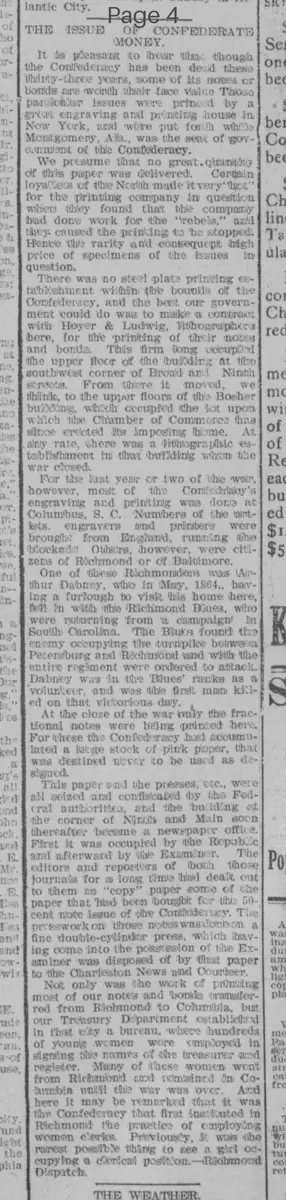
THE ISSUE OF CONFEDERATE MONEY.
It is pleasant to hear that though the Confederacy has been dead these thirty-three years, some of its notes or bonds are worth their face value. Those particular issues were printed by a great engraving and printing house in New York, and were put forth while Montgomery, Ala., was the seat of government of the Confederacy.
We presume that no great quantity of this paper was delivered. Certain loyalists of the North made it very hot for the printing company in question while they found that the company had done work for the "rebels," and they caused the printing to be stopped. Hence the rarity and consequent high price of specimens of the issues in question.
There was no steel plate printing establishment within the bounds of the Confederacy, and the best our government could do was to make a contract with Hoyer & Ludwig, lithographers here, for the printing of their notes and bonds. This firm long occupied the upper floor of the building at the southwest corner of Broad and Ninth streets. From there it moved, we think, to the upper floors of the Bosher building, which occupied the lot upon which the Chamber of Commerce has since erected its imposing home. At any rate, there was a lithographic establishment in that building when the war closed.
For the last year or two of the war, however, most of the Confederacy's engraving and printing was done at Columbus, S. C. Numbers of the artists, engravers and printers were brought from England, running the blockades. Others, however, were citizens of Richmond or of Baltimore.
One of these Richmondians was Arthur Dabney, who in May, 1864, having a furlough to visit his home here, fell in with the Richmond Blues, who were returning from a campaign in South Carolina. The Blues found the enemy occupying the turnpike between Petersburg and Richmond and with the entire regiment were ordered to attack. Dabney was in the Blues' ranks as a volunteer, and was the first man killed on that victorious day.
At the close of the war only the fractional notes were being printed here. For whose the Confederacy had accumulated a large stock of pink paper, that was destined never to be used as designed.
This paper on the presses, etc., were all seized and confiscated by the Federal authorities, and the building at the corner of Ninth and Main soon thereafter became a newspaper office. First it was occupied by the Republican and afterward by the Examiner. The editors and reporters of both those journals for a long time had dealt out to them as "copy" paper some of the paper that had been bought for the 50-cent note issue of the Confederacy. The presswork on those notes was done on a fine double-cylinder press, which having come into the possession of the Examiner was disposed of by that paper to the Charleston News and Courier.
Not only was the work of printing most of our notes and bonds transferred from Richmond to Columbia, but our Treasury Department established in that city a bureau, where hundreds of young women were employed in signing the names of the treasurer and register. Many of these women went from Richmond and remained in Columbia until the war was over. And here it may be remarked that it was the Confederacy that first instituted in Richmond the practice of employing women clerks. Previously, it was the rarest possible thing to see a girl occupying a clerical position.-Richmond Dispatch
It is pleasant to hear that though the Confederacy has been dead these thirty-three years, some of its notes or bonds are worth their face value. Those particular issues were printed by a great engraving and printing house in New York, and were put forth while Montgomery, Ala., was the seat of government of the Confederacy.
We presume that no great quantity of this paper was delivered. Certain loyalists of the North made it very hot for the printing company in question while they found that the company had done work for the "rebels," and they caused the printing to be stopped. Hence the rarity and consequent high price of specimens of the issues in question.
There was no steel plate printing establishment within the bounds of the Confederacy, and the best our government could do was to make a contract with Hoyer & Ludwig, lithographers here, for the printing of their notes and bonds. This firm long occupied the upper floor of the building at the southwest corner of Broad and Ninth streets. From there it moved, we think, to the upper floors of the Bosher building, which occupied the lot upon which the Chamber of Commerce has since erected its imposing home. At any rate, there was a lithographic establishment in that building when the war closed.
For the last year or two of the war, however, most of the Confederacy's engraving and printing was done at Columbus, S. C. Numbers of the artists, engravers and printers were brought from England, running the blockades. Others, however, were citizens of Richmond or of Baltimore.
One of these Richmondians was Arthur Dabney, who in May, 1864, having a furlough to visit his home here, fell in with the Richmond Blues, who were returning from a campaign in South Carolina. The Blues found the enemy occupying the turnpike between Petersburg and Richmond and with the entire regiment were ordered to attack. Dabney was in the Blues' ranks as a volunteer, and was the first man killed on that victorious day.
At the close of the war only the fractional notes were being printed here. For whose the Confederacy had accumulated a large stock of pink paper, that was destined never to be used as designed.
This paper on the presses, etc., were all seized and confiscated by the Federal authorities, and the building at the corner of Ninth and Main soon thereafter became a newspaper office. First it was occupied by the Republican and afterward by the Examiner. The editors and reporters of both those journals for a long time had dealt out to them as "copy" paper some of the paper that had been bought for the 50-cent note issue of the Confederacy. The presswork on those notes was done on a fine double-cylinder press, which having come into the possession of the Examiner was disposed of by that paper to the Charleston News and Courier.
Not only was the work of printing most of our notes and bonds transferred from Richmond to Columbia, but our Treasury Department established in that city a bureau, where hundreds of young women were employed in signing the names of the treasurer and register. Many of these women went from Richmond and remained in Columbia until the war was over. And here it may be remarked that it was the Confederacy that first instituted in Richmond the practice of employing women clerks. Previously, it was the rarest possible thing to see a girl occupying a clerical position.-Richmond Dispatch
What sub-type of article is it?
Historical Event
Curiosity
Biography
What themes does it cover?
Fortune Reversal
Misfortune
Bravery Heroism
What keywords are associated?
Confederate Money
Printing History
Civil War
Richmond Blues
Women Clerks
What entities or persons were involved?
Arthur Dabney
Hoyer & Ludwig
Where did it happen?
Richmond, New York, Montgomery Ala., Columbus S. C., Columbia
Story Details
Key Persons
Arthur Dabney
Hoyer & Ludwig
Location
Richmond, New York, Montgomery Ala., Columbus S. C., Columbia
Event Date
May 1864
Story Details
Article details the printing of Confederate notes in New York and Richmond, shift to Columbia SC, includes anecdote of Arthur Dabney's death in battle, postwar confiscation of materials, and introduction of women clerks.