Thank you for visiting SNEWPapers!
Sign up free
Editorial
October 23, 1830
Providence Patriot, Columbian Phenix
Providence, Providence County, Rhode Island
What is this article about?
An editorial from Providence, 1830, urges the middling interest (middle class) to assert political power against the aristocracy (big bugs, nabobs), citing their successes in economic fights but indifference in politics. It contrasts corrupt governance under Adams with honest rule under Jackson, warning of republican decay from neglect.
Clipping
OCR Quality
98%
Excellent
Full Text
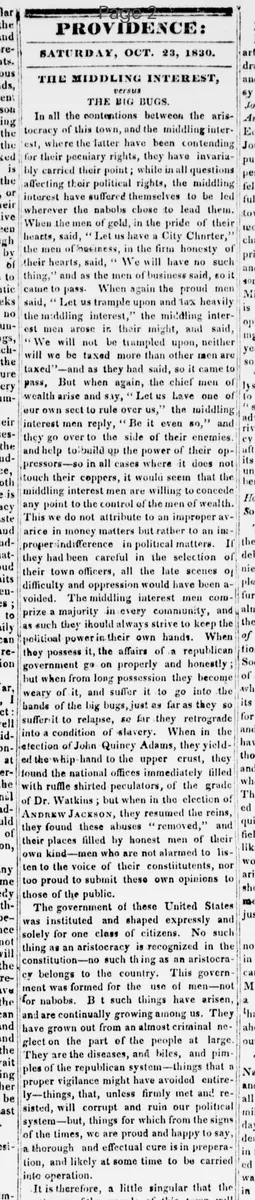
PROVIDENCE: SATURDAY, OCT. 23, 1830.
THE MIDDLING INTEREST, versus THE BIG BUGS.
In all the contentions between the aristocracy of this town, and the middling interest, where the latter have been contending for their pecuniary rights, they have invariably carried their point; while in all questions affecting their political rights, the middling interest have suffered themselves to be led wherever the nabobs chose to lead them When the men of gold, in the pride of their hearts, said, "Let us have a City Charter," the men of lowness, in the firm honesty of their hearts, said, "We will have no such thing," and as the men of business said, so it came to pass. When again the proud men said, "Let us trample upon and tax heavily the middling interest," the middling interest men arose in their might, and said, "We will not be trampled upon, neither will we be taxed more than other men are taxed"—and as they had said, so it came to pass, But when again, the chief men of wealth arise and say, " Let us have one of our own sect to rule over us," the middling interest men reply, "Be it even so," and they go over to the side of their enemies, and help to build up the power of their oppressors—so in all cases where it does not touch their coppers, it would seem that the middling interest men are willing to concede any point to the control of the men of wealth. This we do not attribute to an improper avarice in money matters but rather to an improper indifference in political matters. If they had been careful in the selection of their town officers, all the late scenes of difficulty and oppression would have been avoided. The middling interest men comprise a majority in every community, and as such they should always strive to keep the political power in their own hands. When they possess it, the affairs of a republican government go on properly and honestly; but when from long possession they become weary of it, and suffer it to go into the hands of the big bugs, just as far as they so suffer it to relapse, so far they retrograde into a condition of slavery. When in the election of John Quincy Adams, they yielded the whip-hand to the upper crust, they found the national offices immediately filled with ruffle shirted peculators, of the grade of Dr. Watkins : but when in the election of Andrew Jackson, they resumed the reins, they found these abuses "removed," and their places filled by honest men of their own kind—men who are not alarmed to listen to the voice of their constituents, nor too proud to submit their own opinions to those of the public.
The government of these United States was instituted and shaped expressly and solely for one class of citizens, No such thing as an aristocracy is recognized in the constitution—no such thing as an aristocracy belongs to the country. This government was formed for the use of men—not for nabobs. But such things have arisen, and are continually growing among us. They have grown out from an almost criminal neglect on the part of the people at large. They are the diseases, and boils, and pimples of the republican system—things that a proper vigilance might have avoided entirely—things, that, unless firmly met and resisted, will corrupt and ruin our political system—but, things for which from the signs of the times, we are proud and happy to say a thorough and effectual cure is in preparation, and likely at some time to be carried into operation.
It is therefore, a little singular that the great mass of the people of this town will dispute a point with the nabobs only when their pockets are affected. It is very singular that they cannot have an opinion of their own in political matters. It is very singular and very remarkable—very much so indeed. We cannot help thinking of it.
THE MIDDLING INTEREST, versus THE BIG BUGS.
In all the contentions between the aristocracy of this town, and the middling interest, where the latter have been contending for their pecuniary rights, they have invariably carried their point; while in all questions affecting their political rights, the middling interest have suffered themselves to be led wherever the nabobs chose to lead them When the men of gold, in the pride of their hearts, said, "Let us have a City Charter," the men of lowness, in the firm honesty of their hearts, said, "We will have no such thing," and as the men of business said, so it came to pass. When again the proud men said, "Let us trample upon and tax heavily the middling interest," the middling interest men arose in their might, and said, "We will not be trampled upon, neither will we be taxed more than other men are taxed"—and as they had said, so it came to pass, But when again, the chief men of wealth arise and say, " Let us have one of our own sect to rule over us," the middling interest men reply, "Be it even so," and they go over to the side of their enemies, and help to build up the power of their oppressors—so in all cases where it does not touch their coppers, it would seem that the middling interest men are willing to concede any point to the control of the men of wealth. This we do not attribute to an improper avarice in money matters but rather to an improper indifference in political matters. If they had been careful in the selection of their town officers, all the late scenes of difficulty and oppression would have been avoided. The middling interest men comprise a majority in every community, and as such they should always strive to keep the political power in their own hands. When they possess it, the affairs of a republican government go on properly and honestly; but when from long possession they become weary of it, and suffer it to go into the hands of the big bugs, just as far as they so suffer it to relapse, so far they retrograde into a condition of slavery. When in the election of John Quincy Adams, they yielded the whip-hand to the upper crust, they found the national offices immediately filled with ruffle shirted peculators, of the grade of Dr. Watkins : but when in the election of Andrew Jackson, they resumed the reins, they found these abuses "removed," and their places filled by honest men of their own kind—men who are not alarmed to listen to the voice of their constituents, nor too proud to submit their own opinions to those of the public.
The government of these United States was instituted and shaped expressly and solely for one class of citizens, No such thing as an aristocracy is recognized in the constitution—no such thing as an aristocracy belongs to the country. This government was formed for the use of men—not for nabobs. But such things have arisen, and are continually growing among us. They have grown out from an almost criminal neglect on the part of the people at large. They are the diseases, and boils, and pimples of the republican system—things that a proper vigilance might have avoided entirely—things, that, unless firmly met and resisted, will corrupt and ruin our political system—but, things for which from the signs of the times, we are proud and happy to say a thorough and effectual cure is in preparation, and likely at some time to be carried into operation.
It is therefore, a little singular that the great mass of the people of this town will dispute a point with the nabobs only when their pockets are affected. It is very singular that they cannot have an opinion of their own in political matters. It is very singular and very remarkable—very much so indeed. We cannot help thinking of it.
What sub-type of article is it?
Partisan Politics
Social Reform
What keywords are associated?
Middling Interest
Aristocracy
Political Indifference
Republican Government
Adams Election
Jackson Election
Class Conflict
Providence Politics
What entities or persons were involved?
Middling Interest
Aristocracy
Nabobs
Big Bugs
John Quincy Adams
Andrew Jackson
Dr. Watkins
Editorial Details
Primary Topic
Middling Interest Asserting Political Power Against Aristocracy
Stance / Tone
Critical Of Political Indifference And Aristocratic Control, Supportive Of Republican Vigilance
Key Figures
Middling Interest
Aristocracy
Nabobs
Big Bugs
John Quincy Adams
Andrew Jackson
Dr. Watkins
Key Arguments
Middling Interest Succeeds In Pecuniary Rights But Yields In Political Matters
Careful Selection Of Officers Prevents Oppression
Majority Must Retain Political Power For Honest Republican Government
Adams Election Led To Corrupt Officials Like Dr. Watkins
Jackson Election Restored Honest Governance Responsive To Constituents
U.S. Government Formed For Common Men, Not Aristocracy
Aristocracy Arises From Public Neglect And Threatens Republic
Cure For Aristocratic Growth Is In Preparation