Thank you for visiting SNEWPapers!
Sign up free
Imperial Valley Press
El Centro, Imperial County, California
What is this article about?
The Senate Commerce Committee, on Jan. 23 in Washington, decides to call former Vice President Henry A. Wallace and Secretary of Commerce Jesse Jones for public hearings on Wallace's nomination to succeed Jones and Senator Walter George's bill to separate lending agencies like the RFC from the Commerce Department. The hearing is set for the next day at 2:30 p.m., following internal debates.
Merged-components note: US political nomination hearings, relabeled to domestic_news; continuation across pages.
Clippings
1 of 2
OCR Quality
Full Text
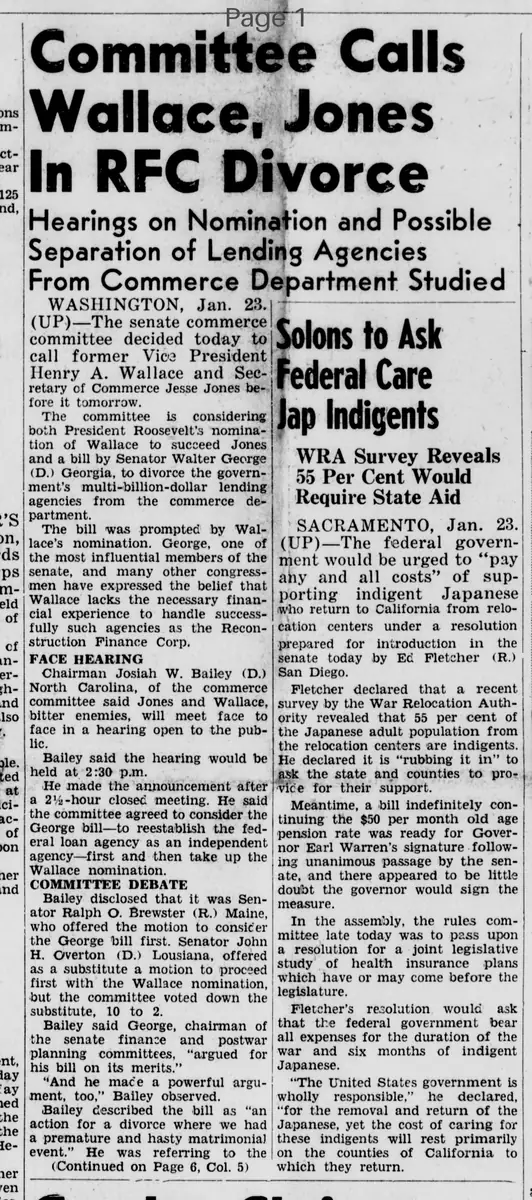
WASHINGTON. Jan. 23. (UP)—The senate commerce committee decided today to call former Vice President Henry A. Wallace and Secretary of Commerce Jesse Jones before it tomorrow.
The committee is considering both President Roosevelt's nomination of Wallace to succeed Jones and a bill by Senator Walter George (D.) Georgia, to divorce the government's multi-billion-dollar lending agencies from the commerce department.
The bill was prompted by Wallace's nomination. George, one of the most influential members of the senate, and many other congressmen have expressed the belief that Wallace lacks the necessary financial experience to handle successfully such agencies as the Reconstruction Finance Corp.
FACE HEARING
Chairman Josiah W. Bailey (D.) North Carolina, of the commerce committee said Jones and Wallace, bitter enemies, will meet face to face in a hearing open to the public.
Bailey said the hearing would be held at 2:30 p.m.
He made the announcement after a 21½-hour closed meeting. He said the committee agreed to consider the George bill—to reestablish the federal loan agency as an independent agency—first and then take up the Wallace nomination.
COMMITTEE DEBATE
Bailey disclosed that it was Senator Ralph O. Brewster (R.) Maine, who offered the motion to consider the George bill first. Senator John H. Overton (D.) Louisiana, offered as a substitute a motion to proceed first with the Wallace nomination, but the committee voted down the substitute. 10 to 2.
Bailey said George, chairman of the senate finance and postwar planning committees, "argued for his bill on its merits."
"And he made a powerful argument, too," Bailey observed.
Bailey described the bill as "an action for a divorce where we had a premature and hasty matrimonial event." He was referring to the
(Continued on Page 6, Col. 5)
Committee Calls Wallace, Jones
(Continued from Page One)
transfer in 1942 of the RFC and its subsidiaries to the commerce department.
WALLACE ATTACKED
Meanwhile, house Republicans attacked the Wallace nomination. Representative Carl T. Curtis (R.) Nebraska, charged that Wallace's theories "are part and parcel of the system of state socialism, known as the New Deal."
Representative Clare Hoffman (R.) Michigan, called attention to the law forbidding a political candidate to promise to use his influence to get employment for a person in return for support during a campaign.
Hoffman said he wanted Attorney General Francis Biddle to investigate to find out if President Roosevelt made such a promise of employment to Wallace.
What sub-type of article is it?
What keywords are associated?
What entities or persons were involved?
Where did it happen?
Domestic News Details
Primary Location
Washington
Event Date
Jan. 23
Key Persons
Outcome
committee votes 10 to 2 to consider george bill first, then wallace nomination; public hearing set for tomorrow at 2:30 p.m.; house republicans criticize nomination.
Event Details
The Senate Commerce Committee, after a 21.5-hour closed meeting, decides to summon Wallace and Jones for hearings on the nomination and the bill to separate lending agencies from the Commerce Department. The bill, prompted by the nomination, aims to make the RFC independent again, reversing the 1942 transfer. Internal debate leads to prioritizing the bill.