Thank you for visiting SNEWPapers!
Sign up free
Letter to Editor
November 5, 1831
The Liberator
Boston, Suffolk County, Massachusetts
What is this article about?
A writer in Georgia, upon first reading the Liberator, reawakens to the horrors of slavery and pledges to join the abolitionist cause. Describes a slave auction in Clinton separating families, a lawyer's exploitative hiring practices, and a planter's unprovoked abuse of a slave driver.
Clipping
OCR Quality
98%
Excellent
Full Text
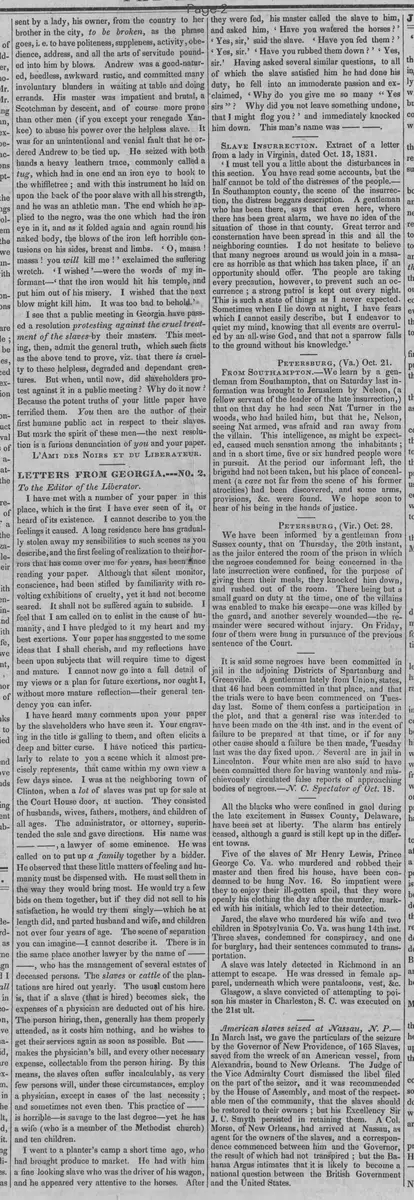
LETTERS FROM GEORGIA.—NO. 2,
To the Editor of the Liberator.
I have met with a number of your paper in this place, which is the first I have ever seen of it, or heard of its existence. I cannot describe to you the feelings it caused. A long residence here has gradually stolen away my sensibilities to such scenes as you describe, and the first feeling of realization to their horrors that has come over me for years, has been since reading your paper. Although that silent monitor, conscience, had been stifled by familiarity with revolting exhibitions of cruelty, yet it had not become seared. It shall not be suffered again to subside. I feel that I am called on to enlist in the cause of humanity, and I have pledged to it my heart and my best exertions. Your paper has suggested to me some ideas that I shall cherish, and my reflections have been upon subjects that will require time to digest and mature. I cannot now go into a full detail of my views or a plan for future exertions, nor ought I, without more mature reflection—their general tendency you can infer.
I have heard many comments upon your paper by the slaveholders who have seen it. Your engraving in the title is galling to them, and often elicits a deep and bitter curse. I have noticed this particularly to relate to you a scene which it almost precisely represents, that came within my own view a few days since. I was at the neighboring town of Clinton, when a lot of slaves was put up for sale at the Court House door, at auction. They consisted of husbands, wives, fathers, mothers, and children of all ages. The administrator, or attorney, superintended the sale and gave directions. His name was —, a lawyer of some eminence. He was called on to put up a family together by a bidder. He observed that these little matters of feeling and humanity must be dispensed with. He must sell them in the way they would bring most. He would try a few bids on them together, but if they did not sell to his satisfaction, he would try them singly—which he at length did, and parted husband and wife, and children not over four years of age. The scene of separation you can imagine—I cannot describe it. There is in the same place another lawyer by the name of —, who has the management of several estates of deceased persons. The slaves or cattle of the plantations are hired out yearly. The usual custom here is, that if a slave (that is hired) becomes sick, the expenses of a physician are deducted out of his hire. The person hiring, then, generally has them properly attended, as it costs him nothing, and he wishes to get their services again as soon as possible. But — makes the physician's bill, and every other necessary expense, collectable from the person hiring. By this means, the slaves often suffer incalculably, as very few persons will, under these circumstances, employ a physician, except in cases of the last necessity: and sometimes not even then. This practice of — is horrible—is savage to the last degree—yet he has a wife (who is a member of the Methodist church) and ten children.
I went to a planter's camp a short time ago, who had brought produce to market. He had with him a fine looking slave who was the driver of his wagon, and he appeared very attentive to the horses. After they were fed, his master called the slave to him, and asked him, 'Have you watered the horses?' 'Yes, sir,' said the slave. 'Have you fed them?' 'Yes, sir.' 'Have you rubbed them down?' 'Yes, sir.' Having asked several similar questions, to all of which the slave satisfied him he had done his duty, he fell into an immoderate passion and exclaimed, 'Why do you give me so many "Yes sirs"? Why did you not leave something undone, that I might flog you?' and immediately knocked him down. This man's name was —.
To the Editor of the Liberator.
I have met with a number of your paper in this place, which is the first I have ever seen of it, or heard of its existence. I cannot describe to you the feelings it caused. A long residence here has gradually stolen away my sensibilities to such scenes as you describe, and the first feeling of realization to their horrors that has come over me for years, has been since reading your paper. Although that silent monitor, conscience, had been stifled by familiarity with revolting exhibitions of cruelty, yet it had not become seared. It shall not be suffered again to subside. I feel that I am called on to enlist in the cause of humanity, and I have pledged to it my heart and my best exertions. Your paper has suggested to me some ideas that I shall cherish, and my reflections have been upon subjects that will require time to digest and mature. I cannot now go into a full detail of my views or a plan for future exertions, nor ought I, without more mature reflection—their general tendency you can infer.
I have heard many comments upon your paper by the slaveholders who have seen it. Your engraving in the title is galling to them, and often elicits a deep and bitter curse. I have noticed this particularly to relate to you a scene which it almost precisely represents, that came within my own view a few days since. I was at the neighboring town of Clinton, when a lot of slaves was put up for sale at the Court House door, at auction. They consisted of husbands, wives, fathers, mothers, and children of all ages. The administrator, or attorney, superintended the sale and gave directions. His name was —, a lawyer of some eminence. He was called on to put up a family together by a bidder. He observed that these little matters of feeling and humanity must be dispensed with. He must sell them in the way they would bring most. He would try a few bids on them together, but if they did not sell to his satisfaction, he would try them singly—which he at length did, and parted husband and wife, and children not over four years of age. The scene of separation you can imagine—I cannot describe it. There is in the same place another lawyer by the name of —, who has the management of several estates of deceased persons. The slaves or cattle of the plantations are hired out yearly. The usual custom here is, that if a slave (that is hired) becomes sick, the expenses of a physician are deducted out of his hire. The person hiring, then, generally has them properly attended, as it costs him nothing, and he wishes to get their services again as soon as possible. But — makes the physician's bill, and every other necessary expense, collectable from the person hiring. By this means, the slaves often suffer incalculably, as very few persons will, under these circumstances, employ a physician, except in cases of the last necessity: and sometimes not even then. This practice of — is horrible—is savage to the last degree—yet he has a wife (who is a member of the Methodist church) and ten children.
I went to a planter's camp a short time ago, who had brought produce to market. He had with him a fine looking slave who was the driver of his wagon, and he appeared very attentive to the horses. After they were fed, his master called the slave to him, and asked him, 'Have you watered the horses?' 'Yes, sir,' said the slave. 'Have you fed them?' 'Yes, sir.' 'Have you rubbed them down?' 'Yes, sir.' Having asked several similar questions, to all of which the slave satisfied him he had done his duty, he fell into an immoderate passion and exclaimed, 'Why do you give me so many "Yes sirs"? Why did you not leave something undone, that I might flog you?' and immediately knocked him down. This man's name was —.
What sub-type of article is it?
Emotional
Persuasive
Social Critique
What themes does it cover?
Slavery Abolition
Social Issues
Morality
What keywords are associated?
Slavery Horrors
Georgia Auction
Slave Separation
Medical Neglect
Planter Abuse
Abolition Awakening
What entities or persons were involved?
To The Editor Of The Liberator
Letter to Editor Details
Recipient
To The Editor Of The Liberator
Main Argument
the liberator has reawakened the writer's conscience to the horrors of slavery in georgia, prompting a pledge to join the humanitarian cause against it, illustrated by specific scenes of family separations at auction, exploitative medical practices, and unprovoked abuse.
Notable Details
Scene Of Slave Auction In Clinton Separating Families
Lawyer's Practice Of Charging Hirers For Slaves' Medical Expenses
Planter Knocking Down Attentive Slave Driver For Excessive Compliance