Thank you for visiting SNEWPapers!
Sign up free
Summit County Labor News
Akron, Summit County, Ohio
What is this article about?
U.S. per capita income hit record $1709 in 1953 per Commerce Dept., up 4% from 1952, but peaked mid-year and declined into 1954; farm states saw drops, worker incomes fell 2.5% with reduced hours and $5.5B less in wages.
Merged-components note: Continuation of article across pages; relabeled to domestic_news for economic reporting focus.
Clippings
1 of 2
OCR Quality
Full Text
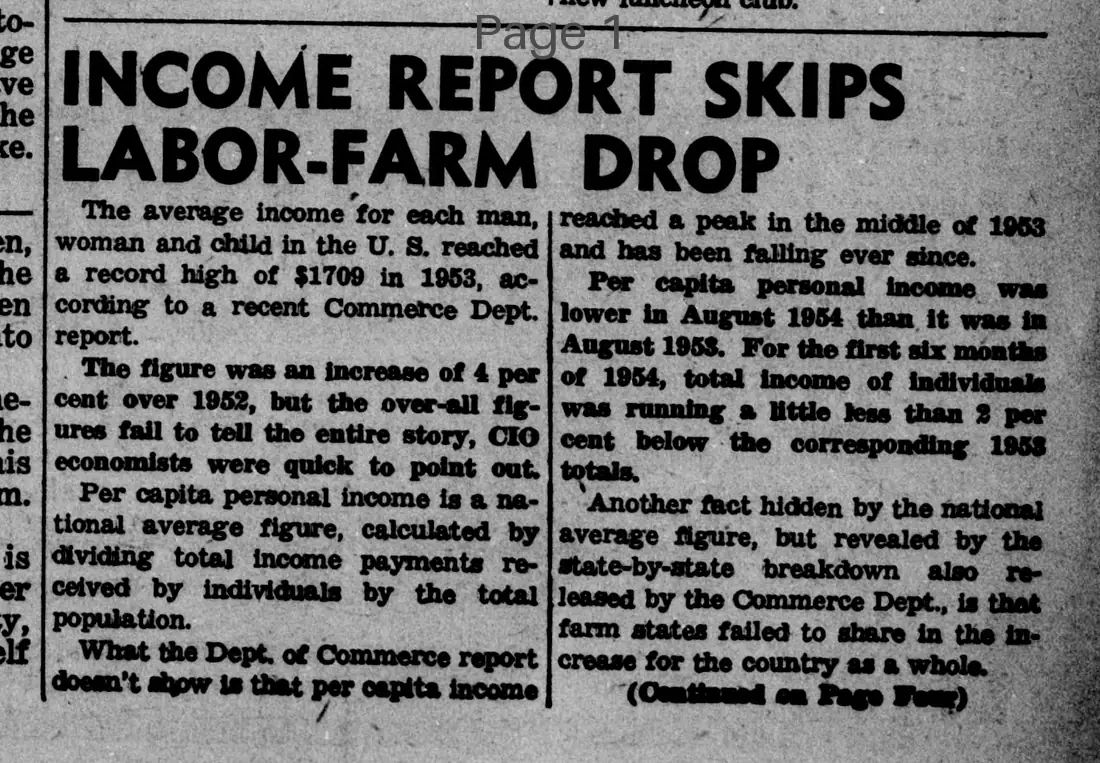
REPORT
SKIPS
LABOR-FARM
DROP
The average income for each man, woman and child in the U. S. reached a record high of $1709 in 1953, according to a recent Commerce Dept. report.
The figure was an increase of 4 per cent over 1952, but the over-all figures fail to tell the entire story, CIO economists were quick to point out.
Per capita personal income is a national average figure, calculated by dividing total income payments received by individuals by the total population.
What the Dept. of Commerce report doesn't show is that per capita income reached a peak in the middle of 1953 and has been falling ever since.
Per capita personal income was lower in August 1954 than it was in August 1953. For the first six months of 1954, total income of individuals was running a little less than 2 per cent below the corresponding 1953 totals.
Another fact hidden by the national average figure, but revealed by the state-by-state breakdown also released by the Commerce Dept., is that farm states failed to share in the increase for the country as a whole.
(Continued on Page Two)
Income Report
(Continued from Page One)
Per capita personal income in Iowa, Idaho, Kansas and Nebraska fell 3 per cent between 1952 and 1953, while the figure in Arkansas and Wyoming remained unchanged. This was during the period of the 4 per cent rise in the national average income figure.
A total of 37 states suffered declines in farm income.
Other personal income figures released by the Dept. of Commerce reveal the decline in farm and labor incomes in the past year.
Total income for workers has fallen 2.5 per cent in the past year, reflecting layoffs and short work weeks.
In the first half of '54, wages and salaries were $5.5 billion below the same period of '53.
Hours of work in manufacturing industry have fallen from 40.3 in July of 1953 to 39.4 in July of this year.
That's a decline of 2.2 per cent while average hourly wages have remained the same. The wage figure, which includes overtime and shift premium payments, was at $1.80 in July of this year, the same as December 1953.
What sub-type of article is it?
What keywords are associated?
Where did it happen?
Domestic News Details
Primary Location
U.S.
Event Date
1953 1954
Outcome
per capita personal income peaked mid-1953 and fell thereafter; lower in august 1954 than august 1953; total income for first six months of 1954 2% below 1953; farm income declined in 37 states including 3% drops in iowa, idaho, kansas, nebraska; unchanged in arkansas, wyoming; total worker income fell 2.5%; wages and salaries $5.5 billion below first half of 1953; manufacturing hours declined 2.2% to 39.4 in july 1954; average hourly wages $1.80 unchanged.
Event Details
Average per capita income reached record $1709 in 1953, up 4% from 1952, per Commerce Dept. report; however, peaked mid-1953 and declined since; CIO economists note national average hides farm and labor drops; state breakdown shows farm states did not share in national rise; total income for workers fell 2.5% due to layoffs and short weeks.