Thank you for visiting SNEWPapers!
Sign up free
Farmers' Gazette, And Cheraw Advertiser
Cheraw, Chesterfield County, South Carolina
What is this article about?
Correspondence from Washington reports on U.S. Congressional proceedings from July 8-11, covering the defeat of the bankrupt bill, navy and army appropriations, discussions on judicial tenure limits, abolition memorials, mileage equalization for members, and other legislative matters.
Merged-components note: Series of sequential reports on US Congressional proceedings from July 8-11; forms a single coherent domestic news unit on national politics; first component relabeled from 'foreign_news' as it covers US events
Clipping
OCR Quality
Full Text
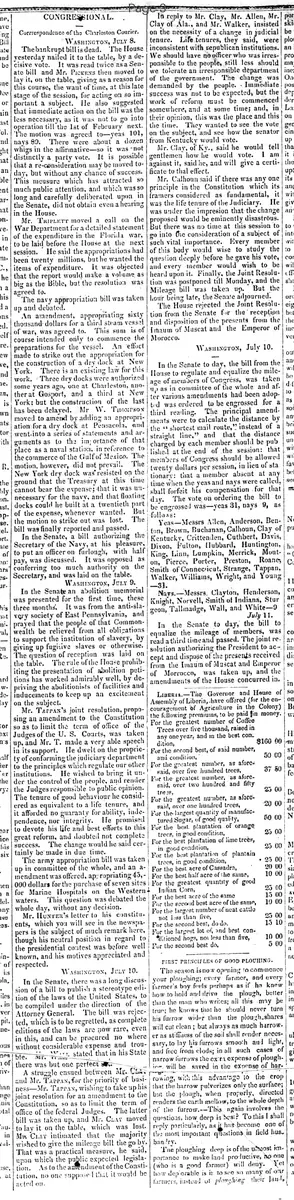
Correspondence of the Charleston Courier.
Washington, July 8.
The bankrupt bill is dead. The House yesterday nailed it to the table, by a decisive vote. It was read twice as a Senate bill and Mr. Pinckney then moved to lay it on the table, giving as a reason for this course, the want of time, at this late stage of the session, for acting on so important a subject. He also suggested that immediate action on the bill was the less necessary, as it was not to go into operation till the 1st of February next. The motion was agreed to—yeas 101, nays 89. There were about a dozen Whigs in the affirmative—so it was not distinctly a party vote. It is possible that a re-consideration may be moved to-day, but without any chance of success.
This measure which has attracted so much public attention, and which was so long and carefully deliberated upon in the Senate, did not obtain even a hearing in the House.
Mr. Trippe moved a call on the War Department for a detailed statement of the expenditure in the Florida war, to be laid before the House at the next session. He said the appropriations had been twenty millions, but he wanted the items of expenditure. It was objected that the report would make a volume as big as the Bible, but the resolution was agreed to.
The navy appropriation bill was taken up and debated.
An amendment, appropriating sixty thousand dollars for a third steam vessel of war, was agreed to. This sum is of course intended only to commence the preparations for the vessel. An effort made to strike out the appropriation for the construction of a dry dock at New York. There is an existing law for this work. Three dry docks were authorized some years ago, one at Charleston, another at Gosport, and a third at New York; but the construction of the last has been delayed. Mr. W. Thompson moved to amend by adding an appropriation for a dry dock at Pensacola, and went into a series of statements and arguments as to the importance of that place as a naval station, in reference to the commerce of the Gulf of Mexico. The motion, however, did not prevail. The New York dry dock was resisted on the ground that the Treasury at this time cannot bear the expense; —that it was unnecessary for the navy, and that floating docks could be built at a twentieth part of the expense, whenever wanted. But the motion to strike out was lost. The bill was finally reported and passed.
In the Senate, a bill authorizing the Secretary of the Navy, at his pleasure, to put an officer on furlough, with half pay, was discussed. It was opposed as conferring too much authority on the Secretary, and was laid on the table.
WASHINGTON, July 9.
In the Senate an abolition memorial was presented for the first time, these three months. It was from the anti-slavery society of East Pennsylvania, and prayed that the people of that Commonwealth be relieved from all obligations to support the institution of slavery, by giving up fugitive slaves or otherwise. The question of reception was laid on the table. The rule of the House prohibiting the presentation of abolition petitions has worked admirably well, by depriving the abolitionists of facilities and inducements to keep up an excitement on the subject.
Mr. Tappan's joint resolution, proposing an amendment to the Constitution so as to limit the term of office of the Judges of the U. S. Courts, was taken up, and Mr. T. made a very able speech in its support. He dwelt on the propriety of conforming the judiciary department to the principles which regulate our other institutions. He wished to bring it under the control of the people, and render the Judges responsible to public opinion. The tenure of good behaviour he considered as equivalent to a life tenure, and it afforded no guaranty for ability, independence, nor integrity. He promised to devote his life and best efforts to this great reform, and doubted not complete success. The change would he said certainly be made in due time.
The army appropriation bill was taken up in committee of the whole, and an amendment was offered, appropriating 45,000 dollars for the purchase of seven sites for Marine Hospitals on the Western waters. This question was debated the whole day, without any decision.
Mr. Hunter's letter to his constituents, which you will see in the newspapers is the subject of much remark here, though his neutral position in regard to the presidential contest was before well known, and his motives appreciated and respected.
WASHINGTON, JULY 10.
In the Senate, there was a long discussion of a bill to publish a stereotype edition of the laws of the United States, to be compiled under the direction of the Attorney General. The bill was rejected, which is to be regretted, as complete editions of the laws are now rare, even in this, and can be procured no where without considerable expense and trouble. Mr. W., stated that in his State there was but one perfect set.
A struggle ensued between Mr. Clay and Mr. Tappan, for the priority of business—Mr. Tappan, wishing to take up his joint resolution for an amendment to the Constitution, so as to limit the term of office of the federal Judges. The latter bill was taken up, and Mr. Clay moved to lay it on the table, which was lost. Mr. Clay intimated that the majority wished to give the mileage bill the go by. That was a practical measure, he said, upon which the public expected legislation. As to the amendment of the Constitution, no one supposed that it would be acted on.
In reply to Mr. Clay. Mr. Allen, Mr. Clay of Ala., and Mr. Walker. insisted on the necessity of a change in judicial tenure. Life tenures, they said, were inconsistent with republican institutions. We should have no officer who was irresponsible to the people, still less should we tolerate an irresponsible department of the government. The change was demanded by the people. Immediate success was not to be expected, but the work of reform must be commenced somewhere, and at some time; and, in their opinion, this was the place and this the time. They wanted to see the vote on the subject, and see how the senator from Kentucky would vote.
Mr. Clay, of Ky., said he would tell gentlemen how he would vote. I am against it, said he, and will give a certificate to that effect.
Mr. Calhoun said if there was any one principle in the Constitution which its framers considered as fundamental, it was the life tenure of the Judiciary. He was under the impression that the change proposed would be eminently disastrous. But there was no time at this session to go into the consideration of a subject of such vital importance. Every member of this body would wish to study the question deeply before he gave his vote, and every member would wish to be heard upon it. Finally, the Joint Resolution was postponed till Monday, and the Mileage bill was taken up. But the hour being late, the Senate adjourned.
The House rejected the Joint Resolution from the Senate for the reception and disposition of the presents from the Imaum of Muscat and the Emperor of Morocco.
WASHINGTON, July 10.
In the Senate to day, the bill from the House to regulate and equalize the mileage of members of Congress, was taken up, as in committee of the whole and after various amendments had been adopted was ordered to be engrossed for a third reading. The principal amendments were to calculate the distance by the "shortest mail route," instead of a "straight line," and that the distance charged by each member should be published at the end of the session: that members of Congress should be allowed twenty dollars per session, in lieu of stationery: that a member absent at any time when the yeas and nays were called, shall forfeit his compensation for that day. The vote on ordering the bill to be engrossed was—yeas 31, nays 9, as follows:
Yeas—Messrs Allen, Anderson, Benton, Brown, Buchanan, Calhoun, Clay of Kentucky, Crittenden, Cuthbert, Davis, Dixon, Fulton, Hubbard, Huntington, King, Linn, Lumpkin, Merrick, Mouton, Pierce, Porter, Preston, Roane Smith of Connecticut, Strange, Tappan, Walker, Williams, Wright, and Young—31.
Nays.—Messrs. Clayton, Henderson, Knight, Norvell, Smith of Indiana, Sturgeon, Tallmadge, Wall, and White—9
July 11.
In the Senate to day, the bill to equalize the mileage of members, was read a third time and passed. The joint resolution authorizing the President to accept and dispose of the presents received from the Imaum of Muscat and Emperor of Morocco, was taken up, and the amendments of the House concurred in.
What sub-type of article is it?
What keywords are associated?
What entities or persons were involved?
Where did it happen?
Domestic News Details
Primary Location
Washington
Event Date
July 8 11
Key Persons
Outcome
bankrupt bill laid on table (yeas 101, nays 89); navy appropriation bill passed with amendments; abolition memorial laid on table; judicial tenure resolution postponed; mileage bill passed (yeas 31, nays 9); other bills debated or rejected.
Event Details
Reports on U.S. Congress sessions including defeat of bankrupt bill in House, call for Florida war expenditures, navy bill with dry dock appropriations debated and passed, Senate discussions on navy furlough bill laid on table, abolition memorial from East Pennsylvania, Tappan's resolution to limit judicial terms debated with speeches by Tappan, Clay, Calhoun, and others, army appropriation amendment debated, rejection of stereotype laws bill, priority struggle leading to mileage bill advancement with amendments, House rejection of foreign presents resolution.