Thank you for visiting SNEWPapers!
Sign up free
Editorial
September 9, 1830
Litchfield Enquirer
Litchfield, Litchfield County, Connecticut
What is this article about?
Eulogistic editorial praising former President John Quincy Adams as a pure patriot and virtuous statesman, highlighting his integrity amid political persecution and party strife, predicting posterity's admiration. Signed by Whittier.
Clipping
OCR Quality
98%
Excellent
Full Text
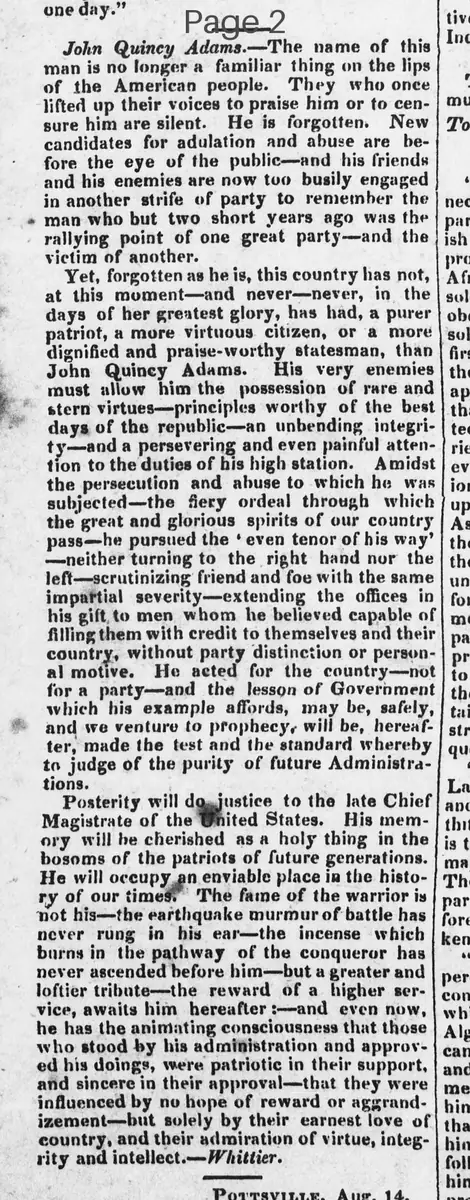
John Quincy Adams.—The name of this man is no longer a familiar thing on the lips of the American people. They who once lifted up their voices to praise him or to censure him are silent. He is forgotten. New candidates for adulation and abuse are before the eye of the public—and his friends and his enemies are now too busily engaged in another strife of party to remember the man who but two short years ago was the rallying point of one great party—and the victim of another.
Yet, forgotten as he is, this country has not, at this moment—and never—never, in the days of her greatest glory, has had, a purer patriot, a more virtuous citizen, or a more dignified and praise-worthy statesman, than John Quincy Adams. His very enemies must allow him the possession of rare and stern virtues—principles worthy of the best days of the republic—an unbending integrity and a persevering and even painful attention to the duties of his high station. Amidst the persecution and abuse to which he was subjected—the fiery ordeal through which the great and glorious spirits of our country pass—he pursued the 'even tenor of his way' neither turning to the right hand nor the left—scrutinizing friend and foe with the same impartial severity—extending the offices in his gift to men whom he believed capable of filling them with credit to themselves and their country, without party distinction or personal motive. He acted for the country—not for a party—and the lesson of Government which his example affords, may be, safely, and we venture to prophecy, will be, hereafter, made the test and the standard whereby to judge of the purity of future Administrations.
Posterity will do justice to the late Chief Magistrate of the United States. His memory will be cherished as a holy thing in the bosoms of the patriots of future generations. He will occupy an enviable place in the history of our times. The fame of the warrior is not his—the earthquake murmur of battle has never rung in his ear—the incense which burns in the pathway of the conqueror has never ascended before him—but a greater and loftier tribute—the reward of a higher service, awaits him hereafter:—and even now, he has the animating consciousness that those who stood by his administration and approved his doings, were patriotic in their support, and sincere in their approval—that they were influenced by no hope of reward or aggrandizement—but solely by their earnest love of country, and their admiration of virtue, integrity and intellect. Whittier.
Yet, forgotten as he is, this country has not, at this moment—and never—never, in the days of her greatest glory, has had, a purer patriot, a more virtuous citizen, or a more dignified and praise-worthy statesman, than John Quincy Adams. His very enemies must allow him the possession of rare and stern virtues—principles worthy of the best days of the republic—an unbending integrity and a persevering and even painful attention to the duties of his high station. Amidst the persecution and abuse to which he was subjected—the fiery ordeal through which the great and glorious spirits of our country pass—he pursued the 'even tenor of his way' neither turning to the right hand nor the left—scrutinizing friend and foe with the same impartial severity—extending the offices in his gift to men whom he believed capable of filling them with credit to themselves and their country, without party distinction or personal motive. He acted for the country—not for a party—and the lesson of Government which his example affords, may be, safely, and we venture to prophecy, will be, hereafter, made the test and the standard whereby to judge of the purity of future Administrations.
Posterity will do justice to the late Chief Magistrate of the United States. His memory will be cherished as a holy thing in the bosoms of the patriots of future generations. He will occupy an enviable place in the history of our times. The fame of the warrior is not his—the earthquake murmur of battle has never rung in his ear—the incense which burns in the pathway of the conqueror has never ascended before him—but a greater and loftier tribute—the reward of a higher service, awaits him hereafter:—and even now, he has the animating consciousness that those who stood by his administration and approved his doings, were patriotic in their support, and sincere in their approval—that they were influenced by no hope of reward or aggrandizement—but solely by their earnest love of country, and their admiration of virtue, integrity and intellect. Whittier.
What sub-type of article is it?
Partisan Politics
Moral Or Religious
What keywords are associated?
John Quincy Adams
Patriotism
Political Integrity
Party Strife
Administration Praise
Virtue
Posterity Honor
What entities or persons were involved?
John Quincy Adams
Whittier
Editorial Details
Primary Topic
Praise For John Quincy Adams' Patriotism And Integrity
Stance / Tone
Strong Admiration And Eulogistic Defense
Key Figures
John Quincy Adams
Whittier
Key Arguments
John Quincy Adams Is Forgotten Amid Current Political Strife But Was A Central Figure Two Years Ago
He Is The Purest Patriot, Most Virtuous Citizen, And Most Dignified Statesman In American History
His Enemies Acknowledge His Rare Virtues, Unbending Integrity, And Diligent Attention To Duty
He Endured Persecution With Impartiality, Appointing Based On Merit Without Party Bias
His Example Sets A Standard For Judging Future Administrations' Purity
Posterity Will Honor Him For His Service Beyond Military Fame
Supporters Backed Him Out Of Sincere Patriotism And Admiration For Virtue