Thank you for visiting SNEWPapers!
Sign up free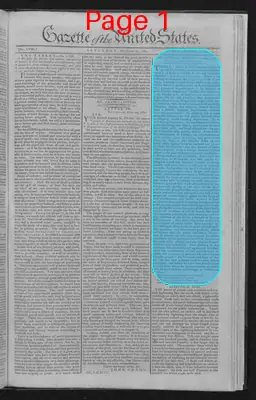
Editorial
October 31, 1789
Gazette Of The United States
New York, New York County, New York
What is this article about?
Editorial critiques the arrogance and forgetfulness of politicians who, upon gaining office, neglect their origins and benefactors, urging humility and benevolence to secure public trust in the new republic.
Clipping
OCR Quality
98%
Excellent
Full Text
[Published on Wednesday and Saturday.]
THE NATIONAL MONITOR.--No. XXIV.
"Pomposo too, who with averted eye,
Now passes all his old acquaintance by."
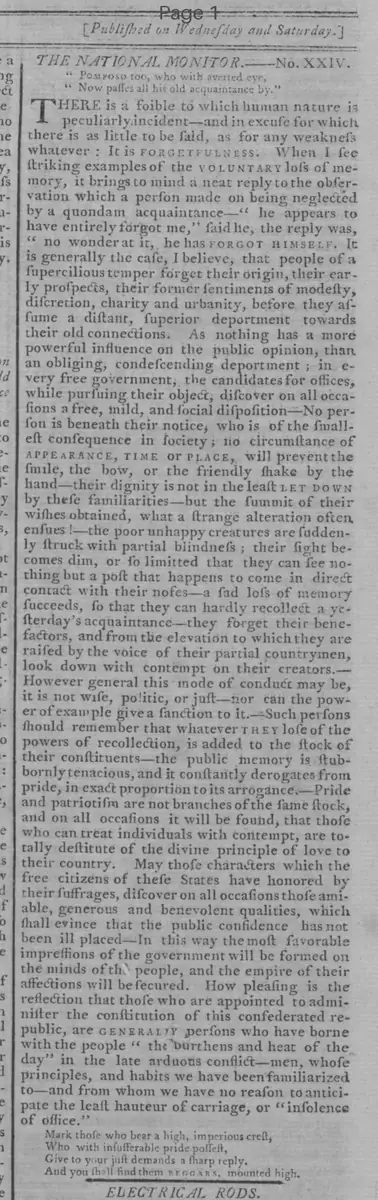
There is a foible to which human nature is peculiarly incident—and in excuse for which there is as little to be said, as for any weakness whatever: It is Forgetfulness. When I see striking examples of the voluntary loss of memory, it brings to mind a neat reply to the observation which a person made on being neglected by a quondam acquaintance—"he appears to have entirely forgot me," said he, the reply was, "no wonder at it, he has FORGOT HIMSELF." It is generally the case, I believe, that people of a supercilious temper forget their origin, their early prospects, their former sentiments of modesty, discretion, charity and urbanity, before they assume a distant, superior deportment towards their old connections. As nothing has a more powerful influence on the public opinion, than an obliging, condescending deportment; in every free government, the candidates for offices, while pursuing their object, discover on all occasions a free, mild, and social disposition. No person is beneath their notice, who is of the smallest consequence in society; no circumstance of APPEARANCE, TIME OR PLACE, will prevent the smile, the bow, or the friendly shake by the hand—their dignity is not in the least LET DOWN by these familiarities—but the summit of their wishes obtained, what a strange alteration often ensues!—the poor unhappy creatures are suddenly struck with partial blindness; their sight becomes dim, or so limited that they can see nothing but a post that happens to come in direct contact with their noses—a sad loss of memory succeeds, so that they can hardly recollect a yesterday's acquaintance—they forget their benefactors, and from the elevation to which they are raised by the voice of their partial countrymen, look down with contempt on their creators.
However general this mode of conduct may be, it is not wise, politic, or just—nor can the power of example give a sanction to it. Such persons should remember that whatever THEY lose of the powers of recollection, is added to the stock of their constituents—the public memory is stubbornly tenacious, and it constantly derogates from pride, in exact proportion to its arrogance.—Pride and patriotism are not branches of the same stock, and on all occasions it will be found, that those who can treat individuals with contempt, are totally destitute of the divine principle of love to their country. May those characters which the free citizens of these States have honored by their suffrages, discover on all occasions those amiable, generous and benevolent qualities, which shall evince that the public confidence has not been ill placed. In this way the most favorable impressions of the government will be formed on the minds of the people, and the empire of their affections will be secured. How pleasing is the reflection that those who are appointed to administer the constitution of this confederated republic, are GENERALLY persons who have borne with the people "the burthens and heat of the day" in the late arduous conflict—men, whose principles, and habits we have been familiarized to—and from whom we have no reason to anticipate the least hauteur of carriage, or "insolence of office."
Mark those who bear a high, imperious crest,
Who with insufferable pride possess,
Give to your just demands a sharp reply.
And you shall find them PEGASUS, mounted high.
THE NATIONAL MONITOR.--No. XXIV.
"Pomposo too, who with averted eye,
Now passes all his old acquaintance by."
There is a foible to which human nature is peculiarly incident—and in excuse for which there is as little to be said, as for any weakness whatever: It is Forgetfulness. When I see striking examples of the voluntary loss of memory, it brings to mind a neat reply to the observation which a person made on being neglected by a quondam acquaintance—"he appears to have entirely forgot me," said he, the reply was, "no wonder at it, he has FORGOT HIMSELF." It is generally the case, I believe, that people of a supercilious temper forget their origin, their early prospects, their former sentiments of modesty, discretion, charity and urbanity, before they assume a distant, superior deportment towards their old connections. As nothing has a more powerful influence on the public opinion, than an obliging, condescending deportment; in every free government, the candidates for offices, while pursuing their object, discover on all occasions a free, mild, and social disposition. No person is beneath their notice, who is of the smallest consequence in society; no circumstance of APPEARANCE, TIME OR PLACE, will prevent the smile, the bow, or the friendly shake by the hand—their dignity is not in the least LET DOWN by these familiarities—but the summit of their wishes obtained, what a strange alteration often ensues!—the poor unhappy creatures are suddenly struck with partial blindness; their sight becomes dim, or so limited that they can see nothing but a post that happens to come in direct contact with their noses—a sad loss of memory succeeds, so that they can hardly recollect a yesterday's acquaintance—they forget their benefactors, and from the elevation to which they are raised by the voice of their partial countrymen, look down with contempt on their creators.
However general this mode of conduct may be, it is not wise, politic, or just—nor can the power of example give a sanction to it. Such persons should remember that whatever THEY lose of the powers of recollection, is added to the stock of their constituents—the public memory is stubbornly tenacious, and it constantly derogates from pride, in exact proportion to its arrogance.—Pride and patriotism are not branches of the same stock, and on all occasions it will be found, that those who can treat individuals with contempt, are totally destitute of the divine principle of love to their country. May those characters which the free citizens of these States have honored by their suffrages, discover on all occasions those amiable, generous and benevolent qualities, which shall evince that the public confidence has not been ill placed. In this way the most favorable impressions of the government will be formed on the minds of the people, and the empire of their affections will be secured. How pleasing is the reflection that those who are appointed to administer the constitution of this confederated republic, are GENERALLY persons who have borne with the people "the burthens and heat of the day" in the late arduous conflict—men, whose principles, and habits we have been familiarized to—and from whom we have no reason to anticipate the least hauteur of carriage, or "insolence of office."
Mark those who bear a high, imperious crest,
Who with insufferable pride possess,
Give to your just demands a sharp reply.
And you shall find them PEGASUS, mounted high.
What sub-type of article is it?
Moral Or Religious
Partisan Politics
What keywords are associated?
Political Arrogance
Humility In Office
Public Memory
Patriotism Vs Pride
Benevolent Governance
What entities or persons were involved?
Candidates For Offices
Free Citizens Of These States
Editorial Details
Primary Topic
Arrogance And Forgetfulness In Public Officials
Stance / Tone
Moral Exhortation Against Pride In Office
Key Figures
Candidates For Offices
Free Citizens Of These States
Key Arguments
People Of Supercilious Temper Forget Their Origins And Former Virtues Upon Gaining Power
Public Opinion Favors Obliging And Condescending Deportment In Candidates
After Election, Officials Often Become Arrogant And Forget Benefactors
Public Memory Is Tenacious And Punishes Arrogance
Pride And Patriotism Are Incompatible
Elected Officials Should Display Benevolence To Secure Public Affection