Thank you for visiting SNEWPapers!
Sign up free
The Massachusetts Spy, Or, Thomas's Boston Journal
Boston, Suffolk County, Massachusetts
What is this article about?
A letter from Atticus in the London Public Advertiser criticizes Lord North's policies on the East India Company, accusing him of using tea shipments to America for corruption and oppression, contrasting with Lord Clive's actions in India, and warning of potential colonial unrest and separation.
Clipping
OCR Quality
Full Text
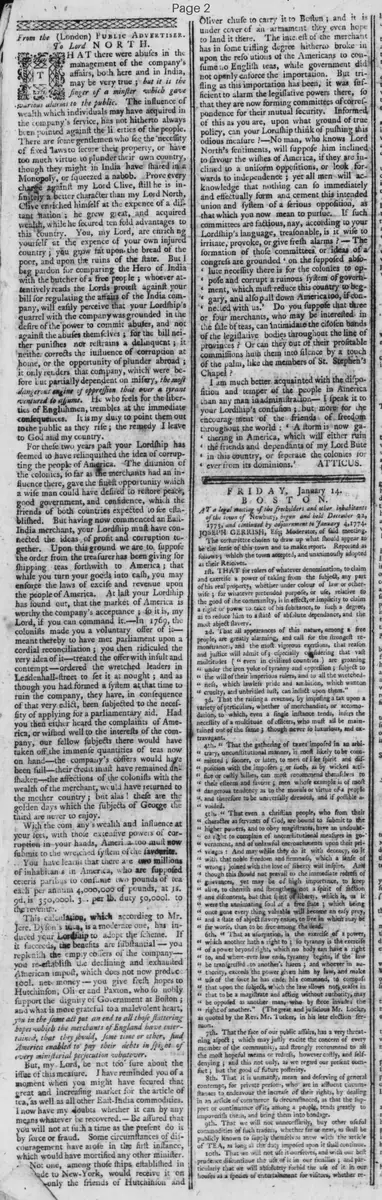
To Lord North.
That there were abuses in the management of the company's affairs, both here and in India, may be very true; but it is the finger of a minister which gave various alarms to the public. The influence of wealth which individuals may have acquired in the company's service, has not hitherto always been pointed against the liberties of the people. There are some gentlemen who see the necessity of fixed laws to secure their property, or have too much virtue to plunder their own country, though they might in India have shared in a monopoly, or squeezed a nabob. Prove every charge against my Lord Clive, still he is infinitely a better character than my Lord North. Clive enriched himself at the expense of a distant nation; he grew great, and acquired wealth, while he secured tenfold advantages to this country. You, my Lord, are enriching yourself at the expense of your own injured country; you grow fat upon the bread of the poor, and upon the ruins of the state. But I beg pardon for comparing the Hero of India with the butcher of a free people; whoever attentively reads the Lords' protest against your bill for regulating the affairs of the India company, will easily perceive that your Lordship's quarrel with the company was grounded in the desire of the power to commit abuses, and not against the abuses themselves; for the bill neither punishes nor restrains a delinquent; it neither corrects the influence of corruption at home, or the opportunity of plunder abroad; it only renders that company, which were before but partially dependent on ministry, the most dangerous engine of oppression that ever a tyrant ventured to assume. He who feels for the liberties of Englishmen, trembles at the immediate consequences. It is my duty to point them out to the public as they rise; the remedy I leave to God and my country.
For these two years past your Lordship has seemed to have relinquished the idea of corrupting the people of America. The disunion of the colonies, so far as the merchants had an influence there, gave the finest opportunity which a wise man could have desired to restore peace, good government, and confidence, which the friends of both countries expected to see established. But having now commenced an East-India merchant, your Lordship must have connected the ideas of profit and corruption together. Upon this ground we are to suppose the order from the treasurer has been given for shipping teas forthwith to America; that while you turn your goods into cash, you may enforce the laws of excise and revenue upon the people of America. At last your Lordship has found out, that the market of America is worthy the company's acceptance; so it is, my Lord, if you can command it. In 1769, the colonists made you a voluntary offer of it, meant thereby to have met parliament upon a cordial reconciliation; you then ridiculed the very idea of it—treated the offer with insult and contempt—ordered the wretched leaders in Leadenhall-street to set it at nought; and as though you had formed a system at that time to ruin the company, they have, in consequence of that very edict, been subjected to the necessity of applying for a parliamentary aid. Had you then either heard the complaints of America, or wished well to the interests of the company, our fellow subjects there would have taken off the immense quantities of teas now on hand—the company's coffers would have been full—their credit must have remained unshaken—the affections of the colonists with the wealth of the merchant, would have returned to the mother country; but alas! these are the golden days which the subjects of George the third are never to enjoy.
With the company's wealth and influence at your feet, with those extensive powers of corruption in your hands, America too must now submit to the wretched system of the favourite. You have learnt that there are two millions of inhabitants in America, who are supposed ceteris paribus to consume two pounds of tea each per annum—4,000,000 of pounds, at 1s. 9d. is 350,000l. 3s. per lb. duty 50,000l. to the revenue.
This calculation, which according to Mr. Jeremiah D——n's idea, is a moderate one, has induced your Lordship to adopt the scheme. If it succeeds, the benefits are substantial—you replenish the empty coffers of the company—you re-establish the declining and exhausted American impost, which does not now produce 100l. net money—you give fresh hopes to Hutchinson, Oliver and Paxton, who so nobly support the dignity of Government at Boston; and what is more grateful to a malevolent heart, you in the same act put an end to all those flattering hopes which the merchants of England have entertained, that they should, some time or other, find America enabled to pay their debts in spite of every ministerial persecution whatever.
But, my Lord, be not too sure about the issue of this measure. I have reminded you of a moment when you might have secured that great and increasing market for the article of tea, as well as all other East-India commodities. I now have my doubts whether it can by any means whatever be recovered. Be assured that you will not at such a time as the present do it by force or fraud. Some circumstances of discouragement have arose in these first instance, which would have mortified any other minister. Not one, among those ships established in trade to New-York, would receive it on board—only the friends of Hutchinson and Oliver chose to carry it to Boston; and it is under cover of an armament they even hope to land it there. The interest of the merchant has in some trifling degree hitherto broke in upon the resolutions of the Americans to consume no English teas, while government did not openly enforce the importation. But trifling as this importation has been, it was sufficient to alarm the legislative powers there, so that they are now forming committees of correspondence for their mutual security. Informed of this as you are, upon what ground of true policy, can your Lordship think of pushing this odious measure?—No man, who knows Lord North's sentiments, will suppose him inclined to favour the wishes of America, if they are inclined to a uniform opposition, or look forwards to independence; yet all men will acknowledge that nothing can so immediately and effectually form and cement this intended union and system of a serious opposition, as that which you now mean to pursue. If such committees are factious, nay, according to your Lordship's language, treasonable, is it wise to irritate, provoke, or give fresh alarms?—The formation of those committees, or ideas of a congress are grounded on the supposed absolute necessity there is for the colonies to oppose and corrupt a ruinous system of government, which must reduce this country to beggary, and also pull down America too, if connected with us. Do you suppose that three or four merchants, who may be interested in the sale of teas, can intimidate the chosen bands of the legislative bodies throughout the line of provinces? Or can they out of their profitable commissions hush them into silence by a touch of the palm, like the members of St. Stephen's Chapel?
I am much better acquainted with the disposition and temper of the people in America than any man in administration—I speak it to your Lordship's confusion; but more—for the encouragement of the friends of freedom throughout the world: A storm is now gathering in America, which will either ruin the friends and dependants of my Lord Bute in this country, or separate the colonies for ever from its dominions.
ATTICUS.
What sub-type of article is it?
What keywords are associated?
What entities or persons were involved?
Where did it happen?
Foreign News Details
Primary Location
America
Event Date
In 1769
Key Persons
Outcome
potential union and opposition in american colonies, risk of separation from britain; benefits to east india company and revenue if tea scheme succeeds, but doubts on enforcement.
Event Details
Critical letter accuses Lord North of using East India Company tea shipments to America for corruption and oppression, ignoring 1769 colonial offer, leading to company aid needs; warns of American committees of correspondence, resistance in New-York and Boston, and gathering storm of opposition or independence.