Thank you for visiting SNEWPapers!
Sign up free
Martinsburg Gazette And Public Advertiser
Martinsburg, Berkeley County, West Virginia
What is this article about?
An editorial by a Citizen of Winchester appeals to Virginia's legislature to ensure equal representation in the constitutional convention based on free white population, opposing the convention committee's plan to use congressional districts or include slave numbers, warning of discord if unequal representation persists, and proposing alternative reform paths if needed.
Merged-components note: This is a single long editorial piece on the convention question in Virginia, continued across pages 1 and 2. The second component's text directly continues the first, with sequential reading order.
Clippings
1 of 2
OCR Quality
Full Text
THURSDAY, JANUARY 15, 1829
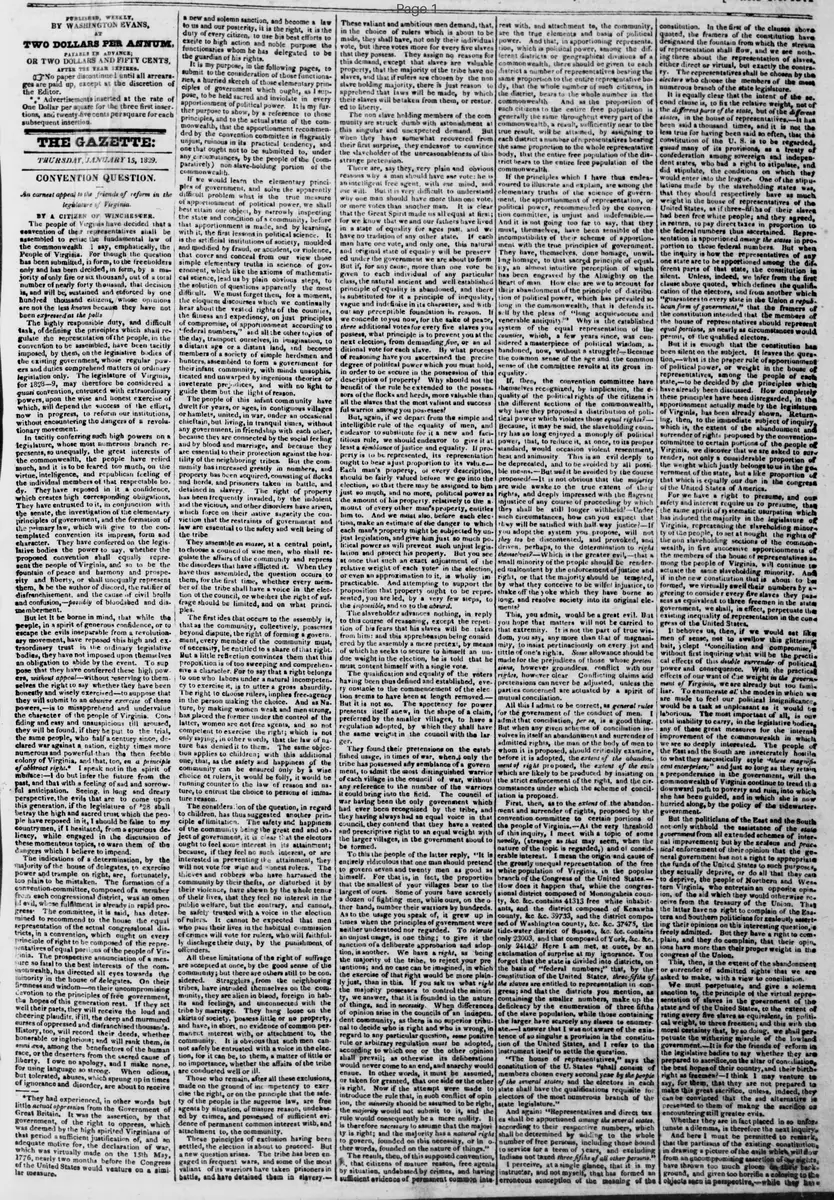
CONVENTION QUESTION.
An earnest appeal to the friends of reform in the
legislature of Virginia.
BY A CITIZEN OF WINCHESTER.
The people of Virginia have decided that a
convention of their representatives shall be
assembled to revise the fundamental law of
the commonwealth. I say, emphatically, the
People of Virginia. For though the question
has been submitted, in form, to the freeholders
only and has been decided, in form, by a ma-
jority of only five or six thousand, out of a total
number of nearly forty thousand, that decision
is, and will be, sustained and enforced by one
hundred thousand citizens, whose opinions
are not the less known because they have not
been expressed at the polls.
The highly responsible duty, and difficult
task, of defining the principles which shall re-
gulate the representation of the people, in the
convention to be assembled, have been tacitly
imposed, by them, on the legislative bodies of
the existing government, whose regular powers
and duties comprehend matters of ordinary
legislation only. The legislature of Virginia,
for 1828-9, may therefore be considered a
quasi convention, entrusted with extraordinary
powers, upon the wise and honest exercise of
which, will depend the success of the effort,
now in progress, to reform our institutions,
without encountering the dangers of a revolu-
tionary movement.
In tacitly conferring such high powers on a
legislature, whose most numerous branch re-
presents, so unequally, the great interests of
the commonwealth, the people have relied
much, and it is to be feared too much, on the
virtue, intelligence, and republican feeling of
the individual members of that respectable body. They have reposed in it a confidence,
which creates high corresponding obligations.
They have entrusted to it, in conjunction with
the senate, the investigation of the elementary
principles of government, and the formation of
the primary law, which will give to the con-
templated convention its impress, form and
character. They have conferred on the legis-
lative bodies the power to say, whether the
proposed convention shall equally repre-
sent the people of Virginia, and so to be the
fountain of peace and harmony and prospe-
rity and liberty, or shall unequally represent
them, & be the author of discord, the ratifier of
disfranchisement, and the cause of civil broils
and confusion,--possibly of bloodshed and dis-
memberment.
But let it be borne in mind, that while the
people, in a spirit of generous confidence, or to
escape the evils inseparable from a revolution-
ary movement, have reposed this high and ex-
traordinary trust in the ordinary legislative
bodies, they have not imposed upon themselves
an obligation to abide by the event. To sup-
pose that they have conferred these high powers, without appeal--without reserving to them-
selves the right to say whether they have been
honestly and wisely exercised--to suppose that
they will submit to an abusive exercise of these
powers,--is to misapprehend and undervalue
the character of the people of Virginia. Con-
fiding and easy and unsuspicious till aroused,
they will be found, if they be put to the trial,
the same people, who half a century since, de-
clared war against a nation, eighty times more
numerous and powerful than the then feeble
colony of Virginia, and that, too, on a principle
of abstract right. I speak not in the spirit of
menace: I do but infer the future from the
past, and that with a feeling of sad and sorrow-
ful anticipation. Seeing, in long and dreary
perspective, the evils that are to come upon
this generation, if the legislature of '28 shall
betray the high and sacred trust which the peo-
ple have reposed in it, I should be false to my
countrymen, if I hesitated, from a spurious de-
licacy, while engaged in the discussion of
these momentous topics, to warn them of the
dangers which I believe to impend.
The indications of a determination, by the
majority of the house of delegates, to exercise
power and trample on right, are, fortunately,
too plain to be mistaken. The formation of a
convention-committee, composed of a member
from each congressional district, was an omen
of evil, whose fulfillment is already in rapid pro-
gress. The committee, it is said, has deter-
mined to recommend to the house the equal
representation of the actual congressional dis-
tricts, in a convention, which ought on every
principle of right to be composed of the repre-
sentatives of equal portions of the people of Vir-
ginia. The prospective annunciation of a mea-
sure so fatal to the best interests of the com-
monwealth, has directed all eyes towards the
minority in the house of delegates. On their
firmness and wisdom--on their uncompromising
devotion to the principles of free government,
the hopes of this generation rest. If they act
well their parts, they will receive the loud and
cheering plaudits, if ill, the deep and murmured
curses of oppressed and disfranchised thousands.
History, too, will record their deeds, whether
honorable or inglorious; and will rank them, in
future eve, among the benefactors of the human
race, or the deserters from the sacred cause of
liberty. I owe no apology, and I make none,
for using language so strong. When odious,
but tolerated, abuses, which sprung up in times
of ignorance and disorder, are about to receive
They had experienced, in other words but
little actual oppression from the Government of
Great Britain. It was the assertion, by that
government, of the right to oppress, which
was deemed by the high spirited Virginians of
that period a sufficient justification of, and adequate motive for, the declaration of war,
which was virtually made on the 15th May,
1776, nearly two months before the Congress
of the United States would venture on a similar measure.
a new and solemn sanction, and become a law
to us and our posterity, it is the right, it is the
duty of every citizen, to use his best efforts to
excite to high action and noble purpose the
functionaries whom he has delegated to be
the guardians of his rights.
It is my purpose, in the following pages, to
submit to the consideration of those functionaries, a hurried sketch of those elementary prin-
ciples of government which ought, as I sup-
pose, to be held sacred and inviolate in every
apportionment of political power. It is my further purpose to show, by a reference to those
principles, and to the actual state of the com-
monwealth, that the apportionment recom-
mended by the convention committee is flagrantly
unjust, ruinous in its practical tendency, and
one that ought not to be submitted to, under
any circumstances, by the people of the (com-
paratively) non-slave-holding portion of the
commonwealth.
If we would learn the elementary princi-
ples of government, and solve the apparently
difficult problem what is the true measure
of apportionment of political power, we shall
best attain our object, by narrowly inspecting
the state and condition of a community, before
that apportionment is made, and by learning,
with it, the first lessons in political science. It
is the artificial institutions of society, moulded
and modified by fraud, or accident, or violence,
that cover and conceal from our view those
simple elementary truths in science of gov-
-ernment, which like the axioms of mathemati-
-cal science, lead us by plain obvious steps, to
the solution of questions apparently the most
difficult. We must forget then, for a moment,
the eloquent discourses which we continually
hear about the vested rights of the counties,
the fitness and expediency, on just principles
of compromise, of apportionment according to
"federal numbers," and all the other topics of
the day, transport ourselves, in imagination, to
a distant age or a distant land, and become
members of a society of simple herdsmen and
hunters, assembled to form a government for
their infant community, with minds unsophisticated and unwarped by ingenious theories or
inveterate prejudices, and with no light to
guide them but the light of reason.
The people of this infant community have
dwelt for years, or ages, in contiguous villages
or hamlets, united, in war, under an occasional
chieftain, but living, in tranquil times, without
any government, in friendship with each other,
because they are connected by the social feeling
and by blood and marriage, and because they
are essential to their protection against the hostility of the neighboring tribes. But the com-
munity has increased greatly in numbers, and
property has been acquired, consisting of flocks
and herds, and prisoners taken in battle, and
detained in slavery. The right of property
has been frequently invaded, by the indolent
and the vicious, and other disorders have arisen,
which force on their native sagacity the con-
viction that the restraints of government and
law are essential to the safety and well being of
the tribe.
They assemble en masse, at a central point,
to choose a council of wise men, who shall re-
gulate the affairs of the community and repress
the disorders that have afflicted it. When they
have thus assembled, the question occurs to
them, for the first time, whether every member of the tribe shall have a voice in the election of the council, or whether the right of suffrage should be limited, and on what principles.
The first idea that occurs to the assembly is,
that as the community, collectively, possesses
beyond dispute, the right of forming a government, every member of the community must,
of necessity, be entitled to a share of that right.
But a little reflection convinces them that this
proposition is of too sweeping and comprehen-
sive a character. For to say that a right belongs to one who labors under a natural incompetency to exercise it, is to utter a gross absurdity.
The right to choose rulers, implies free-agency
in the person making the choice. And as Nature, by making women weak and men strong,
has placed the former under the control of the
latter, women are not free agents, and so not
competent to exercise the right; which is not
only saying, in other words, that the law of nature has denied it to them. The same objection applies to children; with this additional
one, that, as the safety and happiness of the
community can be ensured only by a wise
choice of rulers, it would be folly, it would be
running counter to the law of reason and nature, to entrust the choice to persons of immature reason.
The consideration of the question, in regard
to children, has thus suggested another principle of limitation. The safety and happiness
of the community being the great end and object of government, it is clear that the electors
ought to feel some interest in its attainment;
because, if they feel no such interest, or are
interested in preventing the attainment, they
will not vote for wise and honest rulers. The
thieves and robbers who have harassed the
community by their thefts, or disturbed it by
their violence, have shewn by the whole tenor
of their lives, that they feel no interest in the
public welfare, but the contrary, and cannot,
be safely trusted with a voice in the election
of rulers. It cannot be expected that men
who pass their lives in the habitual commission of crimes will vote for rulers, who will faithfully discharge their duty, by the punishment of offenders.
All these limitations of the right of suffrage
are accepted at once, by the good sense of the
community; but there are others still to be considered. Stragglers, from the neighboring
tribes, have intruded themselves on the com-
munity, they are alien in blood, foreign in habits and feelings, and unconnected with the
tribe by marriage. They hang loose on the
skirts of society, possess little or no property,
and have, in short, no evidence of common permanent interest with, or attachment to, the
community. It is obvious that such men cannot safely be entrusted with a voice in the election, for it can be to them, of little or
no importance, whether the affairs of the tribe
are conducted well or ill.
Those who remain, after all these exclusions,
made on the ground of incompetency to exercise the right, or on the principle that the safety of the people is the supreme law, are free
agents by situation, of mature reason, undebased by crimes, and possessed of sufficient evidence of permanent common interest with, and
attachment to, the community.
These principles of exclusion having been
settled, the election is about to proceed. But
a new question arises. The tribe has been engaged in frequent wars, and some of the most
valiant of its warriors have taken prisoners in
battle, and have detained them in slavery.--
These valiant and ambitious men demand, that,
in the choice of rulers which is about to be
made, they shall have, not only their individual
vote, but three votes more for every five slaves
that they possess. They assign no reasons for
this demand, except that slaves are valuable
property, that the majority of the tribe have no
slaves, and that if rulers are chosen by the non
slave holding majority, there is just reason to
apprehend that laws will be made, by which
their slaves will be taken from them, or restored to liberty.
The non slave holding members of the community are struck dumb with astonishment at
this singular and unexpected demand. But
when they have somewhat recovered from
their first surprise, they endeavor to convince
the slaveholder of the unreasonableness of this
strange pretension.
There are, say they, very plain and obvious
reasons why a man should have one vote: he is
an intelligent free agent, with one mind, and
one will. But it is very difficult to understand
why one man should have more than one vote,
or more votes than another man. It is clear
that the Great Spirit made us all equal at first;
for we know that we and our fathers have lived
in a state of equality for ages past, and we
have no tradition of any other state. If each
man have one vote, and only one, this natural
and original state of equality will be preserved under the government we are about to form.
But if, for any cause, more than one vote be
given to each individual of any particular
class, the natural ancient and well established
principle of equality is abandoned, and there
is substituted for it a principle of inequality,
vague and indefinite in its character, and without any perceptible foundation in reason. If
we concede to you now, for the sake of peace,
three additional votes for every five slaves you
possess, what principle is to prevent you at the
next election, from demanding five, or an additional vote for each slave. By what process
of reasoning have you ascertained the precise
degree of political power which you must hold,
in order to be secure in the possession of this
description of property? Why should not the
benefit of the rule be extended to the possess-
sors of the flocks and herds, more valuable than
all the slaves that the most valiant and successful warrior among you possesses?
But, again, if we depart from the simple and
intelligible rule of the equality of men, and
endeavor to substitute for it a new and factitious rule, we should endeavor to give it at
least a semblance of justice and equality. If property is to be represented, its representation
ought to bear a just proportion to its value.
Each man's property, of every description,
should be fairly valued before we go into the
election, so that there may be assigned to him
just so much, and no more, political power as
the amount of his property, relatively to the amount of every other man's property, entitles
him to. And we must also, before each election, make an estimate of the danger to which
each man's property might be subjected by un-
just legislation, and give him just so much political power as will prevent such unjust legislation and protect his property. But you see
at once that such an exact adjustment of the
relative weight of each voter in the election,
or even an approximation to it, is wholly impracticable. And attempting to support the
proposition that property ought to be represented, you are led, by a very few steps, to
the impossible, and so to the absurd.
The slaveholder advances nothing, in reply
to this course of reasoning, except the repetition of his fears that his slaves will be taken
from him: and this apprehension being considered by the assembly a mere pretext, by means
of which he seeks to secure to himself an undue weight in the election, he is told that he
must content himself with a single vote.
The qualification and equality of the voters
having been thus defined and established, every obstacle to the commencement of the election seems to have been at length removed.--
But it is not so. The appetency for power
presents itself anew, in the shape of a claim,
preferred by the smaller villages, to have
a regulation adopted, by which they shall have
the same weight in the council with the larger.
They found their pretensions on the established usage, in times of war, when, only the
tribe has possessed any semblance of a government, to admit the most distinguished warrior of each village in the council of war, without
any reference to the number of the warriors
it could bring into the field. The council of
war having been the only government which
had ever been recognized by the tribe, and
they having always had an equal voice in that
council, they contend that they have a vested
and prescriptive right to an equal weight with
the larger villages, in the government about to
be formed.
To this the people of the latter reply, "It is
entirely ridiculous that one man should pretend to govern seven and twenty men as good as
himself. For that is, in fact, the proportion
that the smallest of your villages bear to the
largest of ours. Some of yours have scarcely
a dozen of fighting men, while ours, on the other hand, number their warriors by hundreds.
As to the usage you speak of, it grew up in
times when the principles of government were
neither understood nor regarded. To tolerate
an unjust usage, is one thing; to give it the
sanction of a deliberate approbation and adoption, is another. We have a right, as being
the majority of the tribe, to reject your pretensions; and no case can be imagined, in which
the exercise of that right would be more plainly just, than in this. If you ask us what right
the majority possesses to control the minority, we answer, that it is founded in the nature
of things, and in necessity. When differences
of opinion arise in the councils of an independent community, as there is no superior tribunal to decide who is right and who is wrong, in
regard to any particular question, some positive rule or arbitrary regulation must be adopted,
according to which one or the other opinion
shall prevail; as otherwise its deliberations
would never come to an end, and anarchy would ensue. In other words, it must be assumed,
or taken for granted, that one side or the other
is right. Now if the attempt were made to
introduce the rule that, in such conflict of opinion, the minority should be assumed to be right,
the majority would not submit to it, and the
rule would consequently be a mere nullity. It
is therefore necessary to assume that the majority is right; and the majority has a natural right to govern, founded on this necessity, or in other words, founded on the nature of things."
The result, then, of this supposed convention,
that citizens of mature reason, free agents
by situation, undebased by crimes, and having
sufficient evidence of permanent common interest with, and attachment to, the community.
are the true elements and basis of political
power. And that, in apportioning representation, which is political power, among the different districts or geographical divisions of a
commonwealth, there should be given to each
district a number of representatives bearing the same proportion to the entire representative body, that the whole number of such citizens, in the district, bears to the whole number in the
commonwealth. And as the proportion of
such citizens to the entire free population is
generally the same throughout every part of the
commonwealth, a result, sufficiently near to the
true result, will be attained, by assigning to
each district a number of representatives bearing the same proportion to the whole representative body, that the entire free population of the district bears to the entire free population of the
commonwealth.
If the principles which I have thus endeavored to illustrate and explain, are among the
elementary truths of the science of government, the apportionment of representation, or
political power, recommended by the convention committee, is unjust and indefensible.--
And it is not going too far to say, that they
must, themselves, have been sensible of the
incompatibility of their scheme of apportionment with the true principles of government.
They have, themselves, done homage, unwilling homage, to that sacred principle of equality, an almost intuitive perception of which
has been engraved by the Almighty on the
heart of man. How else are we to account for
their abandonment of the principle of distribution of political power, which has prevailed so
long in the commonwealth, that it defends itself by the pleas of "long acquiescence and
venerable antiquity?" Why is the established
system of the equal representation of the
counties, which, a few years since, was considered a masterpiece of political wisdom, abandoned, now, without a struggle?--Because
the common sense of the age and the common
sense of the committee revolts at its gross inequality.
If, then, the convention committee have
themselves recognized, by implication, the equality of the political rights of the citizens in
the different sections of the commonwealth,
why have they proposed a distribution of political power which violates those equal rights?
Because, it may be said, the slaveholding country has so long enjoyed a monopoly of political
power, that, to reduce it, at once, to its proper
standard, would occasion violent resentment,
heat and animosity. This is an evil deeply to
be deprecated, and to be avoided by all possible means.--But will it be avoided by the course
proposed?--It is not obvious that the majority
are wide awake to the true extent of their
rights, and deeply impressed with the flagrant
injustice of any course of proceeding by which
they shall be still longer withheld?--Under
such circumstances, how can you expect that
they will be satisfied with half way justice?--If
you adopt the system you propose, will not
they too be discontented, and provoked, and
driven, perhaps, to the determination to right
themselves?--Which is the greater evil,--that a
small minority of the people should be rendered malcontent by the enforcement of justice and
right, or that the majority should be tempted,
by what they conceive to be wilful injustice, to
shake off the yoke which they have borne so
long, and resolve society into its original elements?
This, you admit, would be a great evil. But
you hope that matters will not be carried to
that extremity. It is not the part of true wisdom, you say, any more than that of magnanimity, to insist pertinaciously on every jot and
tittle of one's rights. Some allowance should be
made for the prejudices of those whose pretensions, however groundless, conflict with our
rights, however clear. Conflicting claims and
pretensions can never be adjusted, unless the
parties concerned are actuated by a spirit of
mutual conciliation.
All this I admit to be correct, as general rules
for the government of the conduct of men. I
admit that conciliation, per se, is a good thing.
But when any given scheme of conciliation involves in itself an abandonment and surrender of
admitted rights, the man or the body of men to
whom it is proposed, should critically examine,
before it is adopted, the extent of the abandonment of right proposed, the extent of the evils
which are likely to be produced by insisting on
the strict enforcement of the right, and the circumstances under which the scheme of conciliation is proposed.
First, then, as to the extent of the abandonment and surrender of rights, proposed by the
convention committee to certain portions of
the people of Virginia.--At the very threshold
of this inquiry, I meet with a topic of some
novelty, (strange as that may seem, when the
nature of the topic is regarded,) and of considerable interest. I mean the origin and cause of
the grossly unequal representation of the free
white population of Virginia, in the popular
branch of the Congress of the United States.--
How does it happen that, while the congressional district composed of Monongahela county, &c. &c. contains 41313 free white inhabitants, and the district composed of Kanawha
county, &c &c. 39733, and the district composed of Washington county, &c. &c. 37475, the
tide-water district of Sussex, &c. &c. contains
only 23003, and that composed of York, &c. &c.
only 24143? Here I am met, at once, by an
exclamation of surprise at my ignorance. You
forget that the state is divided into districts, on
the basis of "federal numbers;" that, by the
Constitution of the United States, three fifths of
the slaves are entitled to representation in congress; and that the districts you mention, as
containing the smaller numbers, make up the
deficiency by the enumeration of three fifths
of the slave population, while those containing the larger have scarcely any slaves to enumerate.--I answer that I was not aware of the existence of so singular a provision in the constitution of the United States, and I refer to the
instrument itself to settle the question.
"The house of representatives" says the
constitution of the U. States "shall consist of
members chosen every second year by the people of the several states; and the electors in each
state shall have the qualifications requisite for
-electors of the most numerous branch of the
state legislature."
And again: "Representatives and direct taxes shall be apportioned among the several states.
according to their respective numbers, which
shall be determined by adding to the whole
number of free persons, including those bound
to service for a term of years, and excluding
Indians not taxed three fifths of all other persons."
I perceive, at a single glance, that it is my
instructor, and not myself, that has formed an
-erroneous conception of the meaning of the
constitution. In the first of the clauses above
quoted, the framers of the constitution have
designated the fountain from which the stream
of representation shall flow, and we see nothing there about the representation of slaves.
either direct or virtual, but exactly the contrary. The representatives shall be chosen by the
electors who choose the members of the most
numerous branch of the state legislature.
It is equally clear that the intent of the second clause is, to fix the relative weight, not of
the different parts of the state, but of the different states, in the house of representatives. It has
been said a thousand times, and it is not the
less true for having been said so often, that the
constitution of the U. S. is to be regarded,
quoad many of its provisions, as a treaty of
confederation among sovereign and independent states, who had a right to stipulate, and
did stipulate, the conditions on which they
would enter into the league. One of the stipulations made by the slaveholding states was,
that they should respectively have as much
weight in the house of representatives of the
United States, as if three-fifths of their slaves
had been free white people; and they agreed,
in return, to pay direct taxes in proportion to
the federal numbers thus ascertained. Representation is apportioned among the states in proportion to those federal numbers. But when
the inquiry is how the representatives of any
one state are to be apportioned among the different parts of that state, the constitution is
silent. Unless, indeed, we infer from the first
clause above quoted, which defines the qualification of the electors, and from another which
"guarantees to every state in the Union a republican form of government," that the framers of
the constitution intended that the members of
the house of representatives should represent
equal portions, as nearly as circumstances would permit, of the qualified electors.
But it is enough that the constitution has
been silent on the subject. It leaves the question,-what is the proper rule of apportionment
of political power, or weight in the house of
representatives, among the people of each
state,-to be decided by the principles which
-have already been discussed. How completely
these principles have been disregarded, in the
apportionment actually made by the legislature of Virginia, has been already shown. Returning, then, to the immediate subject of inquiry.
which is, the extent of the abandonment and
surrender of rights proposed by the convention-
committee to certain portions of the people of
Virginia, we discover that we are asked to surrender, not only a considerable proportion of
the weight which justly belongs to us in the government of the state, but a like proportion of
that which is equally our due in the congress
of the United States of America.
For we have a right to presume, and our
safety and interest require us to presume, that
the same spirit of systematic usurpation which
has induced the majority in the legislature of
Virginia, representing the slaveholding minority of the people, to set at nought the rights of
the non slaveholding sections of the commonwealth, in five successive apportionments of
the members of the house of representatives among the people of Virginia, will continue to
actuate the same slaveholding minority. And
if in the new constitution that is about to be
formed, we virtually swell their numbers by agreeing to consider every five slaves they possess as equivalent to three freemen in the state
government, we shall, in effect, perpetuate the
existing inequality of representation in the congress of the United States.
It behooves us, then, if we would act like
men of sense, not to swallow this glittering
bait, called 'conciliation and compromise,
without first inquiring what will be the practical effects of this double surrender of political
power and consequence. With the practical
effects of our want of due weight in the government of Virginia, we are already but too familiar. To enumerate all the modes in which we
are made to feel our political insignificance
would be a task as unpleasant as it would be
laborious. The most important of all, is our
total inability to carry, in the legislative bodies.
any of those great measures for the internal
improvement of the commonwealth in which
we are so deeply interested. The people of
the East and the South are inveterately hostile
to what they sarcastically style "these magnificent enterprises;" and just so long as they retain a preponderance in the government, will the
commonwealth of Virginia continue to tread the downward path to poverty and ruin, into which
she has been guided, and in which she is now
hurried along, by the policy of the tidewater-
government.
But the politicians of the East and the South
not only withhold the assistance of the state
government from all extended schemes of internal improvement; but by the zealous and practical enforcement of their opinion that the general government has not a right to appropriate the funds of the United States to such purposes,
they actually deprive, or do all that they can
to deprive, the people of Northern and Western Virginia, who entertain an opposite opinion, of the aid which they would otherwise receive from the treasury of the Union. They
the latter have no right to complain of the Eastern and Southern politicians for zealously asserting their opinions on this interesting question, I freely admitted. But they have a right to complain, and they do complain, that their opinions have more than their proper weight in the congress of the Union.
This, then, is the extent of the abandonment
or surrender of admitted rights that we are
asked to make, with a view to conciliation.
We must perpetuate, and give a solemn
sanction to, the principle of the virtual representation of slaves in the government of the
state and of the United States, to the extent of
rating every five slaves as equivalent, in political weight, to three freemen; and this with the
moral certainty that, by so doing, we shall perpetuate the withering misrule of the lowland
government.--It is for the friends of reform in
the legislative bodies to say whether they are
prepared to sacrifice, on the altar of conciliation the best hopes of their country, and their birth-
right as freemen?--I think I may venture to
say, for them, that they are not prepared to
make this great sacrifice, unless, indeed, they
can be convinced that the sad alternative is
presented to them of making the sacrifice or
encountering still greater evils.
Whether they are in fact placed in so unfortunate a dilemma, is therefore the next inquiry--
And here I must be permitted to remark
that the partisans of the existing constitution--
in drawing a picture of the evils which will flow from an uncompromising assertion of our rights,
have thrown too much gloom on their back-
ground, and given too horrible a coloring to the objects seen in perspective while they have
filled the front of the piece with imaginary figures, the unreal creations of an excited fancy. I believe, myself, that representation may be equalized—and that the sun will, nevertheless, rise and set as heretofore. Not on extensive tracts, where the wolf and the fox are the sole inmates of what were once the habitations of man—not on decaying towns and ruined villages—not on a listless, disheartened and impoverished people; but on a land renovated by the hope of better days—on a people full of energy, and actively engaged in all the pursuits whose success renders life joyous, and old age serene and comfortable.
The sad and gloomy picture, to which I have alluded, of the evils which must inevitably be produced by the enforcement of equal rights of all the people of Virginia, was drawn, about four years since, by an able and distinguished man. It is, therefore, doing ample justice to the opposite side of the question, to give it the benefit of his statement of the case. Speaking of the particular question which is now under discussion, the writer alluded to says:
"If, in apportioning the representation, the slave population, so inconsiderable in the western counties, so large in the middle and eastern, shall be wholly disregarded, the western counties will perhaps as eagerly embrace, as the eastern will strenuously resist, this blessing of equality. And let the attempt be made when it will, this question, (which seems to be the very demon of discord) will be sure to rise up, to confound our peace."
And again: "The very agitation of this question is calculated to do great mischief. It is a searching blast, which will find every weak part of the body politic. And those who are prosecuting this design should beware, lest, while they mean only an equitable arrangement of representation, they be not striking a vital blow at the integrity of the commonwealth."
And again: "The actual attempt to execute this design, will array in direct opposition all the conflicting interests of the state, growing out of natural diversities in the face of the country, and out of the moral diversities of our population, and awake into action all the latent causes of civil contention, which good men should wish, and wise men should labor, by all means to allay."
To this imposing statement it was answered then, (and may be answered now,) that the able writer of the defence of the constitution alluded to, had been hurried, by the fervor of his feelings, into a total forgetfulness of the political events of the few preceding years. That in the session of 1816-17, this subject was fully and ably and temperately discussed in the legislature of Virginia, in which the slaveholding country had then (as it has now) a decided preponderance and that both houses concurred in deliberately adopting the principle that representation ought to be apportioned equally among the free white inhabitants of the commonwealth, and made that principle the basis of a new arrangement of the senatorial districts.
Moreover, that a bill was passed through the house of delegates, at the same session, for taking the sense of the freeholders on the question of assembling a convention, with powers most jealousy limited, restrained and defined—and yet that the power to equalize representation, on the basis of free white population, was among these powers so critically and narrowly canvassed. "And that the reader may more distinctly understand," (is the language of the answer alluded to) "how strong an expression this was of the opinion of the house of delegates that such was the proper basis of representation, I will call his attention to the fact, that while there were in the house many friends of reform, provided reform could be effected without endangering the valuable features of the existing constitution, great fears were entertained, on that score, and a spirit of caution, if not timidity, predominated among them.
Hence, in defining and limiting the powers of the proposed convention, a considerable proportion of the friends of reform concurred with its enemies in confining that body, when elected by the people, to subjects where the necessity of reform was great, obvious and almost undeniable. That the bill should have finally passed the house with a clause authorizing the limited convention to equalize representation in both houses, on the basis of free white inhabitants, is therefore strong evidence of the general opinion in the house, that such a change was not only not likely to convulse the commonwealth to its centre,—was not only safe and prudent, but was indispensably necessary to the public weal. The bill, it is true, was abandoned, on the ground of compromise: but it did not the less express the opinion of the house of delegates. The opinion of the senate was as clearly shewn, in the passage of the bill before mentioned, for a new arrangement of the senatorial districts, on the same just principle, that the free white inhabitants of the country are the only just measure of apportionment of political power. Thus did both houses and all parties concur in adopting this great and sacred principle. And yet, we are gravely told, that let the attempt to equalize representation be made when it will, this question (which seems to be the very demon of discord) will be sure to rise up to confound our peace."—"That the very agitation of this subject is a searching blast which will find every weak part of the body politic."
I am wholly incredulous, then, as to the extent of the excitement and animosity which will be produced in the slaveholding country by equalizing the representation of the people of Virginia. But if there must be excitement and animosity, I have already suggested, and I repeat, that the true question is, whether it is not better to exasperate the minority by doing right, than to exasperate the majority by doing wrong.
I come next to consider the circumstances under which a surrender of our rights is asked. When and by whom is it asked?—It is asked in the thirteenth year of our arduous struggle for a just participation in the powers of government.—It is asked by those who, during nearly the whole of that time, treated our requests, our humble petitions and respectful memorials, with cool contemptuous indifference.—By those who, for two successive years, refused to submit the convention question to the people, though the bill for submitting it was voted for by the representatives of an overwhelming majority of that people.—By those who thus violated principles which ought to be held sacred by all who call themselves republicans, in order to retain us in a state of subjection and disfranchisement.—By those, in short, who have defended the citadel of usurped and lawless power till its walls are crumbling in ruins, and it is about to be taken by assault.—And what do they ask?—That for the sake of peace, and harmony and conciliation we should lay down our arms, and not only desist from the attack, but aid them to rebuild their ruined fortress, with dimensions somewhat reduced, to be sure, but with a strength that shall defy all future assaults. If we accede to such terms of capitulation, we shall deserve to be classed with the gallant Carbonari of Naples, whose most valiant professions of devotion to liberty, and most pusillanimous desertion of her standard, in the hour of trial, were the laugh and the scorn of Europe.
What, then, is the alternative?—The legislature refuses us a convention.—Be it so.—A convention clogged with degrading conditions is worse than none.—It would but perpetuate evils which, if we have the manhood to attempt it, we can now shake off forever.
The effort will cost us labor and time and money. But, if the enforcement of our just rights be an object as valuable as it is dear to us, the effort is worth making.
If the bill for assembling a convention be lost, or if it pass the legislative bodies tainted with the principle of slave representation, let the friends of reform in those bodies secede from the legislature, form themselves into a separate body, and perform those duties which the people sent them to perform. They enjoy, in a pre-eminent degree, the confidence of the people. They were selected for this very work; and if they leave it undone, they will disappoint the expectations, and fall short of the hopes and wishes of those who sent them.
The difficulty of organizing a convention, without the aid of the legislature, is not, by any means, so great as might at first be supposed.
The first consideration is the expense which will be incurred. On this point we might follow the example of the catholics of Ireland. We have all heard of the "catholic rents." It is a fund raised by a general subscription, to defray the expenses of emancipation.—Such a fund could be provided in Virginia without the smallest difficulty.
After the necessary expenses were provided for, the most important of the duties of this preliminary convention would be, to fix a standard of representation; or, in other words, the number of free white inhabitants to be represented by each member of the proposed convention.—And here I will remark, that there cannot be a moment's doubt that the standard recommended by the preliminary convention would be adhered to, necessitate rei, by the friends of reform throughout the state.
The census of 1820 would of course be resorted to, in apportioning the representation, and the elections would, necessarily, be county elections—The disposition to be made of the fractions is the most difficult part of the whole arrangement. One solution of the difficulty would be, the transfer of the surplus fractions of the larger counties to the nearest smaller counties holding the same general political creed. For example: suppose the number 5000 to be adopted as the standard. Frederick county, having a free white population of 7657, would be entitled to five members, and would have a disposable surplus fraction of 1557. Hardy county, the nearest small county holding the same political creed, both being nearly unanimous for a convention, possesses a population of 4606, or a fraction of 1606. Add the population of both counties together, and you have 6163, entitled to seven members, with a fraction over of only 163. Give five members to Frederick then, and two instead of one to Hardy.
But after fixing the number of representatives that each county will be entitled to, when, how, and by whom would the members of the proposed convention be elected?—I answer, at the ordinary spring elections in 1829 for delegates to the next general assembly—by the agency of the sheriff in the different counties—and by the freeholders. Tho' the injustice of the present limitation of the right of suffrage is almost universally admitted, any attempt, at this stage of the business, to take the votes of the non freeholders, or of particular classes of them, would be attended with so many practical difficulties, as to endanger the total failure of the whole scheme of operations.—The non-freeholders, those at least who deserve to have, and will have, their right of suffrage recognized under the new government to be established, will have good sense enough to see that a temporary forbearance is necessary to the eventual success of their just pretensions.
But the sheriff might refuse to open such a poll.—Conceded—It would be easy, in such case, to open a poll at the same or adjoining desk or table, for the election of members to the proposed convention, under the superintendence of two or more respectable friends of reform, who might be provisionally selected for the purpose in all the counties by the preliminary convention at Richmond.
But many of the counties would refuse to send representatives to such a convention—True.—But the vote taken on the convention question in the spring of the present year, may be considered a census both of the friends and of the enemies of reform. If a county containing 10,000 white people gave a vote of 9000 for a convention, and 1000 against it, it is fair to count 9000 of the population on one side, and 1000 on the other. If, then, representatives were elected in a number of counties whose aggregate convention population, thus ascertained, constituted a majority of the whole people of Virginia, those representatives, assembled in convention would be the legitimate repositories, pro tempore et pro hac vice, of the sovereign power of the people of Virginia.—That representatives could be elected from a number of counties containing a convention population amounting to a majority of the whole people of Virginia, I have not the smallest doubt.
The only remaining points to be adjusted by the preliminary convention at Richmond would be, the time and place of the meeting of the convention to revise the constitution. The recommendation of the preliminary convention on those points would no doubt be conformed to, though it might not be satisfactory to all parts of the commonwealth, from the necessity of the case.
The writer of these hasty remarks is not vain enough to suppose that they contain a well digested or unobjectionable plan of operations. But he is strong and confident in the belief, that the intelligent body of men, to whom they are respectfully addressed, is capable of forming a plan, which will deserve and receive the approbation and support of all the friends of reform throughout the state, and be carried into full execution.
Here, then, would be a government subsisting at Richmond, sustained by some seventeen thousand freeholders, and a convention assembled at that or some other point, representing twenty-two thousand freeholders, and sustained by the opinion of one hundred thousand citizens more who are now deprived of the right of suffrage. The convention, so sustained, and so supported, would form a constitution and organize a government. That government would go into immediate operation in all the convention counties, its executive and legislative bodies would, of course, assemble at some point, other than Richmond, at first, to avoid collision with the functionaries of the expiring aristocracy. Possessing so great a preponderance of moral and physical force; sustained, not by numbers only, but by the principles of the revolution—the new government would rapidly extend its territorial dominion. The propensity of men to join the strong side is founded deep in their nature, and is but a modification of the principle of self-preservation. The minority would go over in crowds to the new government, and the old would expire of debility, as did that of the Bourbons in France, when Napoleon returned in triumph from the exile to which they had condemned him.
But suppose that it were to retain, for a while, its existence and organization. Would there not, it may be asked, be an inevitable and perhaps violent collision between the two governments? Answer, that the new government would have every inducement to pursue a course of the most decisive moderation. Possessed of a great superiority of physical force, it would not find it necessary to anticipate resistance, by measures of violence calculated to cripple the force of its adversaries. This is the expedient of usurpers, distrustful of their own strength, and knowing that the people are against them. It would extend its sway from county to county just when, and so soon as, the people of the respective counties became sensible of the expediency of sending in their adhesion. It might even refrain from taxation, in the first year of its existence, and defray the expenses of government by loans, to avoid unpleasant collisions between the officers of the two governments in counties of doubtful political character. In short, it would systematically rely on the march of public opinion, and on the final prevalence, and practical recognition by the whole people of Virginia, of the great political truth, that the sovereign power, in every community, is vested by nature and necessity or in other words, rightfully in the majority of the people.
If these flattering anticipations should unhappily prove fallacious, we shall have the consolation left, that though civil war is a great calamity, a slavish submission to usurped authority is a still greater. Such at least was the opinion of those gallant men who cemented with their blood the foundations of the commonwealth.
An uncompromising friend of Reform.
What sub-type of article is it?
What keywords are associated?
What entities or persons were involved?
Editorial Details
Primary Topic
Equal Representation In Virginia Constitutional Convention Excluding Slave Population
Stance / Tone
Strongly Pro Reform Advocating Equal Representation For Free Whites And Warning Against Slave Based Compromise
Key Figures
Key Arguments