Thank you for visiting SNEWPapers!
Sign up free
The New Hampshire Gazette
Portsmouth, Rockingham County, New Hampshire
What is this article about?
On March 19, 1755, a massive snow avalanche buried the village of Bergemoletto near Demonte in the upper valley of Stura, Italy. Three women and a young boy survived over five weeks in a stable, sustained by goat's milk, until rescued on April 25. The boy died during their ordeal.
Clipping
OCR Quality
Full Text
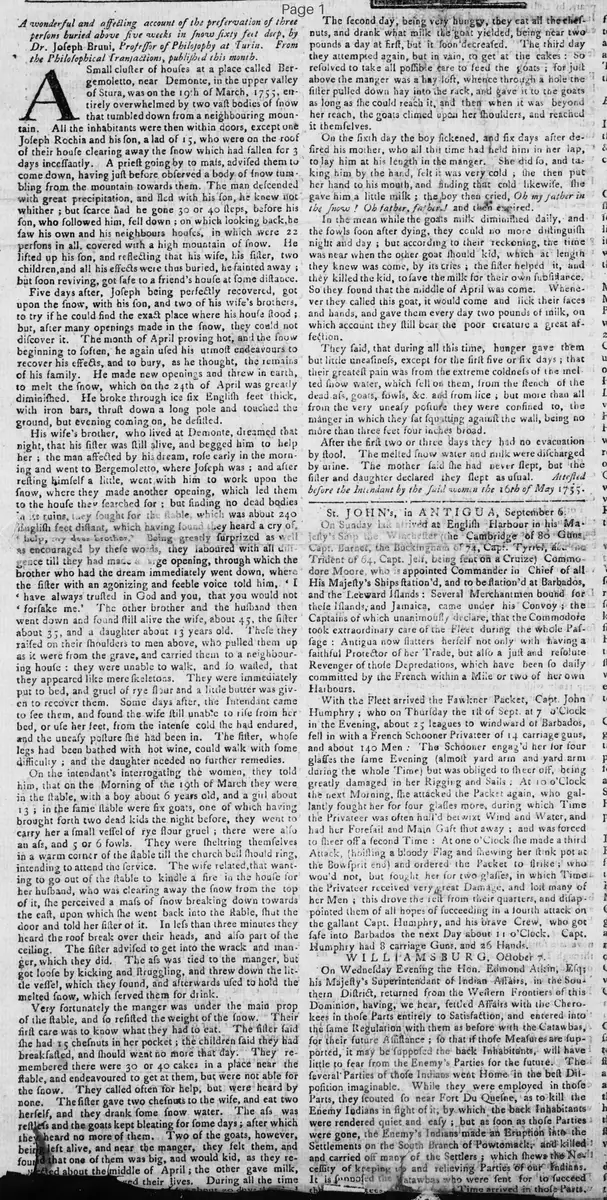
Small cluster of houses at a place called Bergemoletto, near Demonte, in the upper valley of Stura, was on the 19th of March, 1755, entirely overwhelmed by two vast bodies of snow that tumbled down from a neighbouring mountain. All the inhabitants were then within doors, except one Joseph Rochia and his son, a lad of 15, who were on the roof of their house clearing away the snow which had fallen for 3 days incessantly. A priest going by to mass, advised them to come down, having just before observed a body of snow tumbling from the mountain towards them. The man descended with great precipitation, and fled with his son, he knew not whither; but scarce had he gone 30 or 40 steps, before his son, who followed him, fell down; on which looking back, he saw his own and his neighbours' houses, in which were 22 persons in all, covered with a high mountain of snow. He lifted up his son, and reflecting that his wife, his sister, two children, and all his effects were thus buried, he fainted away: but soon reviving, got safe to a friend's house at some distance.
Five days after, Joseph being perfectly recovered, got upon the snow, with his son, and two of his wife's brothers, to try if he could find the exact place where his house stood; but, after many openings made in the snow, they could not discover it. The month of April proving hot, and the snow beginning to soften, he again used his utmost endeavours to recover his effects, and to bury, as he thought, the remains of his family. He made new openings and threw in earth, to melt the snow, which on the 24th of April was greatly diminished. He broke through ice six English feet thick, with iron bars, thrust down a long pole and touched the ground, but evening coming on, he desisted.
His wife's brother, who lived at Demonte, dreamed that night, that his sister was still alive, and begged him to help her; the man affected by his dream, rose early in the morning and went to Bergemoletto, where Joseph was; and after resting himself a little, went with him to work upon the snow, where they made another opening, which led them to the house they searched for: but finding no dead bodies in its ruins, they sought for the stable, which was about 240 English feet distant, which having found they heard a cry of, 'help, my dear brother.' Being greatly surprised as well as encouraged by these words, they laboured with all diligence till they had made a large opening, through which the brother who had the dream immediately went down, where the sister with an agonizing and feeble voice told him, 'I have always trusted in God and you, that you would not forsake me.' The other brother and the husband then went down and found still alive the wife, about 45, the sister about 35, and a daughter about 13 years old. These they raised on their shoulders to men above, who pulled them up as it were from the grave, and carried them to a neighbouring house: they were unable to walk, and so wasted, that they appeared like mere skeletons. They were immediately put to bed, and gruel of rye flour and a little butter was given to recover them. Some days after, the Intendant came to see them, and found the wife still unable to rise from her bed, or use her feet, from the intense cold she had endured, and the uneasy posture she had been in. The sister, whose legs had been bathed with hot wine, could walk with some difficulty: and the daughter needed no further remedies.
On the Intendant's interrogating the women, they told him, that on the Morning of the 19th of March they were in the stable, with a boy about 6 years old, and a girl about 13; in the same stable were six goats, one of which having brought forth two dead kids the night before, they went to carry her a small vessel of rye flour gruel; there were also an ass, and 5 or 6 fowls. They were sheltering themselves in a warm corner of the stable till the church bell should ring, intending to attend the service. The wife related, that wanting to go out of the stable to kindle a fire in the house for her husband, who was clearing away the snow from the top of it, she perceived a mass of snow breaking down towards the east, upon which she went back into the stable, shut the door and told her sister of it. In less than three minutes they heard the roof break over their heads, and also part of the ceiling. The sister advised to get into the wreck and manger, which they did. The ass was tied to the manger, but got loose by kicking and struggling, and threw down the little vessel, which they found, and afterwards used to hold the melted snow, which served them for drink.
Very fortunately the manger was under the main prop of the stable, and so resisted the weight of the snow. Their first care was to know what they had to eat. The sister said she had 15 chestnuts in her pocket; the children said they had breakfasted, and should want no more that day. They remembered there were 30 or 40 cakes in a place near the stable, and endeavoured to get at them, but were not able for the snow. They called often for help, but were heard by none. The sister gave two chestnuts to the wife, and eat two herself, and they drank some snow water. The ass was restless and the goats kept bleating for some days; after which they heard no more of them. Two of the goats, however, being left alive, and near the manger, they felt them, and found that one of them was big, and would kid, as they reckoned about the middle of April; the other gave milk, which saved their lives. During all the time
The second day, being very hungry they eat all the chestnuts, and drank what milk the goat yielded, being near two pounds a day at first, but it soon decreased. The third day they attempted again, but in vain, to get at the cakes: So resolved to take all possible care to feed the goats: for just above the manger was a hay-loft, whence through a hole the sister pulled down hay into the rack, and gave it to the goats as long as she could reach it, and then when it was beyond her reach, the goats climbed upon her shoulders, and reached it themselves.
On the sixth day the boy sickened, and six days after desired his mother, who all this time had held him in her lap, to lay him at his length in the manger. She did so, and taking him by the hand, felt it was very cold; she then put her hand to his mouth, and finding that cold likewise, she gave him a little milk; the boy then cried, Oh my father in the snow! Oh father, father! and then expired.
In the mean while the goats milk diminished daily, and the fowls soon after dying, they could no more distinguish night and day; but according to their reckoning, the time was near when the other goat should kid, which at length they knew was come, by its cries; the sister helped it, and they killed the kid, to save the milk for their own subsistence. So they found that the middle of April was come. Whenever they called this goat, it would come and lick their faces and hands, and gave them every day two pounds of milk, on which account they still bear the poor creature a great affection.
They said, that during all this time, hunger gave them but little uneasiness, except for the first five or six days; that their greatest pain was from the extreme coldness of the melted snow water, which fell on them, from the stench of the dead ass, goats, fowls, &c. and from lice; but more than all from the very uneasy posture they were confined to, the manger in which they sat squatting against the wall, being no more than three feet four inches broad.
After the first two or three days they had no evacuation by stool. The melted snow water and milk were discharged by urine. The mother said she had never slept, but the sister and daughter declared they slept as usual. Attested before the Intendant by the said women the 16th of May 1755.
What sub-type of article is it?
What keywords are associated?
What entities or persons were involved?
Where did it happen?
Foreign News Details
Primary Location
Bergemoletto, Near Demonte, In The Upper Valley Of Stura
Event Date
19th Of March 1755
Key Persons
Outcome
one boy died during the ordeal; three women (joseph rochia's wife about 45, her sister about 35, and daughter about 13) survived after being buried over five weeks and were rescued alive but emaciated.
Event Details
A snow avalanche overwhelmed houses in Bergemoletto on March 19, 1755, burying 22 persons. Joseph Rochia and son escaped. After searches, on April 25, rescuers found and extracted three survivors from a stable manger where they had subsisted on goat's milk and melted snow, protected by the structure. The boy with them died on the 12th day. Attested May 16, 1755.