Thank you for visiting SNEWPapers!
Sign up free
The New Hampshire Gazette
Portsmouth, Rockingham County, New Hampshire
What is this article about?
An extract from a letter in the Columbian Centinel criticizes the House of Representatives' noisy opposition to the treaty-making power of the President and Senate, led by Gallatin, Madison, and Giles. It praises George Washington's firm message refusing their demands, confounding the faction and exposing their unconstitutional claims through ambiguous resolutions by Mr. Blount.
Clipping
OCR Quality
Full Text
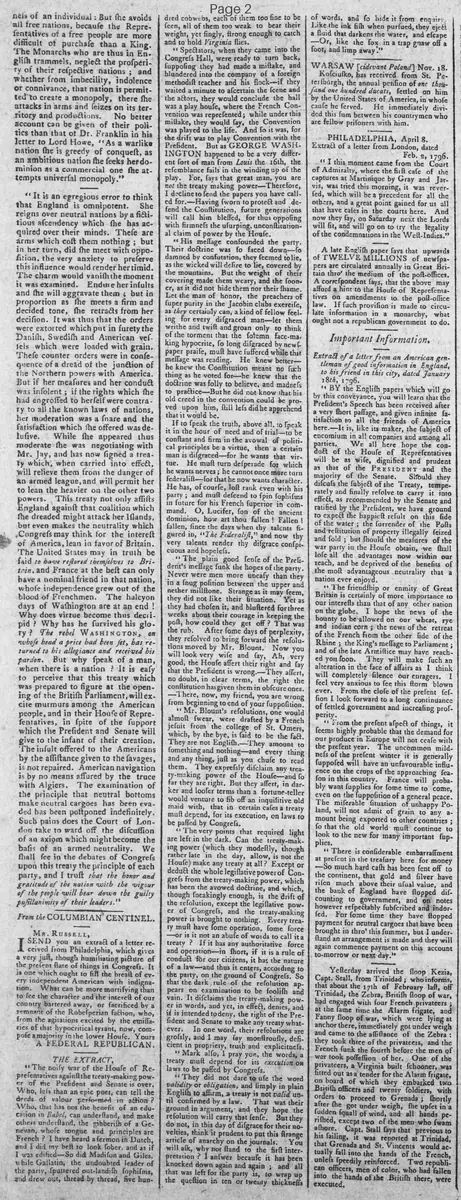
MR. RUSSELL,
I SEND you an extract of a letter received from Philadelphia, which gives a very just, though humiliating picture of the present state of things in Congress. It is one which ought to fill the breast of every independent American with indignation. What can be more mortifying than to see the character and the interest of our country bartered away, or sacrificed by a remnant of the Robespierrian faction, who, from the agitations excited by the emissaries of that hypocritical tyrant, now, compose a majority in the lower House. Yours,
A FEDERAL REPUBLICAN.
THE EXTRACT
" The noisy war of the House of Representatives against the treaty-making power of the President and Senate is over. Who, less than an epic poet, can tell the deeds of valour performed in action ? Who, that has not the benefit of an education in Babel, can understand, and make others understand, the gibberish of a Genevan, whose tongue and principles are French ? I have heard a sermon in Dutch, and I did my best to look sober, and as if I was edified-So did Madison and Giles, while Gallatin, the undoubted leader of the party, sputtered out-landish sophisms, and drew out, thread by thread, five hundred cobwebs. each of them too fine to be seen, all of them too weak to bear their weight, yet singly, strong enough to catch and to hold Virginia flies.
" Spectators, when they came into the Congress Hall, were ready to turn back, supposing they had made a mistake, and blundered into the company of a foreign methodist teacher and his flock--if they waited a minute to ascertain the scene and the actors, they would conclude the hall was a play house, where the French Convention was represented; while under this mistake, they would say, the Convention was played to the life. And so it was, for the drift was to play Convention with the President. But as GEORGE WASHINGTON happened to be a very different sort of man from Louis the 16th, the resemblance fails in the winding up of the play. For, says that great man, you are not the treaty making power--Therefore, I decline to send the papers you have called for.-Having sworn to protect and defend the Constitution, future generations will call him blessed, for thus opposing with firmness the usurping, unconstitutional claim of power by the House.
"His message confounded the party. Their doctrine was so faced down--so damned by confutation, they seemed to lie, as the wicked will desire to lie, covered by the mountains. But the weight of their covering made them weary, and the sooner, as it did not hide them nor their shame. Let the man of honor, the preachers of super purity in the Jacobin clubs exercise, as they certainly can, a kind of fellow feeling for every disgraced man--let them writhe and twist and groan only to think of the torment that the solemn face-making hypocrite, so long disgraced by newspaper praise, must have suffered while that message was reading. He knew better-- he knew the Constitution meant no such thing as he voted for -he knew that the doctrine was folly to believe, and madness to practice-But he did not know that his old creed in the convention could be proved upon him, still less did he apprehend that it would be.
If to speak the truth, above all. to speak it in the hour of need and of trial to be constant and firm in the avowal of political principles be a virtue, then a certain man is disgraced--for he wants that virtue. He must turn desperado for which he wants nerves; he cannot once more turn federalist--for that he now wants character. He has, of course, lost rank even with his party ; and must descend to spin sophisms in future for his French superior in command. O, Lucifer, son of the ancient dominion, how art thou fallen ! Fallen! fallen, since the days when thy talents figured in, "The Federalist," and now thy very talents render thy disgrace conspicuous and hopeless.
" The plain good sense of the President's message sunk the hopes of the party. Never were men more uneasy than they in a snug position between the upper and nether millstone. Strange as it may seem, they did not like their Situation. Yet as they had chosen it, and blustered for three weeks about their courage in keeping the post, how could they get off ? That was the rub. After some days of perplexity, they resolved to bring forward the resolutions moved by Mr. Blount. Now you will look very wise and say, Ah, very good, the House assert their right and say that the President is wrong.-They assert, no doubt, in clear terms, the right the constitution has given them in obscure ones. —There, now, my friend, you are wrong from beginning to end of your supposition.
" Mr. Blount's resolutions, one would almost swear, were drafted by a French Jesuit from the college of St. Omers, which, by the bye, is said to be the fact. They are not English.-They amount to something and nothing-and every thing and any thing, just as you choose to read them. They expressly disclaim any treaty-making power of the House-and so far they are right. But they assert, in darker and looser terms than a fortune-teller would venture to fib off an inquisitive old maid with, that in certain cases a treaty must depend, for its execution, on laws to be passed by Congress.
" The very points that required light are left in the dark. Can the treaty-making power (which they modestly, though rather late in the day, allow, is not the House) make any treaty at all ? Except or deduct the whole legislative power of Congress from the treaty-making power, which has been the avowed doctrine, and which, though sneakingly enough, is the drift of the resolution, except the legislative power of Congress, and the treaty-making power is brought to nothing. Every treaty must have some operation, some force --or is it not an abuse of words to call it a treaty ? If it has any authoritative force and operation-in short, if it is a rule of conduct for our citizens, it has the nature of a law-and thus it enters, according to the party, on the ground of Congress. So that the dark rule of the resolution appears on examination to be foolish and vain. It disclaims the treaty-making power in words, and yet, in effect, denies, and it is intended to deny, the right of the President and Senate to make any treaty whatever. In one word, their resolutions are grossly, and I may say monstrously, deficient in propriety, truth and explicitness.
" Mark also, I pray you, the words, a treaty must depend for its execution on laws to be passed by Congress.
" They did not dare to use the word validity or obligation, and simply in plain English to affirm, a treaty is not valid until confirmed by a law. That was their ground in argument,' and they hope the resolution will carry that sense. But they do not, in this day of disgrace for their novelties, think it prudent to put this strange article of anarchy on the journals. You will ask, why not stand to the first interpretation ? I answer because it has been knocked down again and again ; and all that was left for the party is, to wrap up the question in ten or twenty thicknesses of words, and so hide it from enquiry.
Like the ink fish when pursued, they eject a fluid that darkens the water, and escape -Or, like the fox in a trap gnaw off a foot, and limp away."
What sub-type of article is it?
What themes does it cover?
What keywords are associated?
What entities or persons were involved?
Where did it happen?
Story Details
Key Persons
Location
Congress Hall, Philadelphia
Story Details
The House of Representatives, led by Gallatin, challenges the treaty-making power of the President and Senate with incoherent arguments likened to French gibberish. Washington refuses their demand for papers, defending the Constitution and confounding the opposition. They retreat to ambiguous resolutions by Blount that disclaim but undermine treaty authority, hiding their unconstitutional aims.