Thank you for visiting SNEWPapers!
Sign up free
The New York Journal, And Daily Patriotic Register
New York, New York County, New York
What is this article about?
In the House of Commons on May 5, debate on the budget continued with discussions on increasing British revenues from trade, fisheries, and colonies, comparisons to France's financial shortfall, criticisms of East India Company dealings, and concerns over military expenditures in West Indies.
Clipping
OCR Quality
Full Text
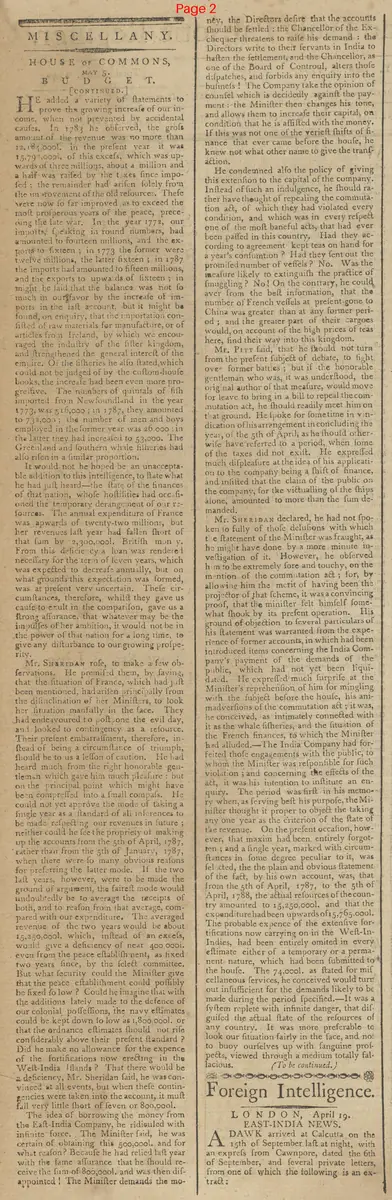
HOUSE OF COMMONS.
MAY 5.
BUDGET.
CONTINUED.
He added a variety of statements to prove the growing increase of our income, when not prevented by accidental causes. In 1778 he observed, the gross amount of the revenue was no more than £12,100,000. In the present year it was £15,792,000. Of this excess, which was upwards of three millions, about a million and a half was raised by the taxes since imposed: the remainder had arisen solely from the improvement of the old resources. These were now so far improved as to exceed the most prosperous years of the peace, preceding the late war. In the year 1772, our imports, speaking in round numbers, had amounted to fourteen millions, and the exports to sixteen; in 1773 the former were twelve millions, the latter sixteen; in 1787 the imports had amounted to fifteen millions, and the exports to upwards of sixteen; in 1788 it might be said that the balance was not so much in our favor by the increase of imports in the last account, but it might be found, on enquiry, that the importation consisted of raw materials for manufacture, or of articles from Ireland, by which we encouraged the industry of the sister kingdom, and strengthened the general interest of the empire. Of the fisheries he also stated, which could not be judged of by the custom-house books, the increase had been even more progressive. The numbers of quintals of fish imported from Newfoundland in the year 1773, was 516,000: in 1787, they amounted to 732,000; the number of men and boys employed in the former year was 26,000; in the latter they had increased to 53,000. The Greenland and southern whale fisheries had also risen in a similar proportion.
It would not, he hoped, be an unacceptable addition to this intelligence, to state what he had just heard—the state of the finances of that nation, whose hostilities had occasioned the temporary derangement of our resources. The annual expenditure of France was upwards of twenty-two millions, but her revenues last year had fallen short of that sum by 2,300,000l. British money. From this deficiency a loan was rendered necessary for the term of seven years, which was expected to decrease annually, but on what grounds—this expectation was formed, was at present very uncertain. These circumstances, therefore, whilst they gave us cause to exult in the comparison, gave us a strong assurance, that whatever may be the impulses of her ambition, it would not be in the power of that nation for a long time, to give any disturbance to our growing prosperity.
Mr. SHERIDAN rose to make a few observations. He premised them, by saying, that the situation of France, which had just been mentioned, had arisen principally from the disinclination of her Ministers, to look her situation manfully in the face. They had endeavoured to put off the evil day, and looked to contingency as a resource. Their present embarrassment, therefore, instead of being a circumstance of triumph, should be to us a lesson of caution. He had heard much from the right honorable gentleman which gave him much pleasure: but on the principal point which might have been compressed into a small compass. He could not yet approve the mode of taking a single year as a standard of all inferences to be made respecting our revenues in future: neither could he see the propriety of making up the accounts from the 5th of April, 1787, rather than from the 5th of January, 1787, when there were so many obvious reasons for preferring the latter mode. If the two last years, however, were to be made the ground of argument, the fairest mode would undoubtedly be to average the receipts of both, and to reason from that average, compared with our expenditure. The averaged revenue of the two years would be about 15,250,000l. which, instead of an excess, would give a deficiency of near 400,000l. even from the peace establishment, as fixed two years since, by the select committee. But what security could the Minister give that the peace establishment could possibly be fixed so low? Could he imagine that with the additions lately made to the defence of our colonial possessions, the navy estimates could be kept down so low as 1,800,000l. or that the ordnance estimates should not rise considerably above their present standard? Did he make no allowance for the expense of the fortifications now erecting in the West-India Islands? That there would be a deficiency, Mr. Sheridan said, he was convinced at all events, but when these contingencies were taken into the account, it must fall very little short of even 700,000l. or 800,000l.
The idea of borrowing the money from the East-India Company, he ridiculed with infinite force. The Minister said, he was certain of obtaining this 500,000l. and for what reason? Because he had relied last year with the same assurance that he should receive the sum of 800,000l. and was then disappointed! The Minister demands the money, the Directors desire that the accounts should be settled: the Chancellor of the Exchequer threatens to raise his demand: the Directors write to their servants in India to hasten the settlement, and the Chancellor, as one of the Board of Control, alters those dispatches, and forbids any enquiry into the business! The Company take the opinion of counsel which is decidedly against the payment: the Minister then changes his tone, and allows them to increase their capital, on condition that he is assisted with the money. If this was not one of the veriest shifts of finance that ever came before the house, he knew not what other name to give the transaction.
He condemned also the policy of giving this extension to the capital of the company. Instead of such an indulgence, he should rather have thought of repealing the commutation act, of which they had violated every condition, and which was in every respect one of the most baneful acts, that had ever been passed in this country. Had they according to agreement kept teas on hand for a year's consumption? Had they sent out the promised number of vessels? No. Was the measure likely to extinguish the practice of smuggling? No! On the contrary, he could aver from the best information, that the number of French vessels at present gone to China was greater than at any former period; and the greater part of their cargoes would, on account of the high prices of teas here, find their way into this kingdom.
Mr. PITT said, that he should not turn from the present subject of debate, to fight over former battles: but if the honorable gentleman who was, it was understood, the original author of that measure, would move for leave to bring in a bill to repeal the commutation act, he should readily meet him on that ground. He spoke for some time in vindication of his arrangement in concluding the year, of the 5th of April, as he should otherwise have referred to a period, when some of the taxes did not exist. He expressed much displeasure at the idea of his application to the company being a shift of finance, and insisted that the claim of the public on the company, for the victualling of the ships alone, amounted to more than the sum demanded.
Mr. SHERIDAN declared, he had not spoken so fully of those delusions with which the statement of the Minister was fraught, as he might have done by a more minute investigation of it. However, he observed him to be extremely sore and touchy, on the mention of the commutation act; for, by allowing him the merit of having been the projector of that scheme, it was a convincing proof, that the minister felt himself somewhat shook by its present operation. His ground of objection to several particulars of his statement was warranted from the experience of former accounts, in which had been introduced items concerning the India Company's payment of the demands of the public, which had not yet been liquidated. He expressed much surprise at the Minister's reprehension of him for mingling with the subject before the house, his animadversions of the commutation act; it was, he conceived, as intimately connected with it as the whale fisheries, and the situation of the French finances, to which the Minister had alluded. The India Company had forfeited those engagements with the public, to whom the Minister was responsible for such violation; and concerning the effects of the act, it was his intention to institute an enquiry. The period was first in his memory when, as serving best his purpose, the Minister thought it proper to object the taking any one year as the criterion of the state of the revenue. On the present occasion, however, that maxim had been entirely forgotten; and a single year, marked with circumstances in some degree peculiar to it, was selected, tho' the plain and obvious statement of the fact, by his own account, was, that from the 5th of April, 1787, to the 5th of April, 1788, the actual resources of the country amounted to 15,250,000l. and that the expenditure had been upwards of 15,765,000l. The probable expense of the extensive fortifications now carrying on in the West-Indies, had been entirely omitted in every estimate either of a temporary or a permanent nature, which had been submitted to the house. The 74,000l. as stated for miscellaneous services, he conceived would turn out insufficient for the demands likely to be made during the period specified. It was a system replete with infinite danger, that disguised the actual state of the resources of any country. It was more preferable to look our situation fairly in the face, and not to buoy ourselves up with sanguine prospects, viewed through a medium totally fallacious.
(To be continued.)
What sub-type of article is it?
What keywords are associated?
What entities or persons were involved?
Where did it happen?
Foreign News Details
Primary Location
France
Event Date
May 5
Key Persons
Outcome
british revenues increased to £15,792,000; france's revenues short by 2,300,000l.; debate on potential deficiencies up to 700,000l. or 800,000l. and east india company loan
Event Details
Debate in House of Commons on budget, highlighting revenue growth from trade, imports/exports, Newfoundland and whale fisheries, and colonial improvements; comparison to France's financial shortfall due to hostilities; criticisms of accounting methods, military estimates for colonies including West-India Islands fortifications, and dealings with East India Company including commutation act violations and proposed loan.