Thank you for visiting SNEWPapers!
Sign up free
Story
June 13, 1941
The Weekly Gazette
East Hartford, Hartford County, Connecticut
What is this article about?
Construction starts on the north tie-in of the East Hartford dike, a 6,400-foot flood barrier costing $1.55 million, using dredged river fill and featuring stop walls at Main Street and the Willimantic railroad bridge.
Clipping
OCR Quality
100%
Excellent
Full Text
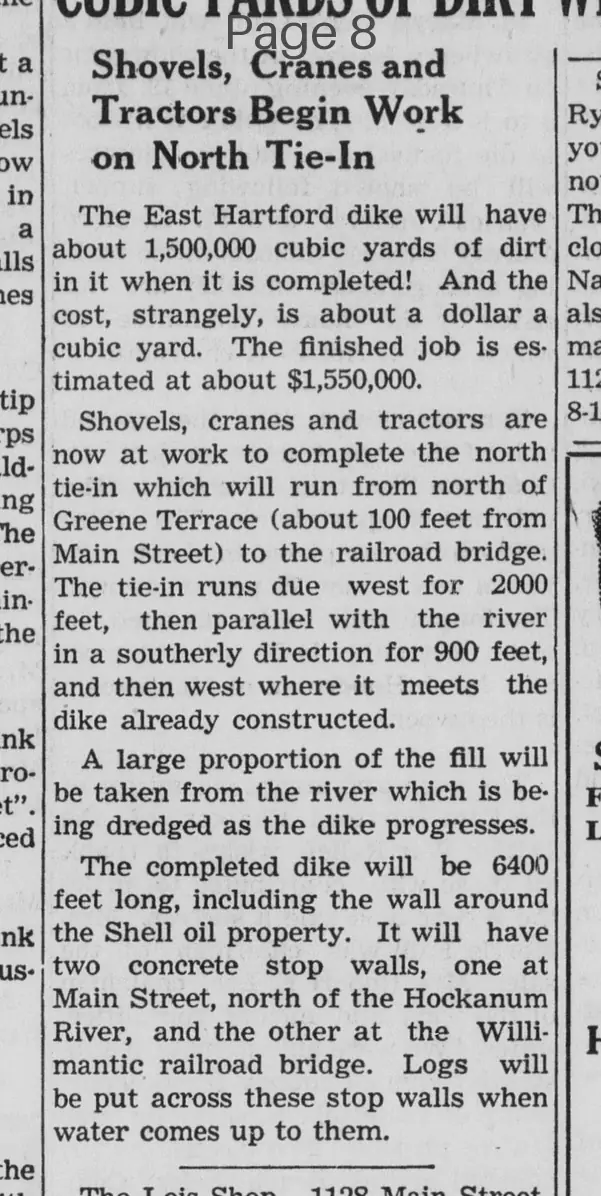
Shovels, Cranes and Tractors Begin Work on North Tie-In
The East Hartford dike will have about 1,500,000 cubic yards of dirt in it when it is completed! And the cost, strangely, is about a dollar a cubic yard. The finished job is estimated at about $1,550,000.
Shovels, cranes and tractors are now at work to complete the north tie-in which will run from north of Greene Terrace (about 100 feet from Main Street) to the railroad bridge.
The tie-in runs due west for 2000 feet, then parallel with the river in a southerly direction for 900 feet, and then west where it meets the dike already constructed.
A large proportion of the fill will be taken from the river which is being dredged as the dike progresses.
The completed dike will be 6400 feet long. including the wall around the Shell oil property. It will have two concrete stop walls, one at Main Street, north of the Hockanum River, and the other at the Willimantic railroad bridge. Logs will be put across these stop walls when water comes up to them.
The East Hartford dike will have about 1,500,000 cubic yards of dirt in it when it is completed! And the cost, strangely, is about a dollar a cubic yard. The finished job is estimated at about $1,550,000.
Shovels, cranes and tractors are now at work to complete the north tie-in which will run from north of Greene Terrace (about 100 feet from Main Street) to the railroad bridge.
The tie-in runs due west for 2000 feet, then parallel with the river in a southerly direction for 900 feet, and then west where it meets the dike already constructed.
A large proportion of the fill will be taken from the river which is being dredged as the dike progresses.
The completed dike will be 6400 feet long. including the wall around the Shell oil property. It will have two concrete stop walls, one at Main Street, north of the Hockanum River, and the other at the Willimantic railroad bridge. Logs will be put across these stop walls when water comes up to them.
What sub-type of article is it?
Historical Event
What keywords are associated?
Dike Construction
East Hartford
Flood Control
River Dredging
Infrastructure Project
Where did it happen?
East Hartford
Story Details
Location
East Hartford
Story Details
Construction begins on the north tie-in of the East Hartford dike, using shovels, cranes, and tractors. The dike will total 1,500,000 cubic yards of dirt at a cost of about $1,550,000. The tie-in path is described, with fill from river dredging. The full dike is 6400 feet long with concrete stop walls and logs for flood control.