Thank you for visiting SNEWPapers!
Sign up free
Literary
April 28, 1927
The Chesterfield Advertiser
Chesterfield, Chesterfield County, South Carolina
What is this article about?
In Chapter X of the serial, Frank Beeson confronts and fights Daniel Adams over Edna Montoyo, killing him in self-defense after a brawl and gunshot. They flee the Mormon wagon train southward to escape retribution, bound together as outlaws.
Merged-components note: Images are illustrations for the serial literary story, placed sequentially in reading order.
Clipping
OCR Quality
75%
Good
Full Text
(Continued From Last Week)
WHAT HAS GONE BEFORE:
Frank Beeson, from Albany, N. Y., reaches Benton, Wyoming, then 1868 western terminus of the Pacific Railroad. He had been ordered by physicians to seek a climate "high and dry". He is robbed of most of his money in his hotel and loses his last twenty dollars at monte in "The Big Tent," a dance hall and gambling resort in the "roaring" town of Benton.
Edna Montoyo, companion of a gambler, is believed by Frank to have cajoled him purposely into the game. Broke, disconsolate over his discovery that "the lady of the blue eyes," as he calls her, is what she is, and finally humiliated over his glaring "greenness", Frank repulses Edna when she begs him to go away with her, sobbingly telling him that she had made a mistake in letting him lose his money. He goes to take a job with George Jenks, a teamster in a wagon train about to leave for Salt Lake City.
Capt. Adams, a Mormon, is in charge of the wagon train. Rachael Adams, an attractive young woman, one of his wives, is in the train, as is Daniel Adams, his loutish son.
When Edna, who has shot, but not killed, the gambler, Montoyo, comes as a fugitive in "britches" to join the train, Daniel tells his father that she is seeking Jenks and Beeson. Capt. Adams shouts, "No hussy in men's garments shall go with the train."
Daniel, by a spectacular gun play, foils Montoyo's attempt to take Edna back with him.
Under Jenks' and Edna's instruction Frank practices shooting--is told to "aim for his feet to hit his heart." This follows a clever exhibition of shooting by young Daniel, who is angered by Edna's interest in Beeson.
Chapter X
INTO THE NIGHT
A meeting between My Lady and me brought on, not long after, the expected crisis. As we talked, suddenly I saw Daniel nearing, striding rapidly, straight for us, a figure portentous in the fading glow, bringing the storm with him.
She saw too. Her eyes widened startled, surveying not him, but me.
"Please go. I'll stop him."
"It is too late now," I asserted, in a voice not mine. "I am here first and I'll go when I get ready."
"You mean to face him? I knew it. You will play the man! Watch him close! He'll give you little grace this time. But remember this: I'll never, never, never marry him. Rather than be bound to him I'll deal with him myself!"
"It won't be necessary, madam," said I, a catch in my throat; for while I was all iciness and clamminess, my hands cold and my tongue dry, I felt that I was going to kill him.
Daniel charged in for us. I did not touch revolver butt; he did not. He bared first at her.
"Go whar yu belong, yu Jezebel! Then I'll tend to this--" The rabid epithet leveled at me I shall not repeat.
"Be careful what you say, Daniel. No man on this earth can speak to me like that."
All his face flushed livid with a sneer, merging together yellow freckles and tanned skin.
"Can't, can't he? I kin an' I do. Now yu git. I've stood yore fast-an'-loose plenty. I mean business. Git! Whar you'll be safe. I'll not hold off much longer."
"No more of that, you brute," I roared. "If you have anything to say, say it to me."
At that he whirled.
"Yu! Whar yu leetle piece o' nothin'--you shut up!" By sudden reach he gripped her arm; to her sharp, short scream he thrust her about.
"Git! I'm boss hyar." And at me: "What yu goin' to do? She's promised to me. Git, yerself, or I'll stomp on yu like on a louse!"
I forgot instructions, I disregarded every movement preliminary to the onset! Bullets were too slow and easy! I did not see his revolver: I saw but the bulk of him and the intolerable sneer of him, and that his flesh was ready to my fingers.
An' quicker than his hand I was upon him, into him, clinching him, clinging to him, arms binding him, legs twining around his, each ounce of me greedy to crush him down and master him.
The shock drove him backward. We swayed and staggered, grappling hither and thither. I had his arms pinioned, to bend him. He spat into my face: and shifting, set his teeth into my shoulder so that they clamped like the teeth of a horse, through shirt and hide to the flesh.
We toppled together, came to the ground with a thump. Here we churned, while he flung me and still I stuck.
The acrid dust of the alkali enveloped us. Again he spat, fetid, sprawled upon him, smothering his flailing arms; gave him all my weight and strength; smelled the sweat of him, snarled into his snarling face, close beneath mine.
Once he partially freed himself and buffeted me in the mouth with his fist, but I caught him--while struggling, tossed and upheaved, dimly saw that as by a miracle we were surrounded by a ring of people, men and women, their countenances pale, alarmed, intent. Voices sounded in a dull roar.
Presently I had him crucified: his one outstretched arm under my knees, his other arm tethered by my two hands, my body across his chest, while his legs threshed vainly.
I looked down into his bulging eyes.
"'Nuf. Cry 'Nuf'!" I commanded.
"'Nuf! Say 'Nuf," echoed the crowd.
He strained again, convulsive; and relaxed.
"'Nuf!" he panted through bared teeth. "Lemme up, Mister."
"That settles it?"
"I said 'Nuf," he growled.
With a quick movement I sprang clear of him, to my feet. He lay for a moment, baleful, and slowly scrambled up.
On a sudden, as he faced me, his hand shot downward. I heard the surge and shout of men and women, to the stunning report of his revolver ducked aside, felt my left arm jerk and sting--felt my own gun explode in my hand (and how it came there I did not know)--beheld him spin around and collapse; an astonishing sight.
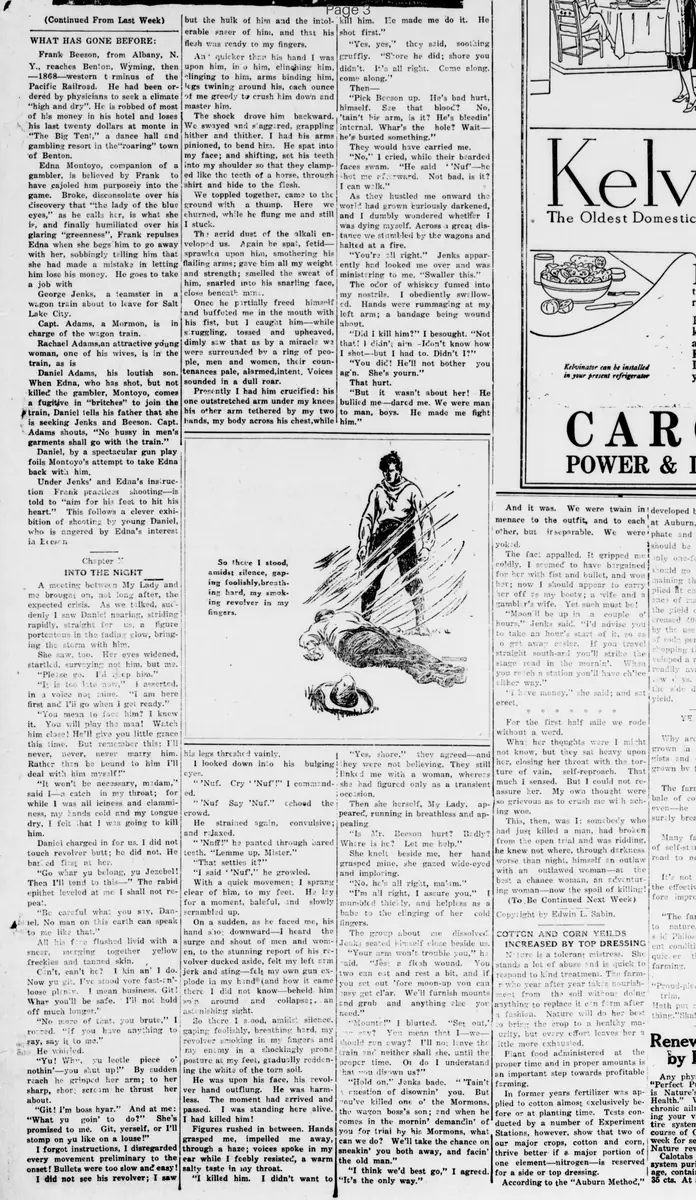
So there I stood, amidst silence, gaping foolishly, breathing hard, my smoking revolver in my fingers and my enemy in a shockingly prone posture at my feet, gradually reddening the white of the torn soil.
He was upon his face, his revolver hand outflung. He was harmless. The moment had arrived and passed. I was standing here alive. I had killed him!
Figures rushed in between. Hands grasped me, impelled me away, through a haze; voices spoke in my ear while I feebly resisted, a warm salty taste in my throat.
"I killed him. I didn't want to kill him. He made me do it. He shot first."
"Yes, yes," they said, soothing gruffly.
"Shore he did; shore you didn't. It's all right. Come along, come along."
Then "Pick Beeson up. He's bad hurt, himself. See that blood? No, 'tain't his arm, is it? He's bleedin' internal. Whar's the hole? Wait--he's busted something."
They would have carried me.
"No," I cried, while their bearded faces swam.
"He said 'Nuf'--he shot me afterward. Not bad, is it? I can walk."
As they hustled me onward the world had grown curiously darkened, and I dumbly wondered whether I was dying myself. Across a great distance we stumbled by the wagons and halted at a fire.
"You're all right." Jenks apparently had looked me over and was ministering to me. "Swaller this."
The odor of whiskey fumed into my nostrils. I obediently swallowed. Hands were rummaging at my left arm; a bandage being wound about.
"Did I kill him?" I besought. "Not that--I didn't aim--I don't know how I shot--but I had to. Didn't I?"
"You did! He'll not bother you ag'n. She's yourn."
That hurt.
"But it wasn't about her! He bullied me--dared me. We were man to man, boys. He made me fight him."
"Yes, shore," they agreed--and they were not believing. They still linked me with a woman, whereas she had figured only as a transient occasion.
Then she herself, My Lady, appeared, running in breathless and appealing.
"Is Mr. Beeson hurt? Badly? Where is he? Let me help."
She knelt beside me, her hand grasped mine, she gazed wide-eyed and imploring.
"No, he's all right, ma'am."
"I'm all right, I assure you," I mumbled thickly, and helpless as a babe to the clinging of her cold fingers.
The group about me dissolved. Jenks seated himself close beside us.
"Your arm won't trouble you," he said. "Jes' a flesh wound. You two can eat and rest a bit, and if you set out 'fore moon-up you can easy get cl'ar. We'll furnish mounts and grub and anything else you need."
"Mounts!" I blurted. "Set out, on ary? You mean that I--we--should run away? I'll not leave the train and" neither shall she, until the proper time. Do I understand that you disown us?"
"Hold on." Jenks bade. "'Tain't a question of disownin' you. But you've killed one o' the Mormons, tho wagon boss's son; and when he comes in the mornin' demandin' of you for trial by his Mormons, what can we do? We'll take the chance on sneakin' you both away, and facin' the old man."
"I think we'd best go," I agreed. "It's the only way."
And it was. We were twain in menace to the outfit, and to each other, but inseparable. We were yoked.
The fact appalled. It gripped me coldly. I seemed to have bargained for her with fist and bullet, and won her; now I should appear to carry her off as my booty; a wife and a gambler's wife. Yet such must be!
"Moon'll be up in a couple o' hours," Jenks said. "I'd advise you to takc an hour's start of it, so as o get awa" easier. If you travel straight southward you'll strike the stage road in the mornin'. When you reech a station you'll have ch'ice either way."
"I have money," she said; and sat erect.
For the first half mile we rode without a word. What her thoughts were I might not know, but they sat heavy upon her, closing her throat with the torture of vain self-reproach. That much I sensed. But I could not reassure her.
My own thoughts were so grievous as to crush me with aching woe.
This, then, was I: somebody who had just killed a man, had broken from the open trial and was riding, he knew not where, through darkness worse than night, himself an outlaw with an outlawed woman--at the best a chance woman, an adventuring woman--now the spoil of killing!
(To Be Continued Next Week)
Copyright by Edwin L. Sabin.
WHAT HAS GONE BEFORE:
Frank Beeson, from Albany, N. Y., reaches Benton, Wyoming, then 1868 western terminus of the Pacific Railroad. He had been ordered by physicians to seek a climate "high and dry". He is robbed of most of his money in his hotel and loses his last twenty dollars at monte in "The Big Tent," a dance hall and gambling resort in the "roaring" town of Benton.
Edna Montoyo, companion of a gambler, is believed by Frank to have cajoled him purposely into the game. Broke, disconsolate over his discovery that "the lady of the blue eyes," as he calls her, is what she is, and finally humiliated over his glaring "greenness", Frank repulses Edna when she begs him to go away with her, sobbingly telling him that she had made a mistake in letting him lose his money. He goes to take a job with George Jenks, a teamster in a wagon train about to leave for Salt Lake City.
Capt. Adams, a Mormon, is in charge of the wagon train. Rachael Adams, an attractive young woman, one of his wives, is in the train, as is Daniel Adams, his loutish son.
When Edna, who has shot, but not killed, the gambler, Montoyo, comes as a fugitive in "britches" to join the train, Daniel tells his father that she is seeking Jenks and Beeson. Capt. Adams shouts, "No hussy in men's garments shall go with the train."
Daniel, by a spectacular gun play, foils Montoyo's attempt to take Edna back with him.
Under Jenks' and Edna's instruction Frank practices shooting--is told to "aim for his feet to hit his heart." This follows a clever exhibition of shooting by young Daniel, who is angered by Edna's interest in Beeson.
Chapter X
INTO THE NIGHT
A meeting between My Lady and me brought on, not long after, the expected crisis. As we talked, suddenly I saw Daniel nearing, striding rapidly, straight for us, a figure portentous in the fading glow, bringing the storm with him.
She saw too. Her eyes widened startled, surveying not him, but me.
"Please go. I'll stop him."
"It is too late now," I asserted, in a voice not mine. "I am here first and I'll go when I get ready."
"You mean to face him? I knew it. You will play the man! Watch him close! He'll give you little grace this time. But remember this: I'll never, never, never marry him. Rather than be bound to him I'll deal with him myself!"
"It won't be necessary, madam," said I, a catch in my throat; for while I was all iciness and clamminess, my hands cold and my tongue dry, I felt that I was going to kill him.
Daniel charged in for us. I did not touch revolver butt; he did not. He bared first at her.
"Go whar yu belong, yu Jezebel! Then I'll tend to this--" The rabid epithet leveled at me I shall not repeat.
"Be careful what you say, Daniel. No man on this earth can speak to me like that."
All his face flushed livid with a sneer, merging together yellow freckles and tanned skin.
"Can't, can't he? I kin an' I do. Now yu git. I've stood yore fast-an'-loose plenty. I mean business. Git! Whar you'll be safe. I'll not hold off much longer."
"No more of that, you brute," I roared. "If you have anything to say, say it to me."
At that he whirled.
"Yu! Whar yu leetle piece o' nothin'--you shut up!" By sudden reach he gripped her arm; to her sharp, short scream he thrust her about.
"Git! I'm boss hyar." And at me: "What yu goin' to do? She's promised to me. Git, yerself, or I'll stomp on yu like on a louse!"
I forgot instructions, I disregarded every movement preliminary to the onset! Bullets were too slow and easy! I did not see his revolver: I saw but the bulk of him and the intolerable sneer of him, and that his flesh was ready to my fingers.
An' quicker than his hand I was upon him, into him, clinching him, clinging to him, arms binding him, legs twining around his, each ounce of me greedy to crush him down and master him.
The shock drove him backward. We swayed and staggered, grappling hither and thither. I had his arms pinioned, to bend him. He spat into my face: and shifting, set his teeth into my shoulder so that they clamped like the teeth of a horse, through shirt and hide to the flesh.
We toppled together, came to the ground with a thump. Here we churned, while he flung me and still I stuck.
The acrid dust of the alkali enveloped us. Again he spat, fetid, sprawled upon him, smothering his flailing arms; gave him all my weight and strength; smelled the sweat of him, snarled into his snarling face, close beneath mine.
Once he partially freed himself and buffeted me in the mouth with his fist, but I caught him--while struggling, tossed and upheaved, dimly saw that as by a miracle we were surrounded by a ring of people, men and women, their countenances pale, alarmed, intent. Voices sounded in a dull roar.
Presently I had him crucified: his one outstretched arm under my knees, his other arm tethered by my two hands, my body across his chest, while his legs threshed vainly.
I looked down into his bulging eyes.
"'Nuf. Cry 'Nuf'!" I commanded.
"'Nuf! Say 'Nuf," echoed the crowd.
He strained again, convulsive; and relaxed.
"'Nuf!" he panted through bared teeth. "Lemme up, Mister."
"That settles it?"
"I said 'Nuf," he growled.
With a quick movement I sprang clear of him, to my feet. He lay for a moment, baleful, and slowly scrambled up.
On a sudden, as he faced me, his hand shot downward. I heard the surge and shout of men and women, to the stunning report of his revolver ducked aside, felt my left arm jerk and sting--felt my own gun explode in my hand (and how it came there I did not know)--beheld him spin around and collapse; an astonishing sight.
So there I stood, amidst silence, gaping foolishly, breathing hard, my smoking revolver in my fingers and my enemy in a shockingly prone posture at my feet, gradually reddening the white of the torn soil.
He was upon his face, his revolver hand outflung. He was harmless. The moment had arrived and passed. I was standing here alive. I had killed him!
Figures rushed in between. Hands grasped me, impelled me away, through a haze; voices spoke in my ear while I feebly resisted, a warm salty taste in my throat.
"I killed him. I didn't want to kill him. He made me do it. He shot first."
"Yes, yes," they said, soothing gruffly.
"Shore he did; shore you didn't. It's all right. Come along, come along."
Then "Pick Beeson up. He's bad hurt, himself. See that blood? No, 'tain't his arm, is it? He's bleedin' internal. Whar's the hole? Wait--he's busted something."
They would have carried me.
"No," I cried, while their bearded faces swam.
"He said 'Nuf'--he shot me afterward. Not bad, is it? I can walk."
As they hustled me onward the world had grown curiously darkened, and I dumbly wondered whether I was dying myself. Across a great distance we stumbled by the wagons and halted at a fire.
"You're all right." Jenks apparently had looked me over and was ministering to me. "Swaller this."
The odor of whiskey fumed into my nostrils. I obediently swallowed. Hands were rummaging at my left arm; a bandage being wound about.
"Did I kill him?" I besought. "Not that--I didn't aim--I don't know how I shot--but I had to. Didn't I?"
"You did! He'll not bother you ag'n. She's yourn."
That hurt.
"But it wasn't about her! He bullied me--dared me. We were man to man, boys. He made me fight him."
"Yes, shore," they agreed--and they were not believing. They still linked me with a woman, whereas she had figured only as a transient occasion.
Then she herself, My Lady, appeared, running in breathless and appealing.
"Is Mr. Beeson hurt? Badly? Where is he? Let me help."
She knelt beside me, her hand grasped mine, she gazed wide-eyed and imploring.
"No, he's all right, ma'am."
"I'm all right, I assure you," I mumbled thickly, and helpless as a babe to the clinging of her cold fingers.
The group about me dissolved. Jenks seated himself close beside us.
"Your arm won't trouble you," he said. "Jes' a flesh wound. You two can eat and rest a bit, and if you set out 'fore moon-up you can easy get cl'ar. We'll furnish mounts and grub and anything else you need."
"Mounts!" I blurted. "Set out, on ary? You mean that I--we--should run away? I'll not leave the train and" neither shall she, until the proper time. Do I understand that you disown us?"
"Hold on." Jenks bade. "'Tain't a question of disownin' you. But you've killed one o' the Mormons, tho wagon boss's son; and when he comes in the mornin' demandin' of you for trial by his Mormons, what can we do? We'll take the chance on sneakin' you both away, and facin' the old man."
"I think we'd best go," I agreed. "It's the only way."
And it was. We were twain in menace to the outfit, and to each other, but inseparable. We were yoked.
The fact appalled. It gripped me coldly. I seemed to have bargained for her with fist and bullet, and won her; now I should appear to carry her off as my booty; a wife and a gambler's wife. Yet such must be!
"Moon'll be up in a couple o' hours," Jenks said. "I'd advise you to takc an hour's start of it, so as o get awa" easier. If you travel straight southward you'll strike the stage road in the mornin'. When you reech a station you'll have ch'ice either way."
"I have money," she said; and sat erect.
For the first half mile we rode without a word. What her thoughts were I might not know, but they sat heavy upon her, closing her throat with the torture of vain self-reproach. That much I sensed. But I could not reassure her.
My own thoughts were so grievous as to crush me with aching woe.
This, then, was I: somebody who had just killed a man, had broken from the open trial and was riding, he knew not where, through darkness worse than night, himself an outlaw with an outlawed woman--at the best a chance woman, an adventuring woman--now the spoil of killing!
(To Be Continued Next Week)
Copyright by Edwin L. Sabin.
What sub-type of article is it?
Prose Fiction
Journey Narrative
What themes does it cover?
Love Romance
Political
What keywords are associated?
Wagon Train
Gunfight
Romance
Mormon
Outlaw
Fistfight
Self Defense
Fugitives
What entities or persons were involved?
Edwin L. Sabin
Literary Details
Title
Chapter X Into The Night
Author
Edwin L. Sabin
Key Lines
"It Won't Be Necessary, Madam," Said I, A Catch In My Throat; For While I Was All Iciness And Clamminess, My Hands Cold And My Tongue Dry, I Felt That I Was Going To Kill Him.
"'Nuf!" He Panted Through Bared Teeth. "Lemme Up, Mister."
So There I Stood, Amidst Silence, Gaping Foolishly, Breathing Hard, My Smoking Revolver In My Fingers And My Enemy In A Shockingly Prone Posture At My Feet, Gradually Reddening The White Of The Torn Soil.
"You Did! He'll Not Bother You Ag'n. She's Yourn."
This, Then, Was I: Somebody Who Had Just Killed A Man, Had Broken From The Open Trial And Was Riding, He Knew Not Where, Through Darkness Worse Than Night, Himself An Outlaw With An Outlawed Woman At The Best A Chance Woman, An Adventuring Woman Now The Spoil Of Killing!