Thank you for visiting SNEWPapers!
Sign up free
Story
February 11, 1954
Atlanta Daily World
Atlanta, Fulton County, Georgia
What is this article about?
Dr. Helen Edmonds critiques American history textbooks for omitting Negro history beyond slavery, hindering integration. She advocates for Negro history's role until unbiased texts emerge, citing examples like Wirth's textbook adopted in Southern states.
Clipping
OCR Quality
95%
Excellent
Full Text
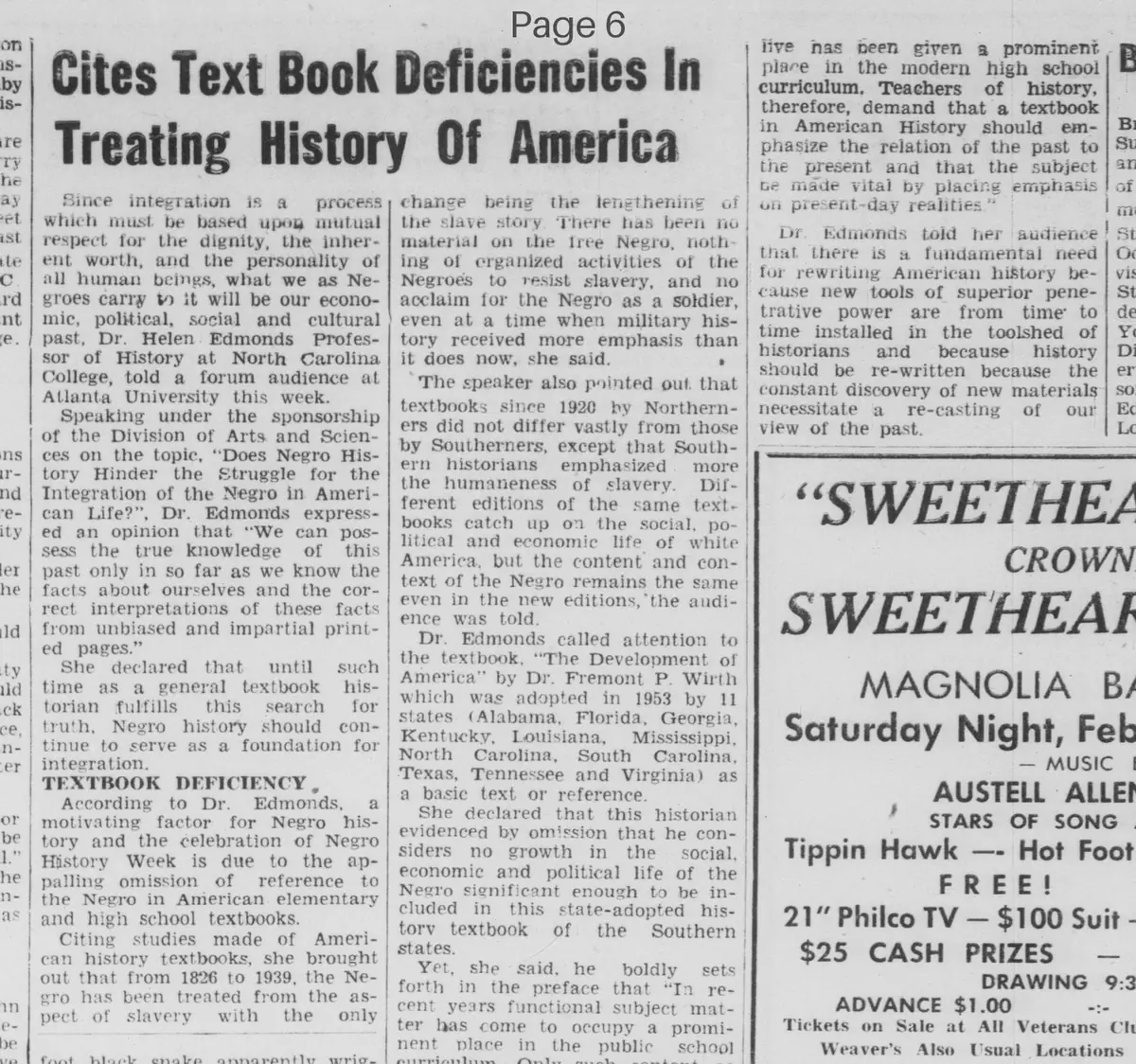
Cites Text Book Deficiencies In Treating History Of America
Since integration is a process which must be based upon mutual respect for the dignity, the inherent worth, and the personality of all human beings, what we as Negroes carry, it will be our economic, political, social and cultural past. Dr. Helen Edmonds, Professor of History at North Carolina College, told a forum audience at Atlanta University this week.
Speaking under the sponsorship of the Division of Arts and Sciences on the topic, "Does Negro History Hinder the Struggle for the Integration of the Negro in American Life?", Dr. Edmonds expressed an opinion that "We can possess the true knowledge of this past only in so far as we know the facts about ourselves and the correct interpretations of these facts from unbiased and impartial printed pages."
She declared that until such time as a general textbook historian fulfills this search for truth, Negro history should continue to serve as a foundation for integration.
TEXTBOOK DEFICIENCY
According to Dr. Edmonds, a motivating factor for Negro history and the celebration of Negro History Week is due to the appalling omission of reference to the Negro in American elementary and high school textbooks.
Citing studies made of American history textbooks, she brought out that from 1826 to 1939, the Negro has been treated from the aspect of slavery with the only change being the lengthening of the slave story. There has been no material on the free Negro, nothing of organized activities of the Negroes to resist slavery, and no acclaim for the Negro as a soldier, even at a time when military history received more emphasis than it does now, she said.
The speaker also pointed out that textbooks since 1920 by Northerners did not differ vastly from those by Southerners, except that Southern historians emphasized more the humaneness of slavery. Different editions of the same textbooks catch up on the social, political and economic life of white America, but the content and context of the Negro remains the same even in the new editions, the audience was told.
Dr. Edmonds called attention to the textbook, "The Development of America" by Dr. Fremont P. Wirth which was adopted in 1953 by 11 states (Alabama, Florida, Georgia, Kentucky, Louisiana, Mississippi, North Carolina, South Carolina, Texas, Tennessee and Virginia) as a basic text or reference.
She declared that this historian evidenced by omission that he considers no growth in the social, economic and political life of the Negro significant enough to be included in this state-adopted history textbook of the Southern states.
Yet, she said, he boldly sets forth in the preface that "In recent years functional subject matter has come to occupy a prominent place in the public school curriculum. Only such content as contributes to a better understanding of the world in which we live has been given a prominent place in the modern high school curriculum. Teachers of history, therefore, demand that a textbook in American History should emphasize the relation of the past to the present and that the subject be made vital by placing emphasis on present-day realities."
Dr. Edmonds told her audience that there is a fundamental need for rewriting American history because new tools of superior penetrative power are from time to time installed in the toolshed of historians and because history should be re-written because the constant discovery of new materials necessitate a re-casting of our view of the past.
Since integration is a process which must be based upon mutual respect for the dignity, the inherent worth, and the personality of all human beings, what we as Negroes carry, it will be our economic, political, social and cultural past. Dr. Helen Edmonds, Professor of History at North Carolina College, told a forum audience at Atlanta University this week.
Speaking under the sponsorship of the Division of Arts and Sciences on the topic, "Does Negro History Hinder the Struggle for the Integration of the Negro in American Life?", Dr. Edmonds expressed an opinion that "We can possess the true knowledge of this past only in so far as we know the facts about ourselves and the correct interpretations of these facts from unbiased and impartial printed pages."
She declared that until such time as a general textbook historian fulfills this search for truth, Negro history should continue to serve as a foundation for integration.
TEXTBOOK DEFICIENCY
According to Dr. Edmonds, a motivating factor for Negro history and the celebration of Negro History Week is due to the appalling omission of reference to the Negro in American elementary and high school textbooks.
Citing studies made of American history textbooks, she brought out that from 1826 to 1939, the Negro has been treated from the aspect of slavery with the only change being the lengthening of the slave story. There has been no material on the free Negro, nothing of organized activities of the Negroes to resist slavery, and no acclaim for the Negro as a soldier, even at a time when military history received more emphasis than it does now, she said.
The speaker also pointed out that textbooks since 1920 by Northerners did not differ vastly from those by Southerners, except that Southern historians emphasized more the humaneness of slavery. Different editions of the same textbooks catch up on the social, political and economic life of white America, but the content and context of the Negro remains the same even in the new editions, the audience was told.
Dr. Edmonds called attention to the textbook, "The Development of America" by Dr. Fremont P. Wirth which was adopted in 1953 by 11 states (Alabama, Florida, Georgia, Kentucky, Louisiana, Mississippi, North Carolina, South Carolina, Texas, Tennessee and Virginia) as a basic text or reference.
She declared that this historian evidenced by omission that he considers no growth in the social, economic and political life of the Negro significant enough to be included in this state-adopted history textbook of the Southern states.
Yet, she said, he boldly sets forth in the preface that "In recent years functional subject matter has come to occupy a prominent place in the public school curriculum. Only such content as contributes to a better understanding of the world in which we live has been given a prominent place in the modern high school curriculum. Teachers of history, therefore, demand that a textbook in American History should emphasize the relation of the past to the present and that the subject be made vital by placing emphasis on present-day realities."
Dr. Edmonds told her audience that there is a fundamental need for rewriting American history because new tools of superior penetrative power are from time to time installed in the toolshed of historians and because history should be re-written because the constant discovery of new materials necessitate a re-casting of our view of the past.
What sub-type of article is it?
Historical Event
Biography
What themes does it cover?
Justice
Social Manners
What keywords are associated?
Negro History
Textbook Deficiencies
American Integration
Slavery Portrayal
Negro Contributions
What entities or persons were involved?
Dr. Helen Edmonds
Dr. Fremont P. Wirth
Where did it happen?
Atlanta University
Story Details
Key Persons
Dr. Helen Edmonds
Dr. Fremont P. Wirth
Location
Atlanta University
Event Date
This Week
Story Details
Dr. Helen Edmonds, Professor of History at North Carolina College, spoke at a forum on whether Negro history hinders integration, arguing that textbook omissions of Negro contributions necessitate continued focus on Negro history for proper integration.