Thank you for visiting SNEWPapers!
Sign up free
The Enquirer
Richmond, Henrico County, Virginia
What is this article about?
In the Richmond Enquirer on February 1, 1805, an editorial introduces a letter from an anonymous Virginia legislator to a friend, reflecting on his disillusionment with the state legislature's proceedings, which lack the grandeur of historical assemblies due to absence of crises and migration of talents to federal roles. The letter sketches expectations versus reality in governance.
Clipping
OCR Quality
Full Text
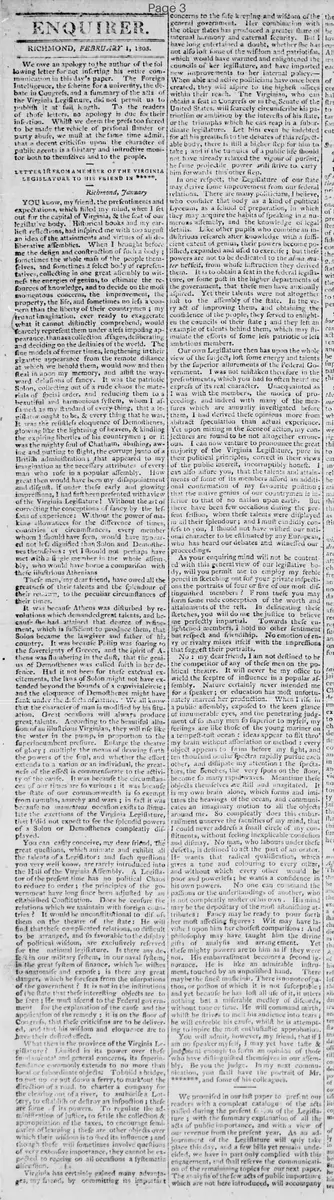
RICHMOND, FEBRUARY 1, 1805.
We owe an apology to the author of the following letter for not inserting his entire communication in this day's paper. The Foreign Intelligence, the scheme for a university, the debate in Congress, and a summary of the acts of the Virginia Legislature, did not permit us to publish it at full length. To the readers of those letters, no apology is due for their insertion. Whilst we deem the press too sacred to be made the vehicle of personal slander or party abuse, we must at the same time admit, that a decent criticism upon the character of public agents is a salutary and instructive monitor both to themselves and to the people.
LETTER FROM A MEMBER OF THE VIRGINIA LEGISLATURE TO HIS FRIEND IN *A***
Richmond, January
You know, my friend, the premonitions and expectations, which filled my mind, when I set out for the capital of Virginia, & the seat of our legislative body. Historical books and my earliest reflections, had inspired me with too august an idea of the attainments and virtues of all deliberative assemblies. When I brought before me the design and construction of such a body; sometimes the whole mass of the people themselves, and sometimes a select body of representatives, collecting in one great assembly to witness the energies of genius, to estimate the resources of knowledge, and to decide on the most momentous concerns, the improvement, the property, the life, and sometimes no less a concern than the liberty of their countrymen; my truant imagination, ever ready to exaggerate what it cannot distinctly comprehend, would scarcely represent them under a less imposing appearance than as a collection of sages, deliberating and deciding on the destinies of the world. The shining models of former times, lengthening in their gigantic appearance from the remote distance at which we behold them, would now and then steal in upon my memory, and assist the wayward delusions of fancy. It was the patriotic Solon, collecting out of a rude chaos the materials of social order, and reducing them to a beautiful and harmonious system, whom I assumed as my standard of every thing, that a legislator ought to be, & every thing that he was. It was the resistless eloquence of Demosthenes, glowing like the lightning of heaven, & kindling the expiring liberties of his countrymen; or it was the mighty soul of Chatham, abashing, awing and putting to flight, the corrupt junto of a British administration; that appeared to my imagination as the necessary attributes of every man who rose in a popular assembly. How great then would have been my disappointment and disgust, if under these early and glowing impressions, I had first been presented with a view of the Virginia Legislature! Without the art of correcting the conceptions of fancy by the lessons of experience: Without the power of making allowances for the difference of times, countries or circumstances, every member whom I should have seen, would have appeared not less dignified than Solon and Demosthenes themselves: yet I should not perhaps have met with a single member in the whole assembly, who would have borne a comparison with these illustrious Athenians. These men, my dear friend, have owed all the greatness of their talents and the splendour of their renown, to the peculiar circumstances of their times. It was because Athens was disturbed by revolutions which demanded great talents, and because she had attained that degree of refinement, which is sufficient to produce them, that Solon became the lawgiver and father of his country. It was because Philip was soaring to the sovereignty of Greece, and the spirit of Athens was slumbering in the dust, that the genius of Demosthenes was called forth in her defence. Had it not been for these external excitements, the laws of Solon might not have extended beyond the bounds of a convivial circle; and the eloquence of Demosthenes might have sunk under the desk of a pedagogue. We all know that the character of man is modified by his situation. Great occasions will always produce great talents. According to the beautiful allusion of an illustrious Virginian, they will rise like the water in the pump, in proportion to the superincumbent pressure. Enlarge the theatre of glory; multiply the means of drawing forth the powers of the soul, and whether the effort extends to a nation or an individual, the greatness of the effect is commensurate to the activity of the cause. It was because the circumstances of our times are so various: it was because the state of our commonwealth is so exempt from tumults, anarchy and wars; in fact it was because no momentous occasion exists to stimulate the exertions of the Virginia Legislature, that I did not expect to see the splendid powers of a Solon or Demosthenes completely displayed. You can easily conceive, my dear friend, The great questions, which animate and exhibit all the talents of a Legislator: and such questions you very well know, are rarely introduced into the Hall of the Virginia Assembly. A Legislator of the present time has no political Chaos to reduce to order; the principles of the government have long since been adjusted by an established Constitution. Does he censure the relations which we maintain with foreign countries? It would be unconstitutional to discuss them on the theatre of the state: He will find that these complicated relations, so difficult to be arranged, and so favorable to the display of political wisdom, are exclusively reserved for the national legislature. Is there any defect in our military system, in our naval system, in the great system of finance, which he wishes to anatomize and expose; is there any great danger, which he foresees from the usurpations of the government? It is not in the institutions of the state that these interesting objects are to be seen; He must ascend to the Federal government for the explanation of the cause and the application of the remedy: it is on the floor of Congress, that these criticisms are to be delivered, and that his wisdom and eloquence are to have their desired effect. What then is the province of the Virginia Legislature? Limited in its power over these fundamental and general concerns, its superintendence commonly extends to no more than local or subordinate objects: To build a bridge, to put up or put down a ferry, to mark out the direction of a road, to charter a company for the clearing out of a river, to authorize a Lottery, to establish or destroy an inspection: these are some of its powers. To regulate the administration of justice, to settle the collection & appropriation of the taxes, to encourage seminaries of learning: these are other objects over which their wisdom is to shed its influence: and though these will sometimes involve questions of very extensive importance, they cannot be expected to receive on all occasions a systematic discussion.
I.
Virginia has certainly gained many advantages, my friend, by committing its important concerns to the safe keeping and wisdom of the general government. Her combination with the other states has produced a greater share of internal harmony and external security. But I have long entertained a doubt, whether she has not also lost some of the wisdom and patriotism, which would have warmed and enlightened the councils of her legislature, and have imparted new improvements to her internal policy. When able and active politicians have once been created, they will aspire to the highest offices within their reach. The Virginian, who can obtain a seat in Congress or in the Senate of the United States, will scarcely circumscribe his patriotism or ambition by the interests of his state, or the triumphs which he can reap in a subordinate legislature. Let him even be indebted for all his greatness to the debates of this respectable body, there is still a higher step for him to take: and if the tumults of a public life should not have already relaxed the vigour of pursuit, the same propelling power will still strive to carry him forwards this other step. In one respect, the Legislature of our state may derive some improvement from our federal relations. There are many politicians, I believe, who consider that body as a kind of political Lyceum, as a school of preparation, in which they may acquire the habits of speaking in a numerous assembly, and the knowledge of legal details. Like other pupils who combine an industrious research after knowledge with a sufficient extent of genius, their powers become polished, expanded and used to exercise; but these powers are not to be dedicated to the alma mater herself, from whose instruction they derived them. It is to obtain a seat in the federal legislature, or some post in the higher departments of the government, that these men have anxiously aspired. Yet their talents were not altogether lost to the assembly of the state. In the very act of improving them, and obtaining the confidence of the people, they served to enlighten the councils of their state; and they left an example of talents behind them, which may still inulate the efforts of some less patriotic or less ambitious members. Our own Legislature then has upon the whole view of the subject, lost some energy and talents by the superior allurements of the Federal Government. I was not mistaken therefore in the premonitions, which you had so often heard me express of its real character. Unacquainted as I was with the members, the modes of proceeding, and indeed with many of the measures which are annually investigated before them, I had derived these opinions more from abstract speculation than actual experience. Yet upon mixing in the scene of action, my conjectures are found to be not altogether erroneous. I can now venture to pronounce the great majority of the Virginia Legislature, pure in their political principles, correct in their views of the public interest, incorruptibly honest. I can also assure you, that the talents and attainments of some of its members afford an additional confirmation of my favourite position; that the native genius of our countrymen is inferior to that of no nation upon earth. But there have been few occasions during the present session, when these talents were displayed in all their splendour; and I must candidly confess to you, I should not have wished our national character to be estimated by any European, who has heard our debates and witnessed our proceedings. As your enquiring mind will not be contented with this general view of our legislative body, will you permit me to employ my feeble pencil in sketching out for your private inspections the portraits of four or five of our most distinguished members? From these you may form some rude conception of the worth and attainments of the rest. In delineating these sketches, you will do me the justice to believe me perfectly impartial. Towards these enlightened members, I hold no other sentiment but respect and friendship. No emotion of envy or rivalry mixes itself with the impressions that suggest their portraits. No: my dear friend, I am not destined to be the competitor of any of these men on the political theatre. It will never be my office to wield the sceptre of influence in a popular assembly. Nature certainly never intended me for a speaker; or education has most unfortunately marred her production. When I rise in a public assembly, exposed to the keen glance of innumerable eyes, and the penetrating judgment of so many men so superior to myself, my feelings are like those of the young mariner on a tempest-tost ocean: ideas appear to flit thro' my brain without association or method: every object appears to swim before my sight, and ten thousand ocular spectra rapidly pursue each other, and dissipate my attention: the spectators, the Benches, the very spots on the floor, become so many rapid waves. Meantime these objects themselves are still and unagitated. It is my own brain alone, which forms and imitates the heavings of the ocean, and communicates an imaginary motion to all the objects around me. So completely does this embarrassment unnerve the faculties of my mind, that I could never address a small circle of my constituents, without feeling inexplicable confusion and dismay. No man, who labours under these defects, is destined to act the part of an orator. He wants that radical qualification, which gives a tone and colouring to every other, and without which every other would be poor and powerless; he wants a confidence in his own powers. No one can command the passions or the understandings of another, who is not completely master of his own. His mind may be the depository of the most astonishing attributes: Fancy may be ready to pour forth her most affecting figures: Wit may have lavished upon him her choicest comparisons: And philosophy may have taught him the divine gifts of analysis and arrangement. Yet these mighty powers are to him as if they were not. His embarrassment becomes a second ignorance. He is like an admirable instrument, touched by an unpolished hand. There may be the finest music in it. There is no note of pathos, or passion of which it is not susceptible; and yet because he has lost all use of it, it utters nothing but a miserable medley of discords, without tone or time. He will command mirth, whilst he strives to melt his audience into tears; he will enfeeble his cause, whilst he is attempting to inspire the most enthusiastic approbation. You will admit, however, my friend, that if I am no speaker myself, I may yet have taste & judgment enough to form an opinion of those who have distinguished themselves in our assembly. Be you the judge. In my next communication, you shall have the portrait of Mr. [name], and some of his colleagues.
We promised in our last paper to present our readers with a complete catalogue of the acts passed during the present session of the Legislature; with the summary explanation of all the acts of public importance, and with a view of our revenue from the present year. As an adjournment of the Legislature will only take place this day, and a few bills yet remain undecided, we have in part only complied with this engagement, and shall reserve the communication of the remaining topics for our next paper. The analysis of the few acts of public importance which are not here introduced, will accompany
What sub-type of article is it?
What themes does it cover?
What keywords are associated?
What entities or persons were involved?
Letter to Editor Details
Author
A Member Of The Virginia Legislature
Recipient
His Friend In *A***
Main Argument
the virginia legislature fails to display the grandeur and talents of historical assemblies like those of solon and demosthenes because the absence of major crises limits its scope to local matters, while ambitious politicians are drawn to the federal government, resulting in a loss of energy and patriotism at the state level.
Notable Details