Thank you for visiting SNEWPapers!
Sign up free
Gazette Of The United States, & Philadelphia Daily Advertiser
Philadelphia, Philadelphia County, Pennsylvania
What is this article about?
Paris report from July 7, 1797: Directory message on Gen. Desfourneaux's advantages in St. Domingo; English plenipotentiary arrives in Lille on July 4; commentary on Europe's war-peace uncertainty, Italian convulsions, and criticisms of French interventions in Venice and Genoa, violating laws of nations.
Clipping
OCR Quality
Full Text
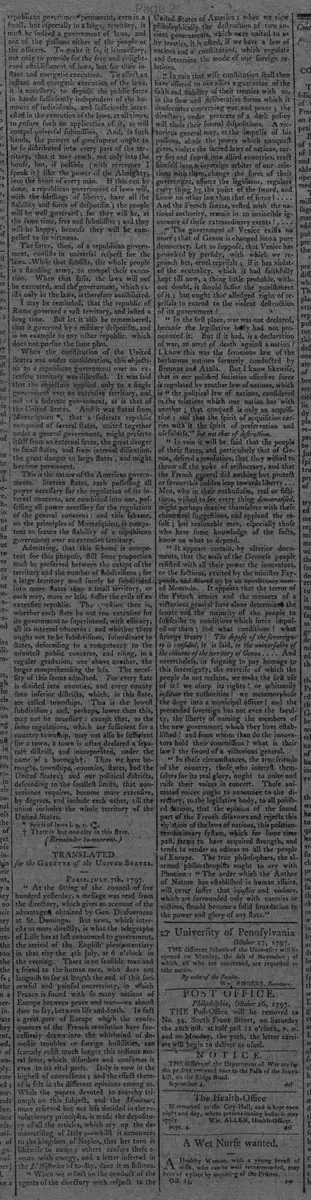
PARIS, July 7th, 1797
At the sitting of the council of five hundred yesterday, a message was read from the directory, which gives an account of the advantages obtained by Gen. Desfourneaux at St. Domingo. But news, which interests us more directly, is what the telegraph of Lille has at last announced to government, the arrival of the English plenipotentiary in that city the 4th July, at 6 o'clock in the evening. There is no sensible man and a friend to the human race, who does not languish to see at length the end of this sorrowful and painful uncertainty, in which France is found with so many nations of Europe between peace and war—we almost dare to say, between life and death. In fact a great part of Europe which the consequences of the French revolution have successively drawn into the whirlwind of domestic troubles or foreign hostilities, can scarcely resist much longer this tedious moral fever, which disorders and consumes it even to its vital parts. Italy is now in the highest of convulsions; and the effect thereof is felt in the different opinions among us. While the papers devoted to anarchy triumph on this subject, and the Moniteur, more reserved but not less decided in the revolutionary principles, is made the depository of all the articles, which cry up the democratizing of Italy;—whilst it announces to the kingdom of Naples, that her turn is likewise to come; others censure these events with energy, and a letter inserted in the L'Historien of to-day, does it as follows.
"When we reflect on the conduct of the agents of the directory with respect to the United States of America; when we view philosophically the destruction of two ancient governments, which were united to us by treaties, it is asked, if we have a law of nations and a constitution, which regulate and determine the mode of our foreign relations.
In vain that wise constitution shall then have offered to our allies a guarantee of the faith and stability of their treaties with us, in the slow and deliberative forms which it consecrates concerning war and peace; the directory, under pretexts of a dark policy will elude their formal dispositions. A victorious general may, at the impulse of his passions, abuse the power which conquest gives, violate the sacred laws of nations, carry fire and sword into allied countries; erect himself into a sovereign arbiter of our relations with them, change the form of their government, assume the legislator, regulate every thing by the point of the sword, and know no other law than that of force!....
And the French senate, vested with the national authority, remain in an invincible ignorance of these extraordinary events!....
The government of Venice exists no more; that of Genoa is changed into a pure democracy. Let us suppose, that Venice has provoked by perfidy, with which we reproach her, cruel reprisals; if it has violated the neutrality, which it had faithfully kept till now, a thing little probable, without doubt, it should suffer the punishment of it; but ought this alleged right of reprisals to extend to the violent destruction of its government?
In the first place, war was not declared, because the legislative body had not pronounced it. But if it had, is a declaration of war, an arrest of death against a nation? I know this was the ferocious law of the barbarous nations formerly conducted by Brennus and Attila. But I know likewise, that in our polished societies offensive force is regulated by another law of nations, which is "the political law of nations, considered in the relations which one nation has with another; that conquest is only an acquisition; and that the spirit of acquisition carries with it the spirit of preservation and usefulness," but not that of destruction.
In vain it will be said that the people of these states, and particularly that of Genoa, desired a revolution, that they wished to throw off the yoke of aristocracy, and that the French general did nothing but protect or favour this sudden leap towards liberty...
Men, who in their enthusiasm, real or fictitious, wished to see every thing democratized, might perhaps deceive themselves with these chimerical suggestions, and applaud the result; but reasonable men, especially those who have some knowledge of the facts, know on what to depend.
It appears certain, by ulterior documents, that the mass of the Genoese people resisted with all their power the innovators, or the factious, excited by the minister Faypoult, and stirred up by an apothecary named Morando. It appears that the terror of the French armies and the menaces of a victorious general have alone determined the senate and the majority of the people to subscribe to conditions which force imposed on them; and what conditions! what strange treaty! The deposit of the sovereignty is confided, it is said, to the universality of the citizens of the territory of Genoa... And nevertheless, in feigning to pay homage to this sovereignty, the exercise of which the people do not reclaim, we make the first use of it! we usurp its rights! or arbitrarily institute the authorities! we metamorphose the doge into a municipal officer! and the pretended sovereign has not even the faculty, the liberty of naming the members of the new government which they have established! and from whom then do the innovators hold their commission? what is their law? the word of a victorious general.
In these circumstances, the true friends of the country, those who interest themselves for its real glory, ought to unite and raise their voices in concert. These animated voices ought to announce to the directory, to the legislative body, to all polished nations, that the opinion of the sound part of the French disavows and rejects this violation of the laws of nations, this politico-revolutionary system, which for some time past, seems to have acquired strength, and tends to render us odious to all the people of Europe. The true philosophers, the well-armed philanthropists ought to cry with Phocion: "The order which the Author of Nature has established in human affairs, will never suffer that injustice and violence, which are surrounded only with enemies or victims, should become a solid foundation to the power and glory of any state."
What sub-type of article is it?
What keywords are associated?
What entities or persons were involved?
Where did it happen?
Foreign News Details
Primary Location
Paris
Event Date
July 7th, 1797
Key Persons
Outcome
advantages obtained by gen. desfourneaux at st. domingo; arrival of english plenipotentiary in lille; destruction of venice government; genoa changed to pure democracy under french influence
Event Details
Council of Five Hundred reads Directory message on Gen. Desfourneaux's successes in St. Domingo. Telegraph announces English plenipotentiary's arrival in Lille on July 4. Commentary on Europe's uncertainty between peace and war, Italian convulsions, and a letter in L'Historien criticizing French Directory's actions in USA, Venice, and Genoa as violations of laws of nations, with Genoa's revolution forced by French general and agents like Faypoult and Morando.