Thank you for visiting SNEWPapers!
Sign up free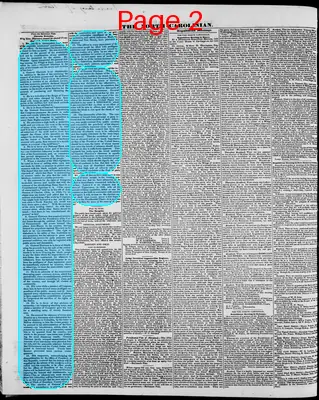
Editorial
March 21, 1840
The North Carolinian
Fayetteville, Cumberland County, North Carolina
What is this article about?
This editorial presents 20 reasons why General Harrison is unfit for the U.S. Presidency, criticizing his incompetence, abolitionist ties, federalist views, support for internal improvements, high tariffs, national bank, debt servitude, slavery abolition by Congress, anti-Masonry, land revenue distribution, paper currency, profligate spending, standing army, diplomatic failures, reliance on advisors, and moral failings, in the context of the 1840 election against Van Buren.
Clipping
OCR Quality
98%
Excellent
Full Text
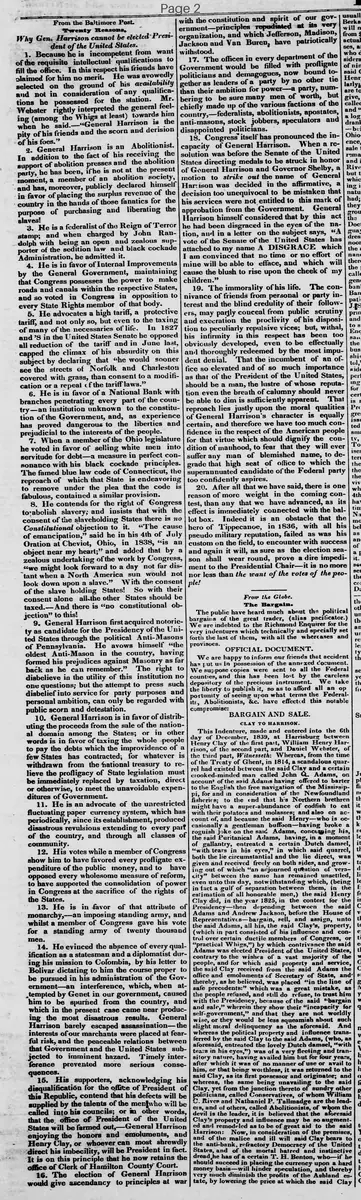
1. Because he is incompetent from want of the requisite intellectual qualifications to fill the office. In this respect his friends have selected him on the ground of his availability and not in consideration of any qualifications he possessed for the station. Mr. Webster rightly interpreted the general feeling (among the Whigs at least) towards him when he said—'General Harrison is the pity of his friends and the scorn and derision of his foes.'
In addition to the fact of his receiving the support of abolition presses and the abolition party, he has been, if he is not at the present moment, a member of an abolition society, and has, moreover, publicly declared himself in favor of placing the surplus revenue of the country in the hands of those fanatics for the purpose of purchasing and liberating the slaves!
2. General Harrison is an Abolitionist.
3. He is a federalist of the Reign of Terror stamp; and when charged by John Randolph with being an open and zealous supporter of the sedition law and black cockade Administration, he admitted it.
4. He is in favor of Internal Improvements by the General Government, maintaining that Congress possesses the power to make roads and canals within the respective States, and so voted in Congress in opposition to every State Rights member of that body.
5. He advocates a high tariff, a protective tariff, and not only so, but even to the taxing of many of the necessaries of life. In 1827 and '28 in the United States Senate he opposed all reduction of the tariff and in June last, capped the climax of his absurdity on this subject by declaring that 'he would sooner see the streets of Norfolk and Charleston covered with grass, than consent to a modification or a repeal of the tariff laws.'
6. He is in favor of a National Bank with branches penetrating every part of the country—an institution unknown to the constitution of the Government, and, as experience has proved dangerous to the liberties and prejudicial to the interests of the people.
7. When a member of the Ohio legislature he voted in favor of selling white men into servitude for debt—a measure in perfect consonance with his black cockade principles. The famed blue law code of Connecticut, the reproach of which that State is endeavoring to remove under the plea that the code is fabulous, contained a similar provision.
8. He contends for the right of Congress to abolish slavery; and insists that with the consent of the slaveholding States there is no Constitutional objection to it. 'The cause of emancipation,' said he in his 4th of July Oration at Cheviot, Ohio, in 1838, 'is an object near my heart;' and added that by a zealous undertaking of the work by Congress, 'we might look forward to a day not far distant when a North America sun would not look down upon a slave.' With the consent of the slave holding States! So with their consent alone all the other States should be taxed.—And there is 'no constitutional objection' to this!
9. General Harrison first acquired notoriety as candidate for the Presidency of the United States through the political Anti-Masons of Pennsylvania. He avows himself 'the oldest Anti-Mason in the country, having formed his prejudices against Masonry as far back as he can remember.' The right to disbelieve in the utility of this institution no one questions; but the attempt to press such disbelief into service for party purposes and personal ambition, can only be regarded with public scorn and detestation.
10. General Harrison is in favor of distributing the proceeds from the sale of the national domain among the States; or in other words is in favor of taxing the whole people to pay the debts which the improvidence of a few States has contracted; for whatever is withdrawn from the national treasury to relieve the profligacy of State legislation must be immediately replaced by taxation, direct or otherwise, to meet the unavoidable expenditures of Government.
11. He is an advocate of the unrestricted fluctuating paper currency system, which has periodically, since its establishment, produced disastrous revulsions extending to every part of the country, and through all classes of community.
12. His votes while a member of Congress show him to have favored every profligate expenditure of the public money, and to have opposed every wholesome measure of reform, to have supported the consolidation of power in Congress at the sacrifice of the rights of the States.
13. He is in favor of that attribute of monarchy,—an imposing standing army, and whilst a member of Congress gave his vote for a standing army of twenty thousand men.
14. He evinced the absence of every qualification as a statesman and a diplomatist during his mission to Colombia, by his letter to Bolivar dictating to him the course proper to be pursued in his administration of the Government—an interference, which, when attempted by Genet in our government, caused him to be spurned from the country, and which in the present case came near producing the most disastrous results. General Harrison barely escaped assassination—the interests of our merchants were placed at fearful risk, and the peaceable relations between that Government and the United States subjected to imminent hazard. Timely interference prevented more serious consequences.
15. His supporters, acknowledging his disqualification for the office of President of this Republic, contend that his defects will be supplied by the talents of the men who will be called into his councils; or in other words, that the office of President of the United States will be farmed out,—General Harrison enjoying the honors and emoluments, and Henry Clay, or whoever can most shrewdly direct his imbecility, will be President in fact. It is on this principle that he now retains the office of Clerk of Hamilton County Court.
16. The election of General Harrison would give ascendancy to principles at war with the constitution and spirit of our government—principles repudiated at its very organization, and which Jefferson, Madison, Jackson and Van Buren, have patriotically withstood. The offices in every department of the Government would be filled with profligate politicians and demagogues, now bound together as leaders of a party by no other tie than their ambition for power—a party, numbering to be sure many men of worth, but chiefly made up of the various factions of the country, federalists, abolitionists, apostates, anti-masons, stock jobbers, speculators and disappointed politicians.
17. Congress itself has pronounced the incapacity of General Harrison. When a resolution was before the Senate of the United States directing medals to be struck in honor of General Harrison and Governor Shelby, a motion to strike out the name of General Harrison was decided in the affirmative, a decision too unequivocal to be mistaken that his services were not entitled to this mark of approbation from the Government. General Harrison himself considered that by this act he had been disgraced in the eyes of the nation, and in a letter on the subject says, 'A vote of the Senate of the United States has attached to my name A DISGRACE which I am convinced that no time or no effort of mine will be able to efface, and which will cause the blush to rise upon the cheek of my children.'
18. The immorality of his life. The connivance of friends from personal or party interest and the blind credulity of their followers, may partly conceal from public scrutiny and execration the proclivity of his disposition to peculiarly repulsive vices; but, withal, his infirmity in this respect has been too obviously developed, even to be effectually and thoroughly redeemed by the most impudent denial. That the incumbent of an office so elevated and of so much importance as that of the President of the United States, should be a man, the lustre of whose reputation even the breath of calumny should never be able to dim is sufficiently apparent. That reproach lies justly upon the moral qualities of General Harrison's character is equally certain, and therefore we have too much confidence in the respect of the American people for that virtue which should dignify the condition of manhood, to fear that they will ever suffer any man of blemished name, to degrade that high seat of office to which the superannuated candidate of the Federal party too confidently aspires.
19. After all that we have said, there is one reason of more weight in the coming contest, than any that we have advanced, as its effect is immediately connected with the ballot box. Indeed it is an obstacle that the hero of Tippecanoe, in 1836, with all his pseudo military reputation, failed—as was his custom on the field, to encounter with success; and again it will, as sure as the election season shall wear round, prove a dire impediment to the Presidential Chair—it is no more nor less than the want of the votes of the people!
20.
In addition to the fact of his receiving the support of abolition presses and the abolition party, he has been, if he is not at the present moment, a member of an abolition society, and has, moreover, publicly declared himself in favor of placing the surplus revenue of the country in the hands of those fanatics for the purpose of purchasing and liberating the slaves!
2. General Harrison is an Abolitionist.
3. He is a federalist of the Reign of Terror stamp; and when charged by John Randolph with being an open and zealous supporter of the sedition law and black cockade Administration, he admitted it.
4. He is in favor of Internal Improvements by the General Government, maintaining that Congress possesses the power to make roads and canals within the respective States, and so voted in Congress in opposition to every State Rights member of that body.
5. He advocates a high tariff, a protective tariff, and not only so, but even to the taxing of many of the necessaries of life. In 1827 and '28 in the United States Senate he opposed all reduction of the tariff and in June last, capped the climax of his absurdity on this subject by declaring that 'he would sooner see the streets of Norfolk and Charleston covered with grass, than consent to a modification or a repeal of the tariff laws.'
6. He is in favor of a National Bank with branches penetrating every part of the country—an institution unknown to the constitution of the Government, and, as experience has proved dangerous to the liberties and prejudicial to the interests of the people.
7. When a member of the Ohio legislature he voted in favor of selling white men into servitude for debt—a measure in perfect consonance with his black cockade principles. The famed blue law code of Connecticut, the reproach of which that State is endeavoring to remove under the plea that the code is fabulous, contained a similar provision.
8. He contends for the right of Congress to abolish slavery; and insists that with the consent of the slaveholding States there is no Constitutional objection to it. 'The cause of emancipation,' said he in his 4th of July Oration at Cheviot, Ohio, in 1838, 'is an object near my heart;' and added that by a zealous undertaking of the work by Congress, 'we might look forward to a day not far distant when a North America sun would not look down upon a slave.' With the consent of the slave holding States! So with their consent alone all the other States should be taxed.—And there is 'no constitutional objection' to this!
9. General Harrison first acquired notoriety as candidate for the Presidency of the United States through the political Anti-Masons of Pennsylvania. He avows himself 'the oldest Anti-Mason in the country, having formed his prejudices against Masonry as far back as he can remember.' The right to disbelieve in the utility of this institution no one questions; but the attempt to press such disbelief into service for party purposes and personal ambition, can only be regarded with public scorn and detestation.
10. General Harrison is in favor of distributing the proceeds from the sale of the national domain among the States; or in other words is in favor of taxing the whole people to pay the debts which the improvidence of a few States has contracted; for whatever is withdrawn from the national treasury to relieve the profligacy of State legislation must be immediately replaced by taxation, direct or otherwise, to meet the unavoidable expenditures of Government.
11. He is an advocate of the unrestricted fluctuating paper currency system, which has periodically, since its establishment, produced disastrous revulsions extending to every part of the country, and through all classes of community.
12. His votes while a member of Congress show him to have favored every profligate expenditure of the public money, and to have opposed every wholesome measure of reform, to have supported the consolidation of power in Congress at the sacrifice of the rights of the States.
13. He is in favor of that attribute of monarchy,—an imposing standing army, and whilst a member of Congress gave his vote for a standing army of twenty thousand men.
14. He evinced the absence of every qualification as a statesman and a diplomatist during his mission to Colombia, by his letter to Bolivar dictating to him the course proper to be pursued in his administration of the Government—an interference, which, when attempted by Genet in our government, caused him to be spurned from the country, and which in the present case came near producing the most disastrous results. General Harrison barely escaped assassination—the interests of our merchants were placed at fearful risk, and the peaceable relations between that Government and the United States subjected to imminent hazard. Timely interference prevented more serious consequences.
15. His supporters, acknowledging his disqualification for the office of President of this Republic, contend that his defects will be supplied by the talents of the men who will be called into his councils; or in other words, that the office of President of the United States will be farmed out,—General Harrison enjoying the honors and emoluments, and Henry Clay, or whoever can most shrewdly direct his imbecility, will be President in fact. It is on this principle that he now retains the office of Clerk of Hamilton County Court.
16. The election of General Harrison would give ascendancy to principles at war with the constitution and spirit of our government—principles repudiated at its very organization, and which Jefferson, Madison, Jackson and Van Buren, have patriotically withstood. The offices in every department of the Government would be filled with profligate politicians and demagogues, now bound together as leaders of a party by no other tie than their ambition for power—a party, numbering to be sure many men of worth, but chiefly made up of the various factions of the country, federalists, abolitionists, apostates, anti-masons, stock jobbers, speculators and disappointed politicians.
17. Congress itself has pronounced the incapacity of General Harrison. When a resolution was before the Senate of the United States directing medals to be struck in honor of General Harrison and Governor Shelby, a motion to strike out the name of General Harrison was decided in the affirmative, a decision too unequivocal to be mistaken that his services were not entitled to this mark of approbation from the Government. General Harrison himself considered that by this act he had been disgraced in the eyes of the nation, and in a letter on the subject says, 'A vote of the Senate of the United States has attached to my name A DISGRACE which I am convinced that no time or no effort of mine will be able to efface, and which will cause the blush to rise upon the cheek of my children.'
18. The immorality of his life. The connivance of friends from personal or party interest and the blind credulity of their followers, may partly conceal from public scrutiny and execration the proclivity of his disposition to peculiarly repulsive vices; but, withal, his infirmity in this respect has been too obviously developed, even to be effectually and thoroughly redeemed by the most impudent denial. That the incumbent of an office so elevated and of so much importance as that of the President of the United States, should be a man, the lustre of whose reputation even the breath of calumny should never be able to dim is sufficiently apparent. That reproach lies justly upon the moral qualities of General Harrison's character is equally certain, and therefore we have too much confidence in the respect of the American people for that virtue which should dignify the condition of manhood, to fear that they will ever suffer any man of blemished name, to degrade that high seat of office to which the superannuated candidate of the Federal party too confidently aspires.
19. After all that we have said, there is one reason of more weight in the coming contest, than any that we have advanced, as its effect is immediately connected with the ballot box. Indeed it is an obstacle that the hero of Tippecanoe, in 1836, with all his pseudo military reputation, failed—as was his custom on the field, to encounter with success; and again it will, as sure as the election season shall wear round, prove a dire impediment to the Presidential Chair—it is no more nor less than the want of the votes of the people!
20.
What sub-type of article is it?
Partisan Politics
Economic Policy
Slavery Abolition
What keywords are associated?
Anti Harrison
Presidential Election
Whig Candidate
Abolitionism
Federalism
Tariff Policy
National Bank
Internal Improvements
Standing Army
Moral Character
What entities or persons were involved?
General Harrison
Mr. Webster
John Randolph
Henry Clay
Jefferson
Madison
Jackson
Van Buren
Bolivar
Governor Shelby
Editorial Details
Primary Topic
Reasons Against Electing General Harrison To The Presidency
Stance / Tone
Strongly Anti Harrison And Pro Democratic Principles
Key Figures
General Harrison
Mr. Webster
John Randolph
Henry Clay
Jefferson
Madison
Jackson
Van Buren
Bolivar
Governor Shelby
Key Arguments
Incompetent Due To Lack Of Intellectual Qualifications
Supported By Abolitionists And Is An Abolitionist Himself
Federalist Supporter Of Sedition Laws
Favors Federal Internal Improvements
Advocates High Protective Tariff
Supports National Bank
Voted For Debt Servitude
Believes Congress Can Abolish Slavery With State Consent
Anti Mason For Political Gain
Favors Distributing Land Revenues To States
Advocates Fluctuating Paper Currency
Favored Profligate Spending And Power Consolidation
Supports Standing Army
Diplomatic Blunder In Colombia
Would Be Puppet President Controlled By Others
Election Would Promote Anti Constitutional Principles
Disgraced By Senate Vote On Medals
Immoral Personal Life
Lacks Popular Votes