Thank you for visiting SNEWPapers!
Sign up free
The Hawaiian Gazette
Honolulu, Honolulu County, Hawaii
What is this article about?
In Honolulu, stakeholders revive the Hawaiian Agricultural Society to promote small farming amid dominant cane growing. Key figures like President Dole and Allan Herbert discuss by-laws, birds' roles, girls' industrial education, colony progress, forest conservation, water management, and experiment stations. (248 characters)
Clipping
OCR Quality
Full Text
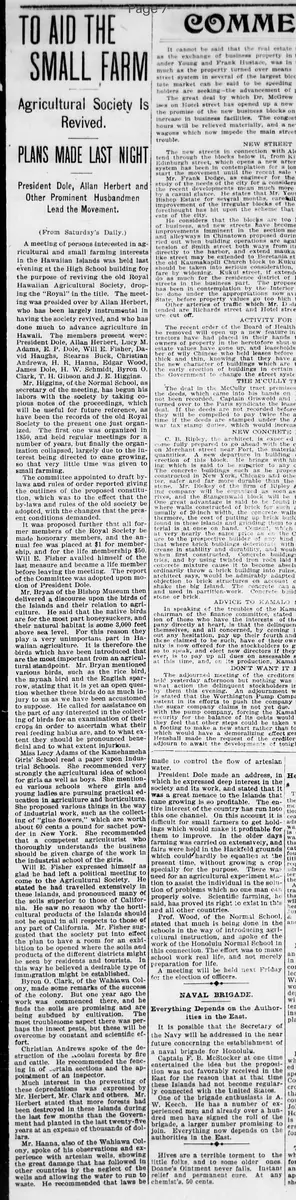
Agricultural Society Is Revived.
PLANS MADE LAST NIGHT
President Dole, Allan Herbert and Other Prominent Husbandmen Lead the Movement.
(From Saturday's Daily.)
A meeting of persons interested in agricultural and small farming interests in the Hawaiian Islands was held last evening at the High School building for the purpose of reviving the old Royal Hawaiian Agricultural Society, dropping the "Royal" in the title. The meeting was presided over by Allan Herbert, who has been largely instrumental in having the society revived, and who has done much to advance agriculture in Hawaii. The members present were:
President Dole, Allan Herbert, Lucy M. Adams, E. P. Dole, Will E. Fisher, David Haughs, Stearns Buck, Christian Andrews, H. R. Hanna, Edgar Wood, James Dole, H. W. Schmidt, Byron O. Clark, T. H. Gibson and J. E. Higgins.
Mr. Higgins, of the Normal School, as secretary of the meeting, has begun his labors with the society by taking copious notes of the proceedings, which will be useful for future reference, as have been the records of the old Royal Society to the present one just organized. The first one was organized in 1850, and held regular meetings for a number of years, but finally the organization collapsed, largely due to the interest being directed to cane growing, so that very little time was given to small farming.
The committee appointed to draft by-laws and rules of order reported giving the outlines of the proposed constitution, which was to the effect that the by-laws and rules of the old society be adopted, with the changes that the present conditions demanded.
It was proposed further that all former members of the Royal Society be made honorary members, and the annual fee was placed at $1 for membership, and for the life membership $50.
Will E. Fisher availed himself of the last measure and became a life member before leaving the meeting. The report of the Committee was adopted upon motion of President Dole.
Mr. Bryan of the Bishop Museum then delivered a discourse upon the birds of the Islands and their relation to agriculture. He said that the native birds are for the most part honeysuckers, and their natural habitat is some 3,000 feet above sea level. For this reason they play a very unimportant part in Hawaiian agriculture. It is therefore the birds which have been introduced that are the most important from an agricultural standpoint. Mr. Bryan mentioned various birds, such as the rice bird, the mynah bird and the English sparrow, stating that it is yet an open question whether these birds do as much injury to us as we have been accustomed to suppose. He called for assistance on the part of any interested in the collecting of birds for an examination of their crops in order to ascertain what their real feeding habits are, and to what extent they should be pronounced beneficial and to what extent injurious.
Miss Lucy Adams of the Kamehameha Girls' School read a paper upon Industrial Schools. She recommended very strongly the agricultural idea of school for girls as well as boys. She mentioned various schools where girls and young ladies are pursuing practical education in agriculture and horticulture.
She proposed various things in the way of industrial work, such as the collecting of "glue flowers," which are worth about 60 cents a pound for sachet powder in New York. She recommended that a competent agriculturist who thoroughly understands the business should be given charge of the work in the industrial school of the girls.
Will E. Fisher expressed himself as glad he had left a political meeting to come to the Agricultural Society. He stated he had travelled extensively in these Islands, and pronounced many of the soils superior to those of California. He saw no reason why the horticultural products of the Islands should not be equal in all respects to those of any part of California. Mr. Fisher suggested that the society put into effect the plan to have a room for an exhibition to be opened where the soils and products of the different districts might be seen by residents and tourists. In this way he believed a desirable type of immigration might be established.
Byron O. Clark, of the Wahiawa Colony, made some remarks of the success of the colony. But one year ago the work was commenced there, and he finds the soils are promising and are being subdued by cultivation. The most troublesome aspect there was perhaps the insect pests, but these will be overcome by constant and scientific effort.
Christian Andrews spoke of the destruction of the Oolau forests by fire and cattle. He recommended the fencing in of certain sections and the appointment of an inspector.
Much interest in the preventing of these depredations was expressed by Mr. Herbert, Mr. Clark and others. Mr. Herbert stated that more forests had been destroyed in these Islands during the last few months than the Government had planted in the last twenty-five years at an expense of thousands of dollars.
Mr. Hanna, also of the Wahiawa Colony, spoke of his observations and experience with artesian wells, showing the great damage that has followed in other countries by the neglect of the wells and allowing the water to run to waste. He recommended that laws be made to control the flow of artesian water.
President Dole made an address, in which he expressed deep interest in the society and its work, and stated that it was a great menace to the Islands that cane growing is so profitable. The entire interest of the country has run into this one channel.
On this account it is difficult for small farmers to get holdings which would make it profitable for them to improve.
In the older days farming was carried on extensively, and fairs were held in the Hackfeld grounds which could hardly be equalled at the present time, without growing a crop specially for the purpose.
There was need for an agricultural experiment station to assist the individual in the solution of problems which no one man can properly solve. Scientific farming, he said, has proved its right to exist in this and all other countries.
Prof. Wood, of the Normal School, stated that much is being done in the schools in the way of introducing agricultural instruction, and spoke of the work of the Honolulu Normal School in this connection. The effort was to make school work real life, and not merely preparation for life.
A meeting will be held next Friday for the election of officers.
What sub-type of article is it?
What themes does it cover?
What keywords are associated?
What entities or persons were involved?
Where did it happen?
Story Details
Key Persons
Location
Hawaiian Islands, Honolulu
Event Date
Last Evening (From Saturday's Daily)
Story Details
Meeting at High School building to revive the Hawaiian Agricultural Society, dropping 'Royal'. Adoption of old by-laws with updates, honorary members, fees set. Speeches on birds' agricultural impact, industrial education for girls, Wahiawa Colony success, Oolau forest protection, artesian wells management, and need for small farming support and experiment station. Next meeting for officer election.