Thank you for visiting SNEWPapers!
Sign up free
The Bossier Banner
Benton, Bellevue, Bossier County, Louisiana
What is this article about?
Letter from Mankato, Minnesota, describes the severe impact of the locust plague on western settlers, including a former professor's family in Cottonwood County facing hardship and debt, yet remaining hopeful; highlights use of hay for fuel and incoming state relief aid.
Clipping
OCR Quality
Full Text
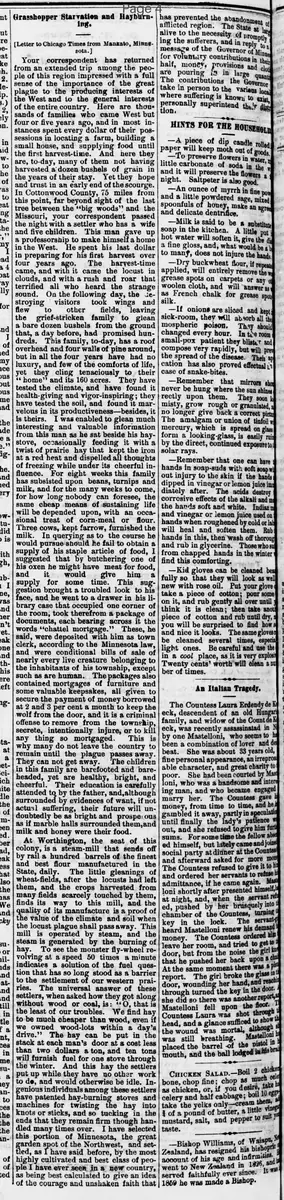
[Letter to Chicago Times from Mankato, Minnesota.]
Your correspondent has returned from an extended trip among the people of this region impressed with a full sense of the importance of the great plague to the producing interests of the West and to the general interests of the entire country. Here are thousands of families who came West but four or five years ago, and in most instances spent every dollar of their possessions in locating a farm, building a small house, and supplying food until the first harvest-time. And here they are, to-day, many of them not having harvested a dozen bushels of grain in the years of their stay. Yet they hope and trust in an early end of the scourge.
In Cottonwood County, 75 miles from this point, far beyond sight of the last tree between the "big woods" and the Missouri, your correspondent passed the night with a settler who has a wife and five children. This man gave up a professorship to make himself a home in the West. He spent his last dollar in preparing for his first harvest over four years ago. The harvest-time came, and with it came the locust in clouds, and with a rush and roar that terrified all who heard the strange sound. On the following day, the destroying visitors took wings and flew to other fields, leaving the grief-stricken family to glean a bare dozen bushels from the ground that, a day before, had promised hundreds. This family, to-day, has a roof overhead and four walls of pine around, but in all the four years have had no luxury, and few of the comforts of life, yet they cling tenaciously to their "home" and its 160 acres. They have tested the climate, and have found it health-giving and vigor-inspiring; they have tested the soil, and found it marvelous in its productiveness—besides, it is theirs. I was enabled to glean much interesting and valuable information from this man as he sat beside his hay-stove, occasionally feeding it with a twist of prairie hay that kept the iron at a red heat and dispelled all thoughts of freezing while under its cheerful influence. For eight weeks this family has subsisted upon beans, turnips and milk, and for the many weeks to come, for how long nobody can foresee, the same cheap means of sustaining life will be depended upon, with an occasional treat of corn-meal or flour. Three cows, kept farrow, furnished the milk. In querying as to the course he would pursue should he fail to obtain a supply of his staple article of food, I suggested that by butchering one of his oxen he might have meat for food, and it would give him a supply for some time. This suggestion brought a troubled look to his face, and he went to a drawer in his library case that occupied one corner of the room, took therefrom a package of documents, each bearing across it the words "chattel mortgage." These, he said, were deposited with him as town clerk, according to the Minnesota law, and were conditional bills of sale of nearly every live creature belonging to the inhabitants of his township, except such as are human. The packages also contained mortgages of furniture and some valuable keepsakes, all given to secure the payment of money borrowed at 2 and 3 per cent a month to keep the wolf from the door, and it is a criminal offense to remove from the township, secrete, intentionally injure, or to kill any thing so mortgaged. This is why many do not leave the country to remain until the plague passes away. They can not get away. The children in this family are barefooted and bare-headed, yet are healthy, bright, and cheerful. Their education is carefully attended to by the father, and, although surrounded by evidences of want, if not actual suffering, their future will undoubtedly be as bright and prosperous as if marble halls surrounded them, and milk and honey were their food.
At Worthington, the seat of this colony, is a steam-mill that sends off by rail a hundred barrels of the finest and best flour manufactured in the State, daily. The little gleanings of wheat-fields, after the locusts had left them, and the crops harvested from many fields scarcely touched by them, finds its way to this mill, and the quality of its manufacture is a proof of the value of the climate and soil when the locust plague shall pass away. This mill is operated by steam, and the steam is generated by the burning of hay. To see the monster fly-wheel revolving at a speed 50 times a minute indicates a solution of the fuel question that has so long stood as a barrier to the settlement of our western prairies. The universal answer of these settlers, when asked how they got along without wood or coal, is: "O, that is the least of our troubles. We find hay to be much cheaper than wood, even if we owned wood-lots within a day's drive." The hay can be put in the stack at each man's door at a cost less than two dollars a ton, and ten tons will furnish fuel for one stove through the winter. And this hay the settlers put up while they have no other work to do, and would otherwise be idle. Ingenious individuals among these settlers have patented hay-burning stoves and machines for twisting the hay into knots or sticks, and so tucking in the ends that they remain firm though handled many times over. I have selected this portion of Minnesota, the great garden spot of the Northwest, and settled, as I have said before, by the most highly cultivated and best class of people I have ever seen in a new country, as being best calculated to give an idea of the courage and unshaken faith that has prevented the abandonment of afflicted region. The State at last is alive to the necessity of promptly relieving the sufferers, and in reply to a message of the Governor of Minnesota for voluntary contributions in their behalf, money, provisions and clothing are pouring in in large quantities. The contributions the Governor will take in person to the various locations where suffering is known to exist, and personally superintend their distribution.
What sub-type of article is it?
What keywords are associated?
What entities or persons were involved?
Where did it happen?
Domestic News Details
Primary Location
Mankato, Minnesota
Key Persons
Outcome
families facing starvation, debt through chattel mortgages, subsistence on beans, turnips, milk; state relief of money, provisions, clothing arriving for distribution.
Event Details
Correspondent reports on locust plague devastating crops of recent western settlers in Minnesota, particularly in Cottonwood County; details a former professor's family's struggles, use of hay for fuel and food, widespread mortgages preventing departure; notes productive soil and climate, ongoing mill operations, and governor-led relief efforts.