Thank you for visiting SNEWPapers!
Sign up free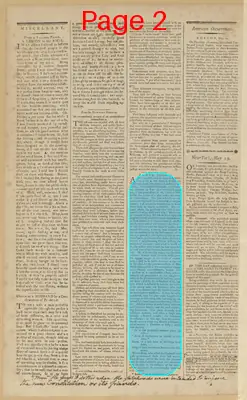
The New York Journal, And Daily Patriotic Register
New York, New York County, New York
What is this article about?
On February 25 in Paris, a new five-act verse comedy titled L'Optimiste, or L'Homme Content de Tout by M. Collin d'Harleville premiered at the French theatre to universal applause. The plot involves an optimistic man's misfortunes resolved happily, ending in marriage.
Clipping
OCR Quality
Full Text
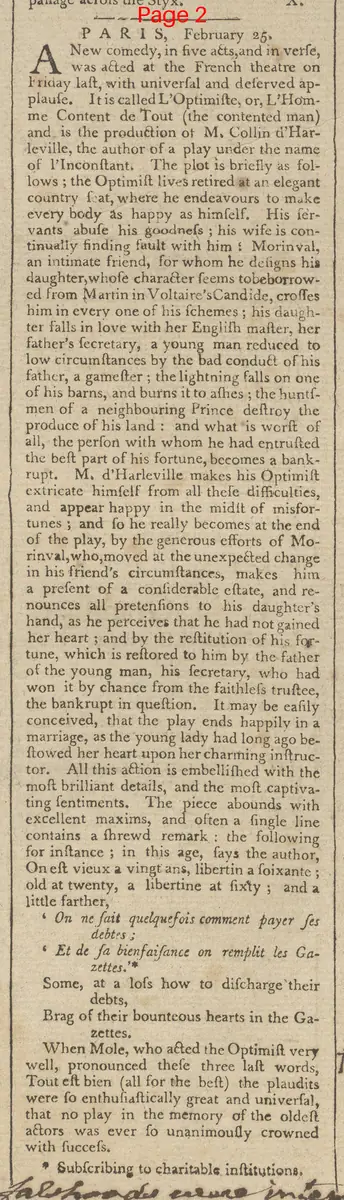
New comedy, in five acts, and in verse, was acted at the French theatre on friday last, with universal and deserved applause. It is called L'Optimiste, or, L'Homme Content de Tout (the contented man) and is the production of M. Collin d'Harleville, the author of a play under the name of l'Inconstant. The plot is briefly as follows; the Optimist lives retired at an elegant country seat, where he endeavours to make every body as happy as himself. His servants abuse his goodness; his wife is continually finding fault with him: Morinval, an intimate friend, for whom he destines his daughter, whose character seems to be borrowed from Martin in Voltaire's Candide, crosses him in every one of his schemes; his daughter falls in love with her English master, her father's secretary, a young man reduced to low circumstances by the bad conduct of his father, a gambler; the lightning falls on one of his barns, and burns it to ashes: the huntsmen of a neighbouring Prince destroy the produce of his land: and what is worst of all, the person with whom he had entrusted the best part of his fortune, becomes a bankrupt. M. d'Harleville makes his Optimist extricate himself from all these difficulties, and appear happy in the midst of misfortunes; and so he really becomes at the end of the play, by the generous efforts of Morinval, who, moved at the unexpected change in his friend's circumstances, makes him a present of a considerable estate, and renounces all pretensions to his daughter's hand, as he perceives that he had not gained her heart; and by the restitution of his fortune, which is restored to him by the father of the young man, his secretary, who had won it by chance from the faithless trustee, the bankrupt in question. It may be easily conceived, that the play ends happily in a marriage, as the young lady had long ago bestowed her heart upon her charming instructor. All this action is embellished with the most brilliant details, and the most captivating sentiments. The piece abounds with excellent maxims, and often a single line contains a shrewd remark: the following for instance; in this age, says the author, On est vieux a vingt ans, libertin a soixante; old at twenty, a libertine at sixty; and a little farther, On ne sait quelquefois comment payer ses debtes; Some, at a loss how to discharge their debts, Et de bienfaisance on remplit les Gazettes. Brag of their bounteous hearts in the Gazettes. When Mole, who acted the Optimist very well, pronounced these three last words, Tout est bien (all for the best) the plaudits were so enthusiastically great and universal, that no play in the memory of the oldest actors was ever so unanimously crowned with success.
What sub-type of article is it?
What keywords are associated?
What entities or persons were involved?
Where did it happen?
Foreign News Details
Primary Location
Paris
Event Date
February 25
Key Persons
Outcome
the play received universal and deserved applause, with enthusiastic plaudits; it ended happily in marriage and was unanimously crowned with success.
Event Details
A new comedy in five acts and verse titled L'Optimiste, or L'Homme Content de Tout by M. Collin d'Harleville was acted at the French theatre on Friday last. The plot follows an optimist facing abuses from servants, faults from his wife, schemes crossed by friend Morinval, daughter's love for her English master (father's secretary from a gambler's family), barn burned by lightning, land destroyed by prince's huntsmen, and fortune lost to bankrupt trustee. He extricates himself, becoming truly happy through Morinval's gift of estate and renunciation of daughter's hand, and restitution of fortune by the secretary's father who won it back. The play abounds in brilliant details, captivating sentiments, excellent maxims, and shrewd remarks. Mole acted the Optimist well.