Thank you for visiting SNEWPapers!
Sign up free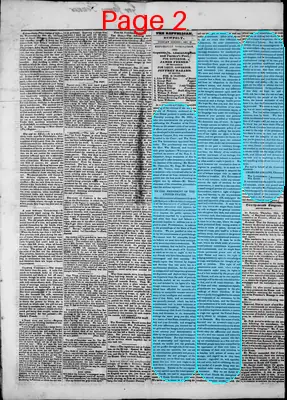
Editorial
December 25, 1832
The Rhode Island Republican
Newport, Newport County, Rhode Island
What is this article about?
On December 20, 1832, citizens of Newport, Rhode Island, convened to support President Jackson's proclamation against South Carolina's tariff nullification. They adopted an address expressing gratitude, condemning secessionist actions, offering aid to preserve the Union, and praying for peaceful resolution without civil war.
Clipping
OCR Quality
95%
Excellent
Full Text
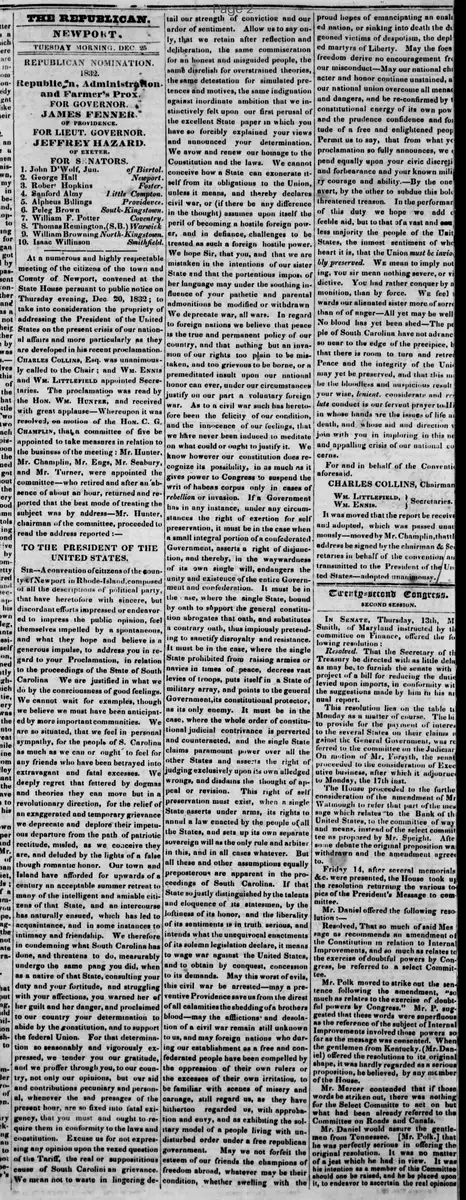
At a numerous and highly respectable meeting of the citizens of the town and County of Newport, convened at the State House pursuant to public notice on Thursday evening, Dec. 20, 1832; to take into consideration the propriety of addressing the President of the United States on the present crisis of our national affairs and more particularly as they are developed in his recent proclamation. Charles Collins, Esq. was unanimously called to the Chair; and WM. Ennis and WM. LITTLEFIELD appointed Secretaries. The proclamation was read by the Hon. WM. Hunter, and received with great applause—Whereupon it was resolved, on motion of the Hon. C. G. CHAMPLIN, that a committee of five be appointed to take measures in relation to the business of the meeting: Mr. Hunter, Mr. Champlin, Mr. Engs, Mr. Seabury, and Mr. Turner, were appointed the committee—who retired and after an absence of about an hour, returned and reported that the best mode of treating the subject was by address—Mr. Hunter, chairman of the committee, proceeded to read the address reported :—
TO THE PRESIDENT OF THE UNITED STATES.
SIR—A convention of citizens of the county of Newport in Rhode-Island, composed of all the descriptions of political party, that have heretofore with sincere, but discordant efforts impressed or endeavored to impress the public opinion, feel themselves impelled by a spontaneous, and what they hope and believe is a generous impulse, to address you in regard to your Proclamation, in relation to the proceedings of the State of South Carolina We are justified in what we do by the consciousness of good feelings. We cannot wait for examples, though we believe we must have been anticipated by more important communities. We are so situated, that. we feel in personal sympathy, for the people of S. Carolina as much as we can or ought to feel for any friends who have been betrayed into extravagant and fatal excesses. We deeply regret that fettered by dogmas and theories they can move but in a revolutionary direction, for the relief of an exaggerated and temporary grievance we deprecate and deplore their impetuous departure from the path of patriotic rectitude, misled, as we, conceive they are, and deluded by the lights of a false though romantic honor. Our town and Island have afforded for upwards of a century an acceptable summer retreat to many of the intelligent and amiable citizens of that State, and an intercourse has naturally ensued, which has led to acquaintance, and in some instances to intimacy and friendship. We therefore in condemning what South Carolina has done, and threatens to do, measurably undergo the same pang you did, when as a native of that State, consulting your duty and your fortitude, and struggling with your affections, you warned her of her guilt and her danger, and proclaimed to our country your determination to abide by the constitution, and to support the federal Union. For that determination so seasonably and vigorously expressed, we tender you our gratitude, and we proffer through you, to our country, not only our opinions, but our aid and contributions pecuniary and personal, whenever the sad presages of the present hour, are so fixed into fatal exigency, that you must and ought to require them in conformity to the laws and constitution. Excuse us for not expressing any opinion upon the vexed question of the Tariff, the real or supposititious cause of South Carolina grievance. We mean not to waste in lingering debate our strength of conviction and our ardor of sentiment. Allow us to say only, that we retain after reflection and deliberation, the same commiseration for an honest and misguided people, the same disrelish for overstrained theories, the same detestation of simulated pretences and motives, the same indignation against inordinate ambition that we instinctively felt upon our first perusal of the excellent State paper in which you have so forcibly explained your views and announced your determination. We avow and renew our homage to the Constitution and the laws. We cannot conceive how a State can exonerate itself from its obligations to the Union, unless it means, and thereby declares civil war, or (if there be any difference in the thought) assumes upon itself the peril of becoming a hostile foreign power, and in defiance, challenges to be treated as such a foreign hostile power. We hope Sir, that you, and that we are mistaken in the intentions of our sister State and that the portentous import of her language may under the soothing influence of your pathetic and parental admonitions be modified or withdrawn We deprecate war, all wars. In regard to foreign nations we believe that peace is the true and permanent policy of our country, and that nothing but an invasion of our rights too plain to be mistaken, and too grievous to be borne, or a premeditated insult upon our national honor can ever, under our circumstances justify on our part a voluntary foreign war. As to a civil war such has heretofore been the felicity of our condition, and the innocence of our feelings, that we have never been induced to meditate on what could or ought to justify it. We know however our constitution does recognize its possibility, in as much as it gives power to Congress to suspend the writ of habeas corpus only in cases of rebellion or invasion. If a Government has in any instance, under any circumstances the right of exertion for self preservation, it must be in the case when a small integral portion of a confederated Government, asserts a right of disjunction, and thereby, in the waywardness of its own single will, endangers the unity and existence of the entire Government and confederation. It must be in the case, where the single State, bound by oath to support the general constitution abrogates that oath, and substitutes a contrary oath, thus impiously pretending to sanctify disloyalty and resistance. It must be in the case, where the single State prohibited from raising armies or navies in times of peace, decrees vast levies of troops, puts itself in a State of military array, and points to the general Government, its constitutional protector, as its only enemy. It must be in the case, where the whole order of constitutional judicial contrivance is perverted and counteracted, and the single State claims paramount power over all the other States and asserts the right of judging exclusively upon its own alleged wrongs, and disdains the thought of appeal or revision. This right of self preservation must exist, when a single State asserts under arms, its rights to annul a law enacted by the people of all the States, and sets up its own separate sovereign will as the only rule and arbiter in this, and in all cases whatever. But all these and other assumptions equally preposterous are apparent in the proceedings of South Carolina. If that State so justly distinguished by the talents and eloquence of its statesmen, by the loftiness of its honor, and the liberality of its sentiments is in truth serious, and intends what the unequivocal enactments of its solemn legislation declare, it means to wage war against the United States, and to obtain by conquest, concession to its demands. May this worst of evils, this civil war be arrested—may a preventive Providence save us from the direst of all calamities the shedding of a brother's blood—may the afflictions and desolation of a civil war remain still unknown to us, and may foreign nations who during our establishment as a free and confederated people have been compelled by the oppression of their own rulers or the excesses of their own irritation, to be familiar with scenes of misery and carnage, still regard us, as they have hitherto regarded us, with approbation and envy, and as exhibiting the solitary model of a people living with undisturbed order under a free republican government. May we not forfeit the esteem of our friends the champions of freedom abroad, whatever may be their condition, whether swelling with the proud hopes of emancipating an enslaved nation, or sinking into death the dungeoned victims of despotism, the deplored martyrs of Liberty. May the foes of freedom derive no encouragement from our misconduct—May our national character and honor continue unstained, until our national union overcome all menaces and dangers, and be re-confirmed by constitutional energy of its own power and the prudence confidence and fortitude of a free and enlightened people Permit us to say, that from what your proclamation so fully announces, we depend equally upon your civic discretion and forbearance and your known military courage and ability.—By the one avert, by the other to subdue this bold threatened treason. In the performance of this duty we hope we add feeble aid, but to that of a vast and conscious majority the people of the United States, the inmost sentiment of whose heart it is, that the Union must be inviolably preserved. We mean to imply nothing, you sir mean nothing severe, or vindictive. You had rather conquer by admonition, than by force. We see towards our alienated sister more of sorrow than of anger—All yet may be well No blood has yet been shed—The people of South Carolina have not advanced so near to the edge of the precipice, but that there is room to turn and retreat Peace and the integrity of the Union may yet be preserved, and that this may be the bloodless and auspicious result of your wise, lenient, considerate and resolute conduct is our fervent prayer to Him in whose hands are the issues of life and death, and whose aid and direction you join with you in imploring in this new and appalling crisis of our national concerns.
For and in behalf of the Convention aforesaid.
CHARLES COLLINS, Chairman
Wm. LITTLEFIELD,
Wm. Ennis.
Secretaries.
It was moved that the report be received and adopted, which was passed unanimously—moved by Mr. Champlin, that the address be signed by the chairman & Secretaries in behalf of the convention/ and transmitted to the President of the United States—adopted unanimously.
TO THE PRESIDENT OF THE UNITED STATES.
SIR—A convention of citizens of the county of Newport in Rhode-Island, composed of all the descriptions of political party, that have heretofore with sincere, but discordant efforts impressed or endeavored to impress the public opinion, feel themselves impelled by a spontaneous, and what they hope and believe is a generous impulse, to address you in regard to your Proclamation, in relation to the proceedings of the State of South Carolina We are justified in what we do by the consciousness of good feelings. We cannot wait for examples, though we believe we must have been anticipated by more important communities. We are so situated, that. we feel in personal sympathy, for the people of S. Carolina as much as we can or ought to feel for any friends who have been betrayed into extravagant and fatal excesses. We deeply regret that fettered by dogmas and theories they can move but in a revolutionary direction, for the relief of an exaggerated and temporary grievance we deprecate and deplore their impetuous departure from the path of patriotic rectitude, misled, as we, conceive they are, and deluded by the lights of a false though romantic honor. Our town and Island have afforded for upwards of a century an acceptable summer retreat to many of the intelligent and amiable citizens of that State, and an intercourse has naturally ensued, which has led to acquaintance, and in some instances to intimacy and friendship. We therefore in condemning what South Carolina has done, and threatens to do, measurably undergo the same pang you did, when as a native of that State, consulting your duty and your fortitude, and struggling with your affections, you warned her of her guilt and her danger, and proclaimed to our country your determination to abide by the constitution, and to support the federal Union. For that determination so seasonably and vigorously expressed, we tender you our gratitude, and we proffer through you, to our country, not only our opinions, but our aid and contributions pecuniary and personal, whenever the sad presages of the present hour, are so fixed into fatal exigency, that you must and ought to require them in conformity to the laws and constitution. Excuse us for not expressing any opinion upon the vexed question of the Tariff, the real or supposititious cause of South Carolina grievance. We mean not to waste in lingering debate our strength of conviction and our ardor of sentiment. Allow us to say only, that we retain after reflection and deliberation, the same commiseration for an honest and misguided people, the same disrelish for overstrained theories, the same detestation of simulated pretences and motives, the same indignation against inordinate ambition that we instinctively felt upon our first perusal of the excellent State paper in which you have so forcibly explained your views and announced your determination. We avow and renew our homage to the Constitution and the laws. We cannot conceive how a State can exonerate itself from its obligations to the Union, unless it means, and thereby declares civil war, or (if there be any difference in the thought) assumes upon itself the peril of becoming a hostile foreign power, and in defiance, challenges to be treated as such a foreign hostile power. We hope Sir, that you, and that we are mistaken in the intentions of our sister State and that the portentous import of her language may under the soothing influence of your pathetic and parental admonitions be modified or withdrawn We deprecate war, all wars. In regard to foreign nations we believe that peace is the true and permanent policy of our country, and that nothing but an invasion of our rights too plain to be mistaken, and too grievous to be borne, or a premeditated insult upon our national honor can ever, under our circumstances justify on our part a voluntary foreign war. As to a civil war such has heretofore been the felicity of our condition, and the innocence of our feelings, that we have never been induced to meditate on what could or ought to justify it. We know however our constitution does recognize its possibility, in as much as it gives power to Congress to suspend the writ of habeas corpus only in cases of rebellion or invasion. If a Government has in any instance, under any circumstances the right of exertion for self preservation, it must be in the case when a small integral portion of a confederated Government, asserts a right of disjunction, and thereby, in the waywardness of its own single will, endangers the unity and existence of the entire Government and confederation. It must be in the case, where the single State, bound by oath to support the general constitution abrogates that oath, and substitutes a contrary oath, thus impiously pretending to sanctify disloyalty and resistance. It must be in the case, where the single State prohibited from raising armies or navies in times of peace, decrees vast levies of troops, puts itself in a State of military array, and points to the general Government, its constitutional protector, as its only enemy. It must be in the case, where the whole order of constitutional judicial contrivance is perverted and counteracted, and the single State claims paramount power over all the other States and asserts the right of judging exclusively upon its own alleged wrongs, and disdains the thought of appeal or revision. This right of self preservation must exist, when a single State asserts under arms, its rights to annul a law enacted by the people of all the States, and sets up its own separate sovereign will as the only rule and arbiter in this, and in all cases whatever. But all these and other assumptions equally preposterous are apparent in the proceedings of South Carolina. If that State so justly distinguished by the talents and eloquence of its statesmen, by the loftiness of its honor, and the liberality of its sentiments is in truth serious, and intends what the unequivocal enactments of its solemn legislation declare, it means to wage war against the United States, and to obtain by conquest, concession to its demands. May this worst of evils, this civil war be arrested—may a preventive Providence save us from the direst of all calamities the shedding of a brother's blood—may the afflictions and desolation of a civil war remain still unknown to us, and may foreign nations who during our establishment as a free and confederated people have been compelled by the oppression of their own rulers or the excesses of their own irritation, to be familiar with scenes of misery and carnage, still regard us, as they have hitherto regarded us, with approbation and envy, and as exhibiting the solitary model of a people living with undisturbed order under a free republican government. May we not forfeit the esteem of our friends the champions of freedom abroad, whatever may be their condition, whether swelling with the proud hopes of emancipating an enslaved nation, or sinking into death the dungeoned victims of despotism, the deplored martyrs of Liberty. May the foes of freedom derive no encouragement from our misconduct—May our national character and honor continue unstained, until our national union overcome all menaces and dangers, and be re-confirmed by constitutional energy of its own power and the prudence confidence and fortitude of a free and enlightened people Permit us to say, that from what your proclamation so fully announces, we depend equally upon your civic discretion and forbearance and your known military courage and ability.—By the one avert, by the other to subdue this bold threatened treason. In the performance of this duty we hope we add feeble aid, but to that of a vast and conscious majority the people of the United States, the inmost sentiment of whose heart it is, that the Union must be inviolably preserved. We mean to imply nothing, you sir mean nothing severe, or vindictive. You had rather conquer by admonition, than by force. We see towards our alienated sister more of sorrow than of anger—All yet may be well No blood has yet been shed—The people of South Carolina have not advanced so near to the edge of the precipice, but that there is room to turn and retreat Peace and the integrity of the Union may yet be preserved, and that this may be the bloodless and auspicious result of your wise, lenient, considerate and resolute conduct is our fervent prayer to Him in whose hands are the issues of life and death, and whose aid and direction you join with you in imploring in this new and appalling crisis of our national concerns.
For and in behalf of the Convention aforesaid.
CHARLES COLLINS, Chairman
Wm. LITTLEFIELD,
Wm. Ennis.
Secretaries.
It was moved that the report be received and adopted, which was passed unanimously—moved by Mr. Champlin, that the address be signed by the chairman & Secretaries in behalf of the convention/ and transmitted to the President of the United States—adopted unanimously.
What sub-type of article is it?
Constitutional
War Or Peace
Economic Policy
What keywords are associated?
Nullification Crisis
Union Preservation
South Carolina
Presidential Proclamation
Tariff
Civil War Threat
Rhode Island Meeting
What entities or persons were involved?
President Of The United States
State Of South Carolina
Charles Collins
Wm. Hunter
C. G. Champlin
Editorial Details
Primary Topic
Support For Presidential Proclamation Against South Carolina Nullification
Stance / Tone
Strong Support For Union Preservation And Presidential Firmness
Key Figures
President Of The United States
State Of South Carolina
Charles Collins
Wm. Hunter
C. G. Champlin
Key Arguments
Gratitude For The President's Proclamation Upholding The Constitution And Union
Condemnation Of South Carolina's Revolutionary Actions And Nullification
Offer Of Pecuniary And Personal Aid To Support Federal Authority
Reaffirmation Of Commitment To The Constitution And Laws
Deprecation Of Civil War And Hope For Peaceful Resolution
Right Of Government Self Preservation Against Disunion