Thank you for visiting SNEWPapers!
Sign up free
Editorial
April 24, 1899
Deseret Evening News
Salt Lake City, Salt Lake County, Utah
What is this article about?
The editorial laments the decline of Christianity in rural and urban America, citing Governor Rollins' proclamation and Dr. Jefferson's observations on weak city faith. It criticizes ministers for lacking divine authority and calls for true prophetic messages to restore robust belief. (248 characters)
Clipping
OCR Quality
95%
Excellent
Full Text
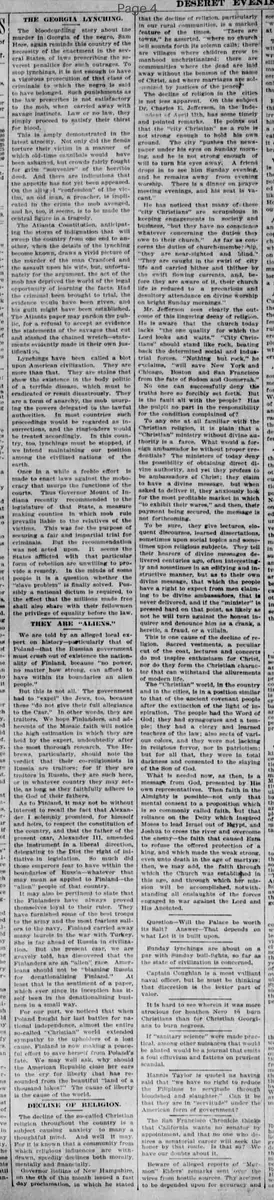
DECLINE OF RELIGION.
The decline of the so-called Christian religion throughout the country is a subject causing anxiety to many a thoughtful mind. And well it may. For it is known that a community from which religious influences are withdrawn, speedily declines both morally, mentally and financially.
Governor Rollins of New Hampshire, on the 6th of this month issued a fast day proclamation, in which he stated that the decline of religion, particularly in our rural communities, is a marked feature of the times.
"There are towns," he asserted, "where no church bell sounds forth its solemn calls; there are villages where children grow to manhood unchristianized; there are communities where the dead are laid away without the benison of the name of Christ, and where marriages are solemnized by justices of the peace."
The decline of religion in the cities is not less apparent.
On this subject Dr. Charles E. Jefferson, in the Independent of April 13th, has some timely and pointed remarks.
He points out that the "city Christian" as a rule is not strong enough to hold his own ground. The city "pushes the newspaper under his eyes on Sunday morning, and he is not strong enough of will to turn his eyes away. A friend drops in to see him Sunday evening, and he remains away from evening worship. There is a dinner on prayer meeting evenings, and his seat is vacant."
He has noticed that many of these "city Christians" are scrupulous in keeping engagements in society and business, "but they have no conscience whatever concerning the duties they owe to their church." As far as concerns the duties of church-membership, "they are near-sighted and blind."
"They are caught in the swirl of city life and carried hither and thither by the swift flowing currents, and, before they are aware of it, their church life is reduced to a precarious and desultory attendance on divine worship on bright Sunday mornings."
Mr. Jefferson sees clearly the outcome of this lingering decay of religion. He is aware that the church today lacks "the one quality for which the Lord looks and waits." "City Christians" should stand like rock, beating back the determined social and industrial forces. "Nothing but rock," he exclaims, "will save New York and Chicago, Boston and San Francisco from the fate of Sodom and Gomorrah."
No one can successfully deny these truths here so forcibly set forth. But is the fault all with the people? Has the pulpit no part in the responsibility for the condition complained of?
To any one at all familiar with the Christian religion, it is plain that a "Christian" ministry without divine authority is a farce. What would a foreign ambassador be without proper credentials? The ministers of today deny the possibility of obtaining direct divine authority, and yet they profess to be ambassadors of Christ; they claim to have a divine message, but when asked to deliver it, they anxiously look for the most profitable market in which "to exhibit their wares," and then, their payment being secured, the message is not forthcoming.
To be sure, they give lectures, eloquent discourses, learned dissertations, sometimes upon social topics and sometimes upon religious subjects. They tell their hearers of divine messages delivered centuries ago, often interestingly and sometimes in an edifying and instructive manner, but as to their own divine message, that which the people have a right to expect from men claiming to be divine ambassadors, that is never delivered, and if the "minister" is pressed hard on that point, as likely as not he will turn against the honest inquirer and denounce him as a crank, a heretic, a fraud, or a villain.
This is one cause of the decline of religion. Sacred vestments, a peculiar cut of the coat, lectures and concerts do not inspire enthusiasm for Christ nor do they form the Christian character that can withstand the allurements of modern life.
The "Christian" world, in the country and in the cities, is in a position similar to that of the ancient covenant people after the extinction of the light of inspiration. The people had the Word of God; they had synagogues and a temple; they had a clergy and learned teachers of the law; also sects of various colors, and they were not lacking in religious fervor, nor in patriotism; but for all that, they were in total darkness and consented to the slaying of the Son of God.
What is needed now, as then, is a message from God, presented by His own representatives. Then faith in the Almighty is possible--not only that mental consent to a proposition which is so commonly called faith, but that reliance on the Deity which inspired Moses to lead Israel out of Egypt, and Joshua, to cross the river and overcome the enemy--the faith that caused Ezra to refuse the offered protection of a king, and which made the weak strong, even unto death in the age of martyrs; then, we may add, the faith through which the Church was established in this age, and through which her mission will be accomplished, notwithstanding all onslaughts of the forces engaged in war against the Lord and His Anointed.
The decline of the so-called Christian religion throughout the country is a subject causing anxiety to many a thoughtful mind. And well it may. For it is known that a community from which religious influences are withdrawn, speedily declines both morally, mentally and financially.
Governor Rollins of New Hampshire, on the 6th of this month issued a fast day proclamation, in which he stated that the decline of religion, particularly in our rural communities, is a marked feature of the times.
"There are towns," he asserted, "where no church bell sounds forth its solemn calls; there are villages where children grow to manhood unchristianized; there are communities where the dead are laid away without the benison of the name of Christ, and where marriages are solemnized by justices of the peace."
The decline of religion in the cities is not less apparent.
On this subject Dr. Charles E. Jefferson, in the Independent of April 13th, has some timely and pointed remarks.
He points out that the "city Christian" as a rule is not strong enough to hold his own ground. The city "pushes the newspaper under his eyes on Sunday morning, and he is not strong enough of will to turn his eyes away. A friend drops in to see him Sunday evening, and he remains away from evening worship. There is a dinner on prayer meeting evenings, and his seat is vacant."
He has noticed that many of these "city Christians" are scrupulous in keeping engagements in society and business, "but they have no conscience whatever concerning the duties they owe to their church." As far as concerns the duties of church-membership, "they are near-sighted and blind."
"They are caught in the swirl of city life and carried hither and thither by the swift flowing currents, and, before they are aware of it, their church life is reduced to a precarious and desultory attendance on divine worship on bright Sunday mornings."
Mr. Jefferson sees clearly the outcome of this lingering decay of religion. He is aware that the church today lacks "the one quality for which the Lord looks and waits." "City Christians" should stand like rock, beating back the determined social and industrial forces. "Nothing but rock," he exclaims, "will save New York and Chicago, Boston and San Francisco from the fate of Sodom and Gomorrah."
No one can successfully deny these truths here so forcibly set forth. But is the fault all with the people? Has the pulpit no part in the responsibility for the condition complained of?
To any one at all familiar with the Christian religion, it is plain that a "Christian" ministry without divine authority is a farce. What would a foreign ambassador be without proper credentials? The ministers of today deny the possibility of obtaining direct divine authority, and yet they profess to be ambassadors of Christ; they claim to have a divine message, but when asked to deliver it, they anxiously look for the most profitable market in which "to exhibit their wares," and then, their payment being secured, the message is not forthcoming.
To be sure, they give lectures, eloquent discourses, learned dissertations, sometimes upon social topics and sometimes upon religious subjects. They tell their hearers of divine messages delivered centuries ago, often interestingly and sometimes in an edifying and instructive manner, but as to their own divine message, that which the people have a right to expect from men claiming to be divine ambassadors, that is never delivered, and if the "minister" is pressed hard on that point, as likely as not he will turn against the honest inquirer and denounce him as a crank, a heretic, a fraud, or a villain.
This is one cause of the decline of religion. Sacred vestments, a peculiar cut of the coat, lectures and concerts do not inspire enthusiasm for Christ nor do they form the Christian character that can withstand the allurements of modern life.
The "Christian" world, in the country and in the cities, is in a position similar to that of the ancient covenant people after the extinction of the light of inspiration. The people had the Word of God; they had synagogues and a temple; they had a clergy and learned teachers of the law; also sects of various colors, and they were not lacking in religious fervor, nor in patriotism; but for all that, they were in total darkness and consented to the slaying of the Son of God.
What is needed now, as then, is a message from God, presented by His own representatives. Then faith in the Almighty is possible--not only that mental consent to a proposition which is so commonly called faith, but that reliance on the Deity which inspired Moses to lead Israel out of Egypt, and Joshua, to cross the river and overcome the enemy--the faith that caused Ezra to refuse the offered protection of a king, and which made the weak strong, even unto death in the age of martyrs; then, we may add, the faith through which the Church was established in this age, and through which her mission will be accomplished, notwithstanding all onslaughts of the forces engaged in war against the Lord and His Anointed.
What sub-type of article is it?
Moral Or Religious
Social Reform
What keywords are associated?
Decline Of Religion
Rural Communities
City Christians
Divine Authority
Ministerial Critique
Faith Renewal
What entities or persons were involved?
Governor Rollins
Dr. Charles E. Jefferson
Editorial Details
Primary Topic
Decline Of Christianity And Critique Of Modern Ministry
Stance / Tone
Anxious Concern And Criticism Of Ministerial Failings
Key Figures
Governor Rollins
Dr. Charles E. Jefferson
Key Arguments
Decline Of Religion Causes Moral, Mental, And Financial Decay In Communities
Rural Areas Lack Church Bells, Unchristianized Youth, And Religious Rites For Death And Marriage
City Christians Fail To Resist Urban Distractions Like Newspapers And Social Engagements
Modern Ministers Lack Direct Divine Authority, Acting Like Merchants Without True Messages
Lectures And Discourses Do Not Inspire True Faith Or Withstand Modern Allurements
Need For Genuine Divine Messages To Restore Faith Like In Biblical Times