Thank you for visiting SNEWPapers!
Sign up free
Story
April 12, 1954
Trainman News
Indianapolis, Marion County, Indiana
What is this article about?
Fifth article in series on train rules by J. F. Crosson discusses dispatcher's authority to prioritize trains while respecting timetable supremacy, using examples like meeting points and waiting orders in Canadian railroads.
Clipping
OCR Quality
98%
Excellent
Full Text
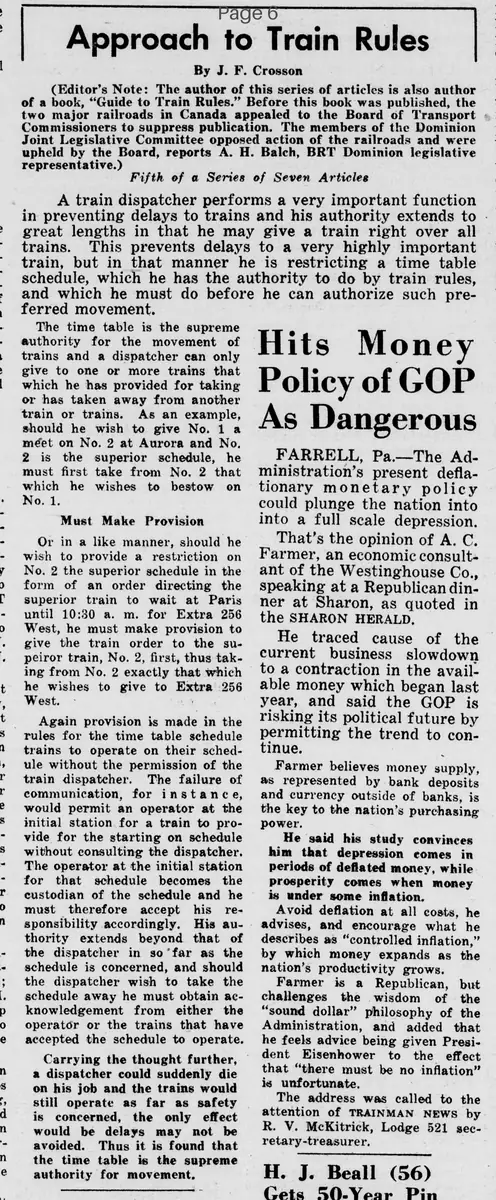
Approach to Train Rules
By J. F. Crosson
(Editor's Note: The author of this series of articles is also author of a book, "Guide to Train Rules." Before this book was published, the two major railroads in Canada appealed to the Board of Transport Commissioners to suppress publication. The members of the Dominion Joint Legislative Committee opposed action of the railroads and were upheld by the Board, reports A. H. Balch, BRT Dominion legislative representative.)
Fifth of a Series of Seven Articles
A train dispatcher performs a very important function in preventing delays to trains and his authority extends to great lengths in that he may give a train right over all trains. This prevents delays to a very highly important train, but in that manner he is restricting a time table schedule, which he has the authority to do by train rules, and which he must do before he can authorize such preferred movement.
The time table is the supreme authority for the movement of trains and a dispatcher can only give to one or more trains that which he has provided for taking or has taken away from another train or trains. As an example, should he wish to give No. 1 a meet on No. 2 at Aurora and No. 2 is the superior schedule, he must first take from No. 2 that which he wishes to bestow on No. 1.
Must Make Provision
Or in a like manner, should he wish to provide a restriction on No. 2 the superior schedule in the form of an order directing the superior train to wait at Paris until 10:30 a. m. for Extra 256 West, he must make provision to give the train order to the superior train, No. 2, first, thus taking from No. 2 exactly that which he wishes to give to Extra 256 West.
Again provision is made in the rules for the time table schedule trains to operate on their schedule without the permission of the train dispatcher. The failure of communication, for instance, would permit an operator at the initial station for a train to provide for the starting on schedule without consulting the dispatcher.
The operator at the initial station for that schedule becomes the custodian of the schedule and he must therefore accept his responsibility accordingly. His authority extends beyond that of the dispatcher in so far as the schedule is concerned, and should the dispatcher wish to take the schedule away he must obtain acknowledgement from either the operator or the trains that have accepted the schedule to operate.
Carrying the thought further, a dispatcher could suddenly die on his job and the trains would still operate as far as safety is concerned, the only effect would be delays may not be avoided. Thus it is found that the time table is the supreme authority for movement.
By J. F. Crosson
(Editor's Note: The author of this series of articles is also author of a book, "Guide to Train Rules." Before this book was published, the two major railroads in Canada appealed to the Board of Transport Commissioners to suppress publication. The members of the Dominion Joint Legislative Committee opposed action of the railroads and were upheld by the Board, reports A. H. Balch, BRT Dominion legislative representative.)
Fifth of a Series of Seven Articles
A train dispatcher performs a very important function in preventing delays to trains and his authority extends to great lengths in that he may give a train right over all trains. This prevents delays to a very highly important train, but in that manner he is restricting a time table schedule, which he has the authority to do by train rules, and which he must do before he can authorize such preferred movement.
The time table is the supreme authority for the movement of trains and a dispatcher can only give to one or more trains that which he has provided for taking or has taken away from another train or trains. As an example, should he wish to give No. 1 a meet on No. 2 at Aurora and No. 2 is the superior schedule, he must first take from No. 2 that which he wishes to bestow on No. 1.
Must Make Provision
Or in a like manner, should he wish to provide a restriction on No. 2 the superior schedule in the form of an order directing the superior train to wait at Paris until 10:30 a. m. for Extra 256 West, he must make provision to give the train order to the superior train, No. 2, first, thus taking from No. 2 exactly that which he wishes to give to Extra 256 West.
Again provision is made in the rules for the time table schedule trains to operate on their schedule without the permission of the train dispatcher. The failure of communication, for instance, would permit an operator at the initial station for a train to provide for the starting on schedule without consulting the dispatcher.
The operator at the initial station for that schedule becomes the custodian of the schedule and he must therefore accept his responsibility accordingly. His authority extends beyond that of the dispatcher in so far as the schedule is concerned, and should the dispatcher wish to take the schedule away he must obtain acknowledgement from either the operator or the trains that have accepted the schedule to operate.
Carrying the thought further, a dispatcher could suddenly die on his job and the trains would still operate as far as safety is concerned, the only effect would be delays may not be avoided. Thus it is found that the time table is the supreme authority for movement.
What sub-type of article is it?
Instructional Article
Railroad Procedures
What keywords are associated?
Train Dispatcher
Timetable
Railroad Rules
Train Orders
Schedule Authority
What entities or persons were involved?
J. F. Crosson
A. H. Balch
Where did it happen?
Canada
Story Details
Key Persons
J. F. Crosson
A. H. Balch
Location
Canada
Story Details
Article in a series explaining train rules, focusing on the train dispatcher's role in preventing delays while upholding the timetable as supreme authority for train movements, with examples of providing rights or restrictions to trains.