Thank you for visiting SNEWPapers!
Sign up free
Constitutional Whig
Richmond, Virginia
What is this article about?
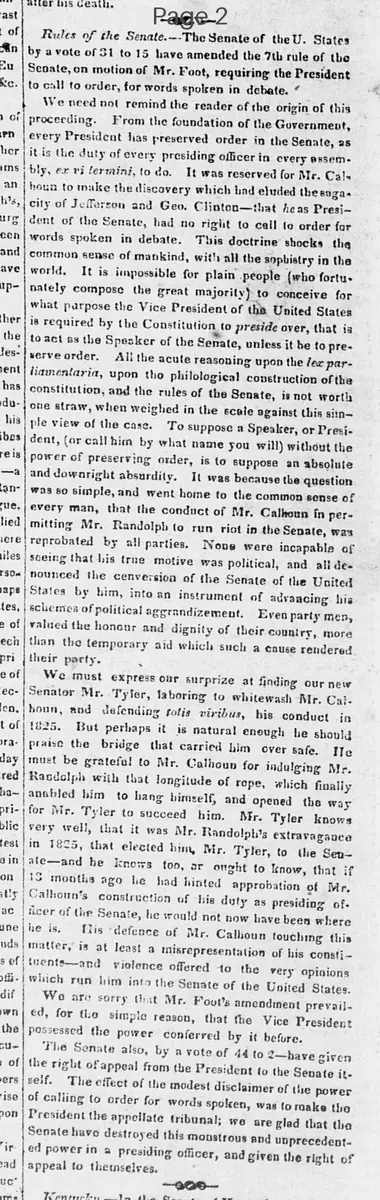
The U.S. Senate amends its 7th rule by a 31-15 vote on Mr. Foot's motion, requiring the President to call to order for words spoken in debate, criticizing Mr. Calhoun's prior stance. The Senate also grants appeal rights from the President to itself by a 44-2 vote, amid commentary on Mr. Tyler's defense of Calhoun.
Clipping
OCR Quality
Full Text
He need not remind the reader of the origin of this proceeding. From the foundation of the Government, every President has preserved order in the Senate, as it is the duty of every presiding officer in every assembly, ex officio, to do. It was reserved for Mr. Calhoun to make the discovery which had eluded the sagacity of Jefferson and Geo. Clinton—that he as President of the Senate, had no right to call to order for words spoken in debate. This doctrine shocks the common sense of mankind, with all the sophistry in the world. It is impossible for plain people (who fortunately compose the great majority) to conceive for what purpose the Vice President of the United States is required by the Constitution to preside over, that is to act as the Speaker of the Senate, unless it be to preserve order. All the acute reasoning upon the lex parliamentaria, upon the philological construction of the constitution, and the rules of the Senate, is not worth one straw, when weighed in the scale against this simple view of the case. To suppose a Speaker, or President, (or call him by what name you will) without the power of preserving order, is to suppose an absolute and downright absurdity. It was because the question was so simple, and went home to the common sense of every man, that the conduct of Mr. Calhoun in permitting Mr. Randolph to run riot in the Senate, was reprobated by all parties. None were incapable of seeing that his true motive was political, and denounced the conversion of the Senate of the United States by him, into an instrument of advancing his schemes of political aggrandizement. Even party men, valued the honour and dignity of their country, more than the temporary aid which such a cause rendered their party.
We must express our surprise at finding our new Senator Mr. Tyler, laboring to whitewash Mr. Calhoun, and defending totis viribus, his conduct in 1825. But perhaps it is natural enough he should praise the bridge that carried him over safe. He must be grateful to Mr. Calhoun for indulging Mr. Randolph with that longitude of rope, which finally enabled him to hang himself, and opened the way for Mr. Tyler to succeed him. Mr. Tyler knows very well, that it was Mr. Randolph's extravagance in 1825, that elected him Mr. Tyler, to the Senate—and he knows too, or ought to know, that if 13 months ago he had hinted approbation of Mr. Calhoun's construction of his duty as presiding officer of the Senate, he would not now have been where he is. His defence of Mr. Calhoun touching this matter, is at least a misrepresentation of his constituents—and violence offered to the very opinions which run him into the Senate of the United States.
We are sorry that Mr. Foot's amendment prevailed, for the simple reason, that the Vice President possessed the power conferred by it before.
The Senate also, by a vote of 44 to 2—have given the right of appeal from the President to the Senate itself. The effect of the modest disclaimer of the power of calling to order for words spoken, was to make the President the appellate tribunal; we are glad that the Senate have destroyed this monstrous and unprecedented power in a presiding officer, and given the right of appeal to themselves.
What sub-type of article is it?
What keywords are associated?
What entities or persons were involved?
Where did it happen?
Domestic News Details
Primary Location
United States Senate
Key Persons
Outcome
amendment to 7th rule passed by vote of 31 to 15; right of appeal from president to senate granted by vote of 44 to 2.
Event Details
The Senate amends the 7th rule on motion of Mr. Foot to require the President to call to order for words spoken in debate, amid criticism of Mr. Calhoun's prior interpretation allowing disorder, such as with Mr. Randolph in 1825, and Mr. Tyler's defense of Calhoun.