Thank you for visiting SNEWPapers!
Sign up free
Editorial
November 9, 1795
Gazette Of The United States
Philadelphia, Philadelphia County, Pennsylvania
What is this article about?
In 'The Defence--No. XXII' from The Argus, Camillus defends the 10th article of the Jay Treaty with Britain, arguing it aligns with prior U.S. treaties (France, Netherlands, Sweden, Prussia) and European conventions by protecting debts and property during wartime, rooted in the law of nations and endorsed by Founding Fathers.
Clipping
OCR Quality
98%
Excellent
Full Text
FROM THE ARGUS.
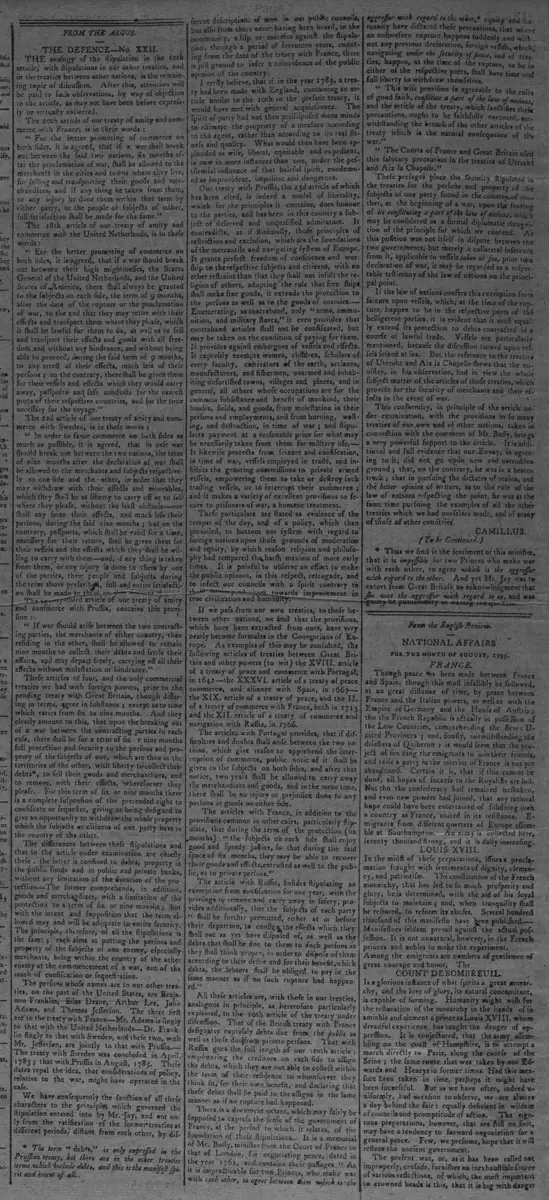
THE DEFENCE--NO. XXII.
THE analogy of the stipulation in the 10th article, with stipulations in our other treaties, and in the treaties between other nations, is the remaining topic of discussion. After this, attention will be paid to such observations, by way of objection to the article, as may not have been before expressly or virtually answered.
The 20th article of our treaty of amity and commerce with France; is in these words :
"For the better promoting of commerce on both sides, it is agreed, that if a war shall break out between the said two nations, six months after the proclamation of war, shall be allowed to the merchants in the cities and towns where they live, for selling and transporting their goods and merchandizes, and if any thing be taken from them, or any injury be done them within that term by either party, or the people or subjects of either, full satisfaction shall be made for the same."
The 18th article of our treaty of amity and commerce with the United Netherlands, is in these words:
"For the better promoting of commerce on both sides, it is agreed, that if a war should break out between their high mightiness, the States General of the United Netherlands, and the United States of America, there shall always be granted to the subjects on each side, the term of six months, after the date of the rupture or the proclamation of war, to the end that they may retire with their effects and transport them where they please, which it shall be lawful for them to do, as well as to sell and transport their effects and goods with all freedom and without any hindrance, and without being able to proceed, during the said term of six months, to any arrest of their effects, much less of their persons ; on the contrary, there shall be given them passports and safe conducts for the nearest ports of their respective countries, and for the time necessary for the voyage."
The 22d article of our treaty of amity and commerce with Sweden, is in these words :
"In order to favor commerce on both sides as much as possible, it is agreed, that in case war should break out between the two nations, the term of nine months after the declaration of war shall be allowed to the merchants and subjects respectively on one side and the other, in order that they may withdraw with their effects and moveables, which they shall be at liberty, to carry off or to sell where they please, without the least obstacle--nor shall any seize their effects, and much less their persons, during the said nine months : but on the contrary, passports, which shall be valid for a time, necessary for their return, shall be given them for their vessels and the effects which they shall be willing to carry with them--and, if any thing is taken from them, or any injury is done to them by one of the parties, their people and subjects during the term above prescribed, full and entire satisfaction shall be made to them."
The twenty-third article of our treaty of amity and commerce with Prussia, contains this provision :-
"If war should arise between the two contracting parties, the merchants of either country, then residing in the other, shall be allowed to remain nine months to collect their debts and settle their affairs, and may depart freely, carrying off all their effects without molestation or hindrance."
These articles of four, and the only commercial treaties we had with foreign powers, prior to the pending treaty with Great Britain, though differing in terms, agree in substance ; except as to time which varies from six to nine months. And they clearly amount to this, that upon the breaking out of a war between the contracting parties in each case, there shall be for a term of six or nine months full protection and security to the persons and property of the subjects of one, which are then in the territories of the other, with liberty to collect their debts, to sell their goods and merchandizes, and to remove, with their effects, wheresoever they please. For this term of six or nine months there is a complete suspension of the pretended right to confiscate or sequester, giving or being designed to give an opportunity to withdraw the whole property which the subjects or citizens of one party have in the country of the other.
The differences between these stipulations and that in the article under examination are chiefly these. the latter is confined to debts, property in the public funds and in public and private banks, without any limitation of the duration of the protection--The former comprehends, in addition, goods and merchandizes, with a limitation of the protection to a term of six or nine months; but with the intent and supposition that the term allowed may and will be adequate to entire security.
The principle, therefore, of all the stipulations is the same ; each aims at putting the persons and property of the subjects of one enemy, especially merchants, being within the country of the other enemy at the commencement of a war, out of the reach of confiscation or sequestration.
The persons whose names are to our other treaties, on the part of the United States, are Benjamin Franklin, Silas Deane, Arthur Lee, John Adams, and Thomas Jefferson. The three first are to the treaty with France--Mr. Adams is singly to that with the United Netherlands--Dr. Franklin singly to that with Sweden, and these two, with Mr. Jefferson, are jointly to that with Prussia.-- The treaty with Sweden was concluded in April, 1783 ; that with Prussia in August, 1785. These dates repel the idea, that considerations of policy, relative to the war, might have operated in the case.
We have consequently the sanction of all these characters to the principle, which governed the stipulation entered into by Mr. Jay, and not only from the ratification of the former treaties at different periods, distant from each other, by different descriptions of men in our public councils but also from their never having been heard, in the community, a lip or murmur against the stipulation, through a period of seventeen years, counting from the date of the treaty with France, there is just ground to infer a coincidence of the public opinion of the country.
I verily believe, that if in the year 1783, a treaty had been made with England, containing an article similar to the 10th in the present treaty, it would have met with general acquiescence. The spirit of party had not then predisposed mens minds to estimate the propriety of a measure according to its agent, rather than according to its real fitness and quality. What would then have been applauded as wise, liberal, equitable and expedient, is now in more instances than one, under the pestilential influence of that baleful spirit, condemned as improvident, impolitic and dangerous.
Our treaty with Prussia, the 23d article of which has been cited, is indeed a model of liberality, which for the principles it contains, does honour to the parties, and has been in this country a subject of deserved and unqualified admiration. It contradicts, as if studiously, those principles of restriction and exclusion, which are the foundations of the mercantile and navigating system of Europe. It grants perfect freedom of conscience and worship to the respective subjects and citizens, with no other restraint than that they shall not insult the religion of others, adopting the rule that free ships shall make free goods, it extends the protection to the persons as well as to the goods of enemies.-- Enumerating, as contraband, only "arms, ammunition, and military stores," it even provides that contraband articles shall not be confiscated, but may be taken on the condition of paying for them. It provides against embargoes of vessels and effects. It expressly exempts women, children, scholars of every faculty, cultivators of the earth, artisans, manufacturers, and fishermen, unarmed and inhabiting unfortified towns, villages and places, and in general, all others whose occupations are for the common subsistence and benefit of mankind, their houses, fields, and goods, from molestation in their persons and employments, and from burning, wasting, and destruction, in time of war ; and stipulates payment at a reasonable price for what may be necessarily taken from them for military use.-- It likewise protects from seizure and confiscation, in time of war, vessels employed in trade, and prohibits the granting commissions to private armed vessels, empowering them to take or destroy such trading vessels, or to interrupt their commerce ; and it makes a variety of excellent provisions to secure to prisoners of war, a humane treatment.
These particulars are stated as evidence of the temper of the day, and of a policy, which then prevailed, to bottom our system with regard to foreign nations upon those grounds of moderation and equity, by which reason religion and philosophy had tempered the harsh maxims of more early times. It is painful to observe an effort to make the public opinion, in this respect, retrograde, and to infect our councils with a spirit contrary to the towards improvement in true civilization and humanity.
If we pass from our own treaties, to those between other nations, we find that the provisions, which have been extracted from ours, have very nearly become formulas in the Conventions of Europe. As examples of this may be consulted, the following articles of treaties between Great Britain and other powers (to wit) the XVIII. article of a treaty of peace and commerce with Portugal, in 1642--the XXXVI. article of a treaty of peace commerce, and alliance with Spain, in 1667-- the XIX. article of a treaty of peace, and the II. of a treaty of commerce with France, both in 1713 and the XII. article of a treaty of commerce and navigation with Russia, in 1766.
The articles with Portugal provides, that if difficulties and doubts shall arise between the two nations, which give reason to apprehend the interruption of commerce, public notice of it shall be given to the subjects on both sides, and after that notice, two years shall be allowed to carry away the merchandizes and goods, and in the mean time, there shall be no injury or prejudice done to any persons or goods on either side.
The articles with France, in addition to the provisions common in other cases, particularly stipulate, that during the term of the protection (six months) " the subjects on each side shall enjoy good and speedy justice, so that during the said space of six months, they may be able to recover their goods and effects, entrusted as well to the public, as to private persons."
The article with Russia, besides stipulating an exemption from confiscation for one year, with the privilege to remove and carry away in safety, provides additionally, that the subjects of each party " shall be further permitted, either at or before their departure, to consign the effects which they shall not as yet have disposed of, as well as the debts that shall be due to them to such persons as they shall think proper, in order to dispose of them according to their desire and for their benefit, which debts, the debtors shall be obliged to pay in the same manner as if no such rupture had happened."
All these articles are, with those in our treaties, analogous in principle, as heretofore particularly explained, to the 10th article of the treaty under discussion. That of the British treaty with France designates expressly debts due from the public as well as those due from private persons. That with Russia goes the full length of our tenth article; empowering the creditors on each side to assign the debts, which they are not able to collect within the term of their residence to whomsoever they think fit, for their own benefit, and declaring that these debts shall be paid to the assignees in the same manner as if no rupture had happened.
There is a document extant, which may fairly be supposed to express the sense of the government of France, at the period to which it relates, of the foundation of these stipulations. It is a memorial of Mr. Bussy, minister from the Court of France to that of London, for negotiating peace, dated in the year 1761, and contains these passages " As it is impracticable for two Princes, who make war with each other, to agree between them which is the aggressor with regard to the other. Equity and humanity have dictated these precautions, that where an unforeseen rupture happens suddenly and without any previous declaration, foreign vessels, which, navigating under the security of peace, and of treaties, happen, at the time of the rupture, to be in either of the respective ports, shall have time and full liberty to withdraw themselves.
" This wise provision so agreeable to the rules of good faith, constitute a part of the law of nations, and the article of the treaty, which sanctifies these precautions, ought to be faithfully executed, notwithstanding the breach of the other articles of the treaty which is the natural consequence of the war."
" The Courts of France and Great Britain used this salutary precaution in the treaties of Utrecht and Aix la Chapelle."
These passages place the security stipulated in the treaties for the persons and property of the subjects of one party found in the country of another, at the beginning of a war, upon the footing of its constituting a part of the law of nations, which may be considered as a formal diplomatic recognition of the principle for which we contend. As this position was not itself in dispute between the two governments, but merely a collateral inference from it, applicable to vessels taken at sea, prior to a declaration of war, it may be regarded as a respectable testimony of the law of nations on the principal point.
If the law of nations confers this exemption from seizure upon vessels, which, at the time of the rupture, happen to be in the respective ports of the belligerent parties, it is evident that it must equally extend its protection to debts contracted in a course of lawful trade. Vessels are particularly mentioned, because the discussion turned upon vessels seized at sea. But the reference to the treaties of Utrecht and Aix la Chapelle shews that the minister, in his observation, had in view the whole subject matter of the articles of those treaties, which provide for the security of merchants and their effects in the event of war.
This conformity, in principle of the article under examination, with the provisions in so many treaties of our own and of other nations, taken in connection with the comment of Mr. Bussy, brings a very powerful support to the article. It is additional and full evidence that our Envoy, in agreeing to it, did not go upon new and untrodden ground ; that, on the contrary, he was in a beaten track ; that in pursuing the dictates of reason, and the better opinion of writers, as to the rule of the law of nations respecting the point, he was at the same time pursuing the examples of all the other treaties which we had ourselves made, and of many of those of other countries
CAMILLUS.
(To be Continued.)
Thus we find it the sentiment of this minister, that it is impossible for two Princes who make war with each other, to agree which is the aggressor with regard to the other. And yet Mr. Jay was to extort from Great Britain an acknowledgment that she was the aggressor with regard to us, and was guilty of pusillanimity in waiving the question
THE DEFENCE--NO. XXII.
THE analogy of the stipulation in the 10th article, with stipulations in our other treaties, and in the treaties between other nations, is the remaining topic of discussion. After this, attention will be paid to such observations, by way of objection to the article, as may not have been before expressly or virtually answered.
The 20th article of our treaty of amity and commerce with France; is in these words :
"For the better promoting of commerce on both sides, it is agreed, that if a war shall break out between the said two nations, six months after the proclamation of war, shall be allowed to the merchants in the cities and towns where they live, for selling and transporting their goods and merchandizes, and if any thing be taken from them, or any injury be done them within that term by either party, or the people or subjects of either, full satisfaction shall be made for the same."
The 18th article of our treaty of amity and commerce with the United Netherlands, is in these words:
"For the better promoting of commerce on both sides, it is agreed, that if a war should break out between their high mightiness, the States General of the United Netherlands, and the United States of America, there shall always be granted to the subjects on each side, the term of six months, after the date of the rupture or the proclamation of war, to the end that they may retire with their effects and transport them where they please, which it shall be lawful for them to do, as well as to sell and transport their effects and goods with all freedom and without any hindrance, and without being able to proceed, during the said term of six months, to any arrest of their effects, much less of their persons ; on the contrary, there shall be given them passports and safe conducts for the nearest ports of their respective countries, and for the time necessary for the voyage."
The 22d article of our treaty of amity and commerce with Sweden, is in these words :
"In order to favor commerce on both sides as much as possible, it is agreed, that in case war should break out between the two nations, the term of nine months after the declaration of war shall be allowed to the merchants and subjects respectively on one side and the other, in order that they may withdraw with their effects and moveables, which they shall be at liberty, to carry off or to sell where they please, without the least obstacle--nor shall any seize their effects, and much less their persons, during the said nine months : but on the contrary, passports, which shall be valid for a time, necessary for their return, shall be given them for their vessels and the effects which they shall be willing to carry with them--and, if any thing is taken from them, or any injury is done to them by one of the parties, their people and subjects during the term above prescribed, full and entire satisfaction shall be made to them."
The twenty-third article of our treaty of amity and commerce with Prussia, contains this provision :-
"If war should arise between the two contracting parties, the merchants of either country, then residing in the other, shall be allowed to remain nine months to collect their debts and settle their affairs, and may depart freely, carrying off all their effects without molestation or hindrance."
These articles of four, and the only commercial treaties we had with foreign powers, prior to the pending treaty with Great Britain, though differing in terms, agree in substance ; except as to time which varies from six to nine months. And they clearly amount to this, that upon the breaking out of a war between the contracting parties in each case, there shall be for a term of six or nine months full protection and security to the persons and property of the subjects of one, which are then in the territories of the other, with liberty to collect their debts, to sell their goods and merchandizes, and to remove, with their effects, wheresoever they please. For this term of six or nine months there is a complete suspension of the pretended right to confiscate or sequester, giving or being designed to give an opportunity to withdraw the whole property which the subjects or citizens of one party have in the country of the other.
The differences between these stipulations and that in the article under examination are chiefly these. the latter is confined to debts, property in the public funds and in public and private banks, without any limitation of the duration of the protection--The former comprehends, in addition, goods and merchandizes, with a limitation of the protection to a term of six or nine months; but with the intent and supposition that the term allowed may and will be adequate to entire security.
The principle, therefore, of all the stipulations is the same ; each aims at putting the persons and property of the subjects of one enemy, especially merchants, being within the country of the other enemy at the commencement of a war, out of the reach of confiscation or sequestration.
The persons whose names are to our other treaties, on the part of the United States, are Benjamin Franklin, Silas Deane, Arthur Lee, John Adams, and Thomas Jefferson. The three first are to the treaty with France--Mr. Adams is singly to that with the United Netherlands--Dr. Franklin singly to that with Sweden, and these two, with Mr. Jefferson, are jointly to that with Prussia.-- The treaty with Sweden was concluded in April, 1783 ; that with Prussia in August, 1785. These dates repel the idea, that considerations of policy, relative to the war, might have operated in the case.
We have consequently the sanction of all these characters to the principle, which governed the stipulation entered into by Mr. Jay, and not only from the ratification of the former treaties at different periods, distant from each other, by different descriptions of men in our public councils but also from their never having been heard, in the community, a lip or murmur against the stipulation, through a period of seventeen years, counting from the date of the treaty with France, there is just ground to infer a coincidence of the public opinion of the country.
I verily believe, that if in the year 1783, a treaty had been made with England, containing an article similar to the 10th in the present treaty, it would have met with general acquiescence. The spirit of party had not then predisposed mens minds to estimate the propriety of a measure according to its agent, rather than according to its real fitness and quality. What would then have been applauded as wise, liberal, equitable and expedient, is now in more instances than one, under the pestilential influence of that baleful spirit, condemned as improvident, impolitic and dangerous.
Our treaty with Prussia, the 23d article of which has been cited, is indeed a model of liberality, which for the principles it contains, does honour to the parties, and has been in this country a subject of deserved and unqualified admiration. It contradicts, as if studiously, those principles of restriction and exclusion, which are the foundations of the mercantile and navigating system of Europe. It grants perfect freedom of conscience and worship to the respective subjects and citizens, with no other restraint than that they shall not insult the religion of others, adopting the rule that free ships shall make free goods, it extends the protection to the persons as well as to the goods of enemies.-- Enumerating, as contraband, only "arms, ammunition, and military stores," it even provides that contraband articles shall not be confiscated, but may be taken on the condition of paying for them. It provides against embargoes of vessels and effects. It expressly exempts women, children, scholars of every faculty, cultivators of the earth, artisans, manufacturers, and fishermen, unarmed and inhabiting unfortified towns, villages and places, and in general, all others whose occupations are for the common subsistence and benefit of mankind, their houses, fields, and goods, from molestation in their persons and employments, and from burning, wasting, and destruction, in time of war ; and stipulates payment at a reasonable price for what may be necessarily taken from them for military use.-- It likewise protects from seizure and confiscation, in time of war, vessels employed in trade, and prohibits the granting commissions to private armed vessels, empowering them to take or destroy such trading vessels, or to interrupt their commerce ; and it makes a variety of excellent provisions to secure to prisoners of war, a humane treatment.
These particulars are stated as evidence of the temper of the day, and of a policy, which then prevailed, to bottom our system with regard to foreign nations upon those grounds of moderation and equity, by which reason religion and philosophy had tempered the harsh maxims of more early times. It is painful to observe an effort to make the public opinion, in this respect, retrograde, and to infect our councils with a spirit contrary to the towards improvement in true civilization and humanity.
If we pass from our own treaties, to those between other nations, we find that the provisions, which have been extracted from ours, have very nearly become formulas in the Conventions of Europe. As examples of this may be consulted, the following articles of treaties between Great Britain and other powers (to wit) the XVIII. article of a treaty of peace and commerce with Portugal, in 1642--the XXXVI. article of a treaty of peace commerce, and alliance with Spain, in 1667-- the XIX. article of a treaty of peace, and the II. of a treaty of commerce with France, both in 1713 and the XII. article of a treaty of commerce and navigation with Russia, in 1766.
The articles with Portugal provides, that if difficulties and doubts shall arise between the two nations, which give reason to apprehend the interruption of commerce, public notice of it shall be given to the subjects on both sides, and after that notice, two years shall be allowed to carry away the merchandizes and goods, and in the mean time, there shall be no injury or prejudice done to any persons or goods on either side.
The articles with France, in addition to the provisions common in other cases, particularly stipulate, that during the term of the protection (six months) " the subjects on each side shall enjoy good and speedy justice, so that during the said space of six months, they may be able to recover their goods and effects, entrusted as well to the public, as to private persons."
The article with Russia, besides stipulating an exemption from confiscation for one year, with the privilege to remove and carry away in safety, provides additionally, that the subjects of each party " shall be further permitted, either at or before their departure, to consign the effects which they shall not as yet have disposed of, as well as the debts that shall be due to them to such persons as they shall think proper, in order to dispose of them according to their desire and for their benefit, which debts, the debtors shall be obliged to pay in the same manner as if no such rupture had happened."
All these articles are, with those in our treaties, analogous in principle, as heretofore particularly explained, to the 10th article of the treaty under discussion. That of the British treaty with France designates expressly debts due from the public as well as those due from private persons. That with Russia goes the full length of our tenth article; empowering the creditors on each side to assign the debts, which they are not able to collect within the term of their residence to whomsoever they think fit, for their own benefit, and declaring that these debts shall be paid to the assignees in the same manner as if no rupture had happened.
There is a document extant, which may fairly be supposed to express the sense of the government of France, at the period to which it relates, of the foundation of these stipulations. It is a memorial of Mr. Bussy, minister from the Court of France to that of London, for negotiating peace, dated in the year 1761, and contains these passages " As it is impracticable for two Princes, who make war with each other, to agree between them which is the aggressor with regard to the other. Equity and humanity have dictated these precautions, that where an unforeseen rupture happens suddenly and without any previous declaration, foreign vessels, which, navigating under the security of peace, and of treaties, happen, at the time of the rupture, to be in either of the respective ports, shall have time and full liberty to withdraw themselves.
" This wise provision so agreeable to the rules of good faith, constitute a part of the law of nations, and the article of the treaty, which sanctifies these precautions, ought to be faithfully executed, notwithstanding the breach of the other articles of the treaty which is the natural consequence of the war."
" The Courts of France and Great Britain used this salutary precaution in the treaties of Utrecht and Aix la Chapelle."
These passages place the security stipulated in the treaties for the persons and property of the subjects of one party found in the country of another, at the beginning of a war, upon the footing of its constituting a part of the law of nations, which may be considered as a formal diplomatic recognition of the principle for which we contend. As this position was not itself in dispute between the two governments, but merely a collateral inference from it, applicable to vessels taken at sea, prior to a declaration of war, it may be regarded as a respectable testimony of the law of nations on the principal point.
If the law of nations confers this exemption from seizure upon vessels, which, at the time of the rupture, happen to be in the respective ports of the belligerent parties, it is evident that it must equally extend its protection to debts contracted in a course of lawful trade. Vessels are particularly mentioned, because the discussion turned upon vessels seized at sea. But the reference to the treaties of Utrecht and Aix la Chapelle shews that the minister, in his observation, had in view the whole subject matter of the articles of those treaties, which provide for the security of merchants and their effects in the event of war.
This conformity, in principle of the article under examination, with the provisions in so many treaties of our own and of other nations, taken in connection with the comment of Mr. Bussy, brings a very powerful support to the article. It is additional and full evidence that our Envoy, in agreeing to it, did not go upon new and untrodden ground ; that, on the contrary, he was in a beaten track ; that in pursuing the dictates of reason, and the better opinion of writers, as to the rule of the law of nations respecting the point, he was at the same time pursuing the examples of all the other treaties which we had ourselves made, and of many of those of other countries
CAMILLUS.
(To be Continued.)
Thus we find it the sentiment of this minister, that it is impossible for two Princes who make war with each other, to agree which is the aggressor with regard to the other. And yet Mr. Jay was to extort from Great Britain an acknowledgment that she was the aggressor with regard to us, and was guilty of pusillanimity in waiving the question
What sub-type of article is it?
Foreign Affairs
Trade Or Commerce
War Or Peace
What keywords are associated?
Jay Treaty
Wartime Protection
Commercial Treaties
Law Of Nations
Merchant Rights
Foreign Conventions
What entities or persons were involved?
Mr. Jay
Benjamin Franklin
Silas Deane
Arthur Lee
John Adams
Thomas Jefferson
Camillus
Great Britain
France
United Netherlands
Sweden
Prussia
Mr. Bussy
Editorial Details
Primary Topic
Defense Of The 10th Article Of The Jay Treaty On Wartime Protection Of Debts And Property
Stance / Tone
Strongly Supportive Of The Treaty Article As Consistent With Prior Treaties And Law Of Nations
Key Figures
Mr. Jay
Benjamin Franklin
Silas Deane
Arthur Lee
John Adams
Thomas Jefferson
Camillus
Great Britain
France
United Netherlands
Sweden
Prussia
Mr. Bussy
Key Arguments
The 10th Article Aligns With Stipulations In U.S. Treaties With France, Netherlands, Sweden, And Prussia Protecting Merchants' Property During War
Endorsed By Founding Fathers Like Franklin, Adams, And Jefferson In Prior Treaties
Reflects Public Opinion And Lack Of Prior Objections Over 17 Years
Consistent With European Treaties And Formulas In Conventions
Rooted In The Law Of Nations As Per Mr. Bussy's Memorial
Criticizes Partisan Spirit For Opposing What Was Once Seen As Wise And Equitable