Thank you for visiting SNEWPapers!

Sign up free

Page thumbnail for Richmond Enquirer
Foreign News October 17, 1817

Richmond Enquirer

Richmond, Richmond County, Virginia

What is this article about?

Political speculation in London over the King of Prussia's arrival in Paris and Duke of Wellington's meeting with him, focusing on discussions to reduce the Allied army of occupation in France, amid concerns over Bourbon stability two years after Waterloo.

Clipping
OCR Quality

95% Excellent

Full Text

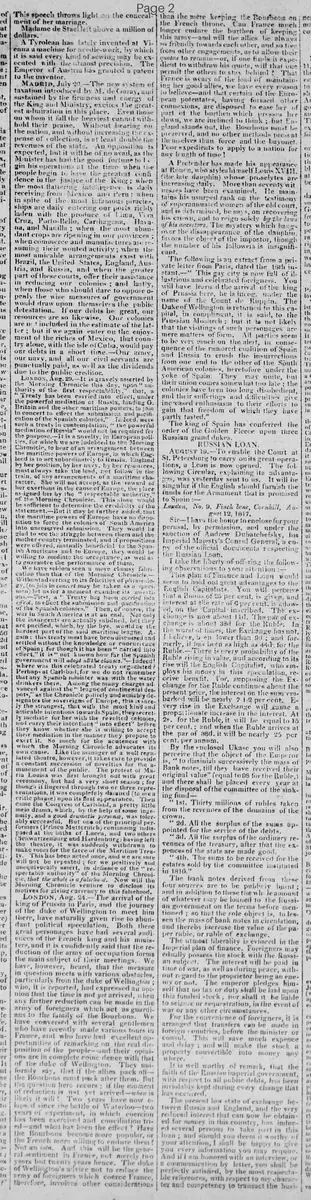
London, Aug. 24.—The arrival of the king of Prussia in Paris, and the journey of the duke of Wellington to meet him there, have naturally given rise to abundant political speculation. Both these great personages have had several audiences of the French king and his ministers, and it is confidently said that the reduction of the army of occupation forms the main subject of their meetings. We have, however, heard, that the measure in question meets with various obstacles, particularly from the duke of Wellington; who, it is reported, had expressed an opinion that the time is not yet arrived, when any farther reduction can be made in the army of foreigners which act as guardians to the family of the Bourbons. We have conversed with several gentlemen who have recently made various tours in France, and who have had excellent opportunities of remarking on the real disposition of the people—and their opinions are in complete coincidence with that of the duke of Wellington. They uniformly say, that if the allies pack off, the Bourbons must pack after them. But the question here recurs: if the moment of reduction is not yet arrived—when is likely it will? Two years have now elapsed since the battle of Waterloo—two years of experiment, in which coercion has been exercised and conciliation tried—and what has been the effect? Have the Bourbons become more popular, or the French more willing to endure them? Not at all. And this will be the general sentiment in France, not merely two years but twenty years hence. The duke of Wellington's advice not to reduce the army of foreigners which coerce France, therefore, involves other considerations than the mere keeping the Bourbons on the French throne. Can France much longer endure the burthen of keeping this army—and will the allies be always so friendly towards each other, and so free from other engagements, as to allow their quotas to remain—or, if one finds it expedient to withdraw his quota, will that one permit the others to stay behind? That France is weary of the load of maintaining her good allies, we have every reason to believe—and that certain of the European potentates, having formed other connexions, are disposed to ease her of part of the burthen which presses her down, we are inclined to think: but England stands out, the Bourbons must be preserved, and no other methods present themselves than force and the bayonet. Poor expedients to apply to a nation for any length of time!

What sub-type of article is it?

Diplomatic Political

What keywords are associated?

King Of Prussia Paris Duke Wellington Meeting Army Occupation Reduction Bourbons Stability French Disposition Allied Forces Withdrawal Post Waterloo Occupation

What entities or persons were involved?

King Of Prussia Duke Of Wellington French King

Where did it happen?

Paris

Foreign News Details

Primary Location

Paris

Event Date

Two Years After The Battle Of Waterloo

Key Persons

King Of Prussia Duke Of Wellington French King

Outcome

obstacles to reducing the army of occupation, particularly from duke of wellington; opinion that bourbons would fall without it; france weary of the burden

Event Details

The king of Prussia arrived in Paris, met by the duke of Wellington; both had audiences with the French king and ministers on reducing the army of occupation; Wellington opposes further reduction, citing unstable disposition of French people; travelers confirm Bourbons unpopular and likely to fall if allies withdraw; questions on sustainability of occupation and allied unity

Are you sure?