Thank you for visiting SNEWPapers!
Sign up free
Literary
July 13, 1860
Union County Star And Lewisburg Chronicle
Lewisburg, Union County, Pennsylvania
What is this article about?
An essay exploring the transformative power of reading and writing on personal conduct, historical events, and society, with examples from Benjamin Franklin's inspiration by Cotton Mather's Essays to Do Good, Jeremy Bentham's guiding phrase, and influences like Robinson Crusoe and George Washington's story.
Clipping
OCR Quality
98%
Excellent
Full Text
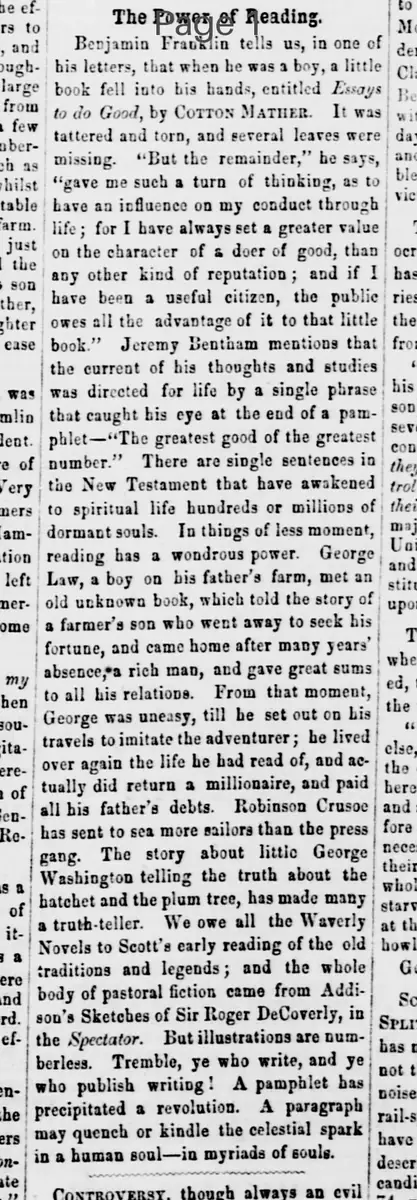
Benjamin Franklin tells us, in one of
his letters, that when he was a boy, a little
book fell into his hands, entitled Essays
to do Good, by Cotton Mather. It was
tattered and torn, and several leaves were
missing.
"But the remainder," he says,
"gave me such a turn of thinking, as to
have an influence on my conduct through
life; for I have always set a greater value
on the character of a doer of good, than
any other kind of reputation; and if I
have been a useful citizen, the public
owes all the advantage of it to that little
book."
Jeremy Bentham mentions that
the current of his thoughts and studies
was directed for life by a single phrase
that caught his eye at the end of a pam-
phlet—"The greatest good of the greatest
number."
There are single sentences in
the New Testament that have awakened
to spiritual life hundreds or millions of
dormant souls. In things of less moment,
reading has a wondrous power. George
Law, a boy on his father's farm, met an
old unknown book, which told the story of
a farmer's son who went away to seek his
fortune, and came home after many years'
absence, a rich man, and gave great sums
to all his relations. From that moment,
George was uneasy, till he set out on his
travels to imitate the adventurer; he lived
over again the life he had read of, and ac-
tually did return a millionaire, and paid
all his father's debts. Robinson Crusoe
has sent to sea more sailors than the press
gang.
The story about little George
Washington telling the truth about the
hatchet and the plum tree, has made many
a truth-teller. We owe all the Waverley
Novels to Scott's early reading of the old
traditions and legends; and the whole
body of pastoral fiction came from Addi-
son's Sketches of Sir Roger de Coverley, in
the Spectator. But illustrations are num-
berless. Tremble, ye who write, and ye
who publish writing! A pamphlet has
precipitated a revolution. A paragraph
may quench or kindle the celestial spark
in a human soul—in myriads of souls.
his letters, that when he was a boy, a little
book fell into his hands, entitled Essays
to do Good, by Cotton Mather. It was
tattered and torn, and several leaves were
missing.
"But the remainder," he says,
"gave me such a turn of thinking, as to
have an influence on my conduct through
life; for I have always set a greater value
on the character of a doer of good, than
any other kind of reputation; and if I
have been a useful citizen, the public
owes all the advantage of it to that little
book."
Jeremy Bentham mentions that
the current of his thoughts and studies
was directed for life by a single phrase
that caught his eye at the end of a pam-
phlet—"The greatest good of the greatest
number."
There are single sentences in
the New Testament that have awakened
to spiritual life hundreds or millions of
dormant souls. In things of less moment,
reading has a wondrous power. George
Law, a boy on his father's farm, met an
old unknown book, which told the story of
a farmer's son who went away to seek his
fortune, and came home after many years'
absence, a rich man, and gave great sums
to all his relations. From that moment,
George was uneasy, till he set out on his
travels to imitate the adventurer; he lived
over again the life he had read of, and ac-
tually did return a millionaire, and paid
all his father's debts. Robinson Crusoe
has sent to sea more sailors than the press
gang.
The story about little George
Washington telling the truth about the
hatchet and the plum tree, has made many
a truth-teller. We owe all the Waverley
Novels to Scott's early reading of the old
traditions and legends; and the whole
body of pastoral fiction came from Addi-
son's Sketches of Sir Roger de Coverley, in
the Spectator. But illustrations are num-
berless. Tremble, ye who write, and ye
who publish writing! A pamphlet has
precipitated a revolution. A paragraph
may quench or kindle the celestial spark
in a human soul—in myriads of souls.
What sub-type of article is it?
Essay
What themes does it cover?
Moral Virtue
Political
What keywords are associated?
Reading Influence
Books Shaping Lives
Moral Virtue
Historical Figures
Power Of Writing
Literary Details
Key Lines
"But The Remainder," He Says, "Gave Me Such A Turn Of Thinking, As To Have An Influence On My Conduct Through Life; For I Have Always Set A Greater Value On The Character Of A Doer Of Good, Than Any Other Kind Of Reputation; And If I Have Been A Useful Citizen, The Public Owes All The Advantage Of It To That Little Book."
"The Greatest Good Of The Greatest Number."
There Are Single Sentences In The New Testament That Have Awakened To Spiritual Life Hundreds Or Millions Of Dormant Souls.
Robinson Crusoe Has Sent To Sea More Sailors Than The Press Gang.
A Paragraph May Quench Or Kindle The Celestial Spark In A Human Soul—In Myriads Of Souls.