Thank you for visiting SNEWPapers!
Sign up free
The Times
Washington, District Of Columbia
What is this article about?
Unique religious service at Odd Fellows Hall featured graphophone music and sermon by Rev. George Buckler on church-stage rivalry, his acting past, Methodist theater bans, and urging equal financial support for church as theater expenses.
Clipping
OCR Quality
Full Text
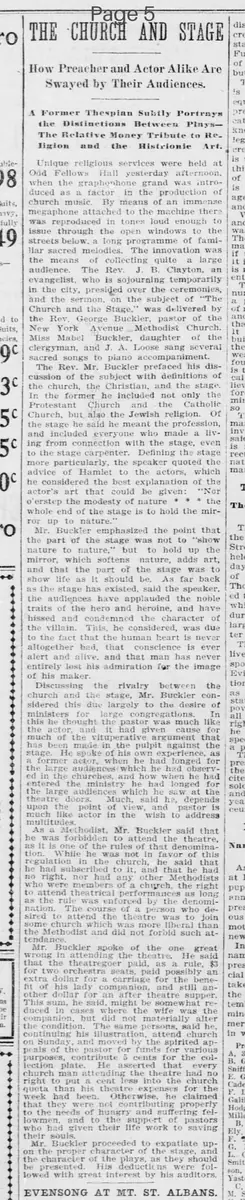
How Preacher and Actor Alike Are
Swayed by Their Audiences.
A Former Thespian Subtly Portrays
the Distinctions
Between Plays-
The Relative Money Tribute to Re-
Iigion and
the Histrionic Art.
Unique religious services were held at
Odd Fellows Hall yesterday afternoon,
when the graphophone grand was intro-
duced as a factor in the production of
church music. By means of an immense
megaphone attached to the machine there
was reproduced in tones loud enough to
issue through the open windows to the
streets below, a long programme of fami-
liar sacred melodies. The innovation was
the means of collecting quite a large
audience. The Rev. J. B. Clayton, an
evangelist, who is sojourning temporarily
in the city, presided over the ceremonies,
and the sermon, on the subject of "The
Church and the Stage," was delivered by
the Rev. George Buckler, pastor of the
New York Avenue Methodist Church.
Miss Mabel Buckler, daughter of the
clergyman, and J. A. Loose sang several
sacred songs to piano accompaniment.
The Rev. Mr. Buckler prefaced his dis-
cussion of the subject with definitions of
the church, the Christian, and the stage.
In the former he included not only the
Protestant Church and the Catholic
Church, but also the Jewish religion. Of
the stage he said he meant the profession,
and included everyone who made a liv-
ing from connection with the stage, even
to the stage carpenter. Defining the stage
more particularly, the speaker quoted the
advice of Hamlet to the actors, which
he considered the best explanation of the
actor's art that could be given: "Nor
o'erstep the modesty of nature * the
whole end of the stage is to hold the mir-
ror up to nature."
Mr. Buckler emphasized the point that
the part of the stage was not to "show
nature to nature," but to hold up the
mirror, which softens nature, adds art.
and that the part of the stage was to
show life as it should be. As far back
as the stage has existed, said the speaker,
the audiences have applauded the noble
traits of the hero and heroine, and have
hissed and condemned the character of
the villain. This, he considered, was due
to the fact that the human heart is never
altogether bad, that conscience is ever
alert and alive, and that man has never
entirely lost his admiration for the image
of his maker.
Discussing the rivalry between the
church and the stage, Mr. Buckler con-
sidered this due largely to the desire of
ministers for large congregations. In
this he thought the pastor was much like
the actor, and it had given cause for
much of the vituperative argument that
has been made in the pulpit against the
stage. He spoke of his own experience, as
a former actor, when he had longed for
the large audiences which he had observed
in the churches, and how when he had
entered the ministry he had longed for
the large audiences which he saw at the
theatre doors. Much, said he, depends
upon the point of view, and pastor is
much like actor in the wish to address
multitudes.
As a Methodist, Mr. Buckler said that
he was forbidden to attend the theatre,
as it is one of the rules of that denomina-
tion. While he was not in favor of this
regulation in the church, he said that
he had subscribed to it, and that he had
no right, nor had any other Methodists
who were members of a church, the right
to attend theatrical performances as long
as the rule was enforced by the denomi-
nation. The course of a person who de-
sired to attend the theatre was to join
some church which was more liberal than
the Methodist and did not forbid such at-
tendance.
Mr. Buckler spoke of the one great
wrong in attending the theatre. He said
that the theatregoer paid, as a rule, $2
for two orchestra seats, paid possibly an
extra dollar for a carriage for the bene-
fit of his lady companion, and still an-
other dollar for an after theatre supper.
This sum, he said, might be somewhat re-
duced in cases where the wife was the
companion, but did not materially alter
the condition. The same persons, said he,
continuing his illustration, attend church
on Sunday, and moved by the spirited ap-
peals of the pastor for funds for various
purposes, contribute 5 cents for the col-
lection plate. He asserted that every
church man attending the theatre had no
right to put a cent less into the church
quota than his theatre expenses for the
week had been. Otherwise, he claimed
that they were not contributing properly
to the needs of hungry and suffering fel-
lowmen, and to the support of pastors
who had given their life work to saving
their souls.
Mr. Buckler proceeded to expatiate up-
on the proper character of the stage, and
the character of the plays, as they should
be presented. His deductions were fol-
lowed with great interest by his auditors.
What sub-type of article is it?
What keywords are associated?
What entities or persons were involved?
Where did it happen?
Domestic News Details
Primary Location
Odd Fellows Hall
Event Date
Yesterday Afternoon
Key Persons
Outcome
collected a large audience; sermon delivered on 'the church and the stage' with discussions on rivalry, methodist rules, and financial contributions.
Event Details
Unique religious services held at Odd Fellows Hall using a graphophone with megaphone for sacred music reproduction. Rev. J. B. Clayton presided; Rev. George Buckler delivered sermon comparing church and stage, drawing from his acting background. Miss Mabel Buckler and J. A. Loose sang sacred songs.