Thank you for visiting SNEWPapers!
Sign up free
The National Intelligencer And Washington Advertiser
Washington, District Of Columbia
What is this article about?
In the U.S. House of Representatives on November 10, 1807, members debated a bill appropriating funds for navy expenses incurred after the Chesapeake-Leopard incident, including seamen, marines, stores, and timber for gunboats. Debate focused on executive authority, prior appropriations, and national defense needs; the bill advanced to third reading.
Merged-components note: These two components continue the same congressional debate on the navy appropriation bill from Tuesday, November 10, spanning pages 1 and 2. The second component starts mid-debate and ends with '(DEBATE TO BE CONTINUED.)'. Merged under domestic_news as the dominant label for congressional proceedings.
Clippings
1 of 2
OCR Quality
Full Text
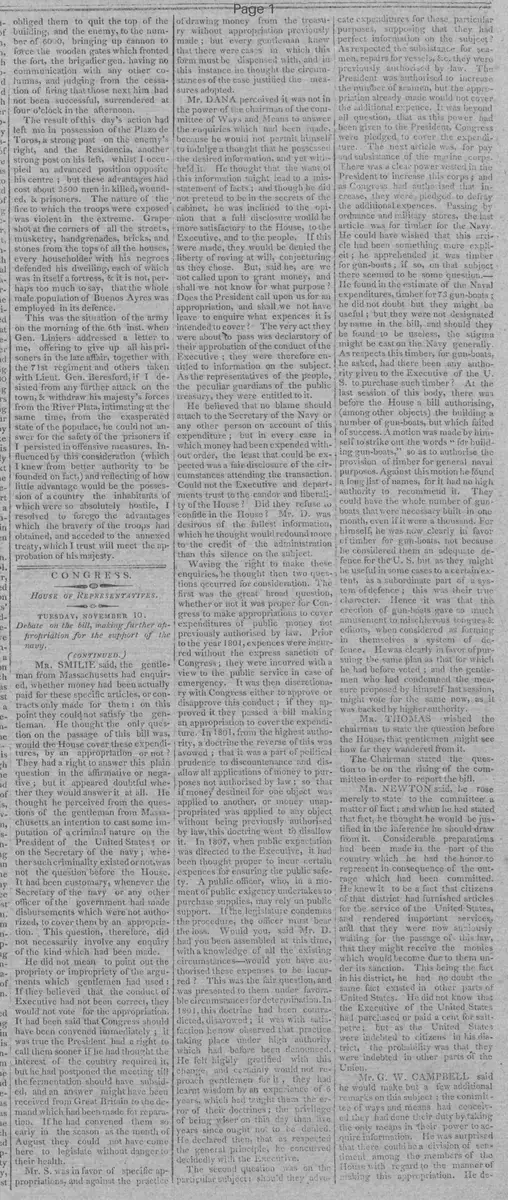
HOUSE OF REPRESENTATIVES.
TUESDAY, NOVEMBER 10.
Debate on the bill, making further appropriation for the support of the navy.
(CONTINUED.)
MR. SMILIE said, the gentleman from Massachusetts had enquired, whether money had been actually paid for these specific articles, or contracts only made for them: on this point they could not satisfy the gentleman. He thought the only question on the passage of this bill was, would the House cover these expenditures, by an appropriation or not? They had a right to answer this plain question in the affirmative or negative; but it appeared doubtful whether they would answer it at all. He thought he perceived from the questions of the gentleman from Massachusetts an intention to cast some imputation of a criminal nature on the President of the United States; or on the Secretary of the navy; whether such criminality existed or not, was not the question before the House.
It had been customary, whenever the Secretary of the navy or any other officer of the government had made disbursements which were not authorized, to cover them by an appropriation. This question, therefore, did not necessarily involve any enquiry of the kind which had been made. He did not mean to point out the propriety or impropriety of the arguments which gentlemen had used: If they believed that the conduct of Executive had not been correct, they would not vote for the appropriation.
It had been said that Congress should have been convened immediately; it was true the President had a right to call them sooner if he had thought the interest of the country required it, but he had postponed the meeting till the fermentation should have subsided, and an answer might have been received from Great Britain to the demand which had been made for reparation. If he had convened them so early in the season as the month of August they could not have come here to legislate without danger to their health.
Mr. S. was in favor of specific appropriations, and against the practice of drawing money from the treasury without appropriation previously made; but every gentleman knew that there were cases in which this form must be dispensed with, and in this instance he thought the circumstances of the case justified the measures adopted.
MR. DANA perceived it was not in the power of the chairman of the committee of Ways and Means to answer the enquiries which had been made, because he would not permit himself to indulge a thought that he possessed the desired information, and yet withheld it. He thought that the want of this information might lead to a mis-statement of facts; and though he did not pretend to be in the secrets of the cabinet, he was inclined to the opinion that a full disclosure would be more satisfactory to the House, to the Executive, and to the people. If this were made, they would be denied the liberty of roving at will, conjecturing as they chose. But, said he, are we not called upon to grant money, and shall we not know for what purpose? Does the President call upon us for an appropriation, and shall we not have leave to enquire what expences it is intended to cover? The very act they were about to pass was declaratory of their approbation of the conduct of the Executive; they were therefore entitled to information on the subject. As the representatives of the people, the peculiar guardians of the public treasury, they were entitled to it.
He believed that no blame should attach to the Secretary of the Navy or any other person on account of this expenditure; but in every case in which money had been expended without order, the least that could be expected was a fair disclosure of the circumstances attending the transaction. Could not the Executive and departments trust to the candor and liberality of the House? Did they refuse to confide in the House? Mr. D. was desirous of the fullest information, which he thought would redound more to the credit of the administration than this silence on the subject.
Waving the right to make these enquiries, he thought then two questions occurred for consideration. The first was the great broad question, whether or not it was proper for Congress to make appropriations to cover expenditures of public money not previously authorised by law. Prior to the year 1801, expences were incurred without the express sanction of Congress; they were incurred with a view to the public service in case of emergency. It was then discretionary with Congress either to approve or disapprove this conduct; if they approved it they passed a bill making an appropriation to cover the expenditure. In 1801, from the highest authority, a doctrine the reverse of this was avowed; that it was a part of political prudence to discountenance and disallow all applications of money to purposes not authorised by law; so that if money destined for one object was applied to another, or money unappropriated was applied to any object without being previously authorised by law, this doctrine went to disallow it. In 1807, when public expectation was directed to the Executive, it had been thought proper to incur certain expences for ensuring the public safety. A public officer, who, in a moment of public exigency undertakes to purchase supplies, may rely on public support. If the legislature condemns the procedure, the officer must bear the loss. Would you, said Mr. D. had you been assembled at this time, with a knowledge of all the existing circumstances—would you have authorised these expenses to be incurred? This was the fair question, and was presented to them under favorable circumstances for determination. In 1801, this doctrine had been contradicted, disavowed; it was with satisfaction he now observed that practice taking place under high authority which had before been denounced. He felt highly gratified with this change, and certainly would not reproach gentlemen for it, they had learnt wisdom by an experience of 6 years, which had taught them the error of their doctrines; the privilege of being wiser on this day than five years since ought not to be denied. He declared then, that as respected the general principle, he concurred decidedly with the Executive.
The second question was on the particular subject: should they advocate expenditures for those particular purposes, supposing that they had perfect information on the subject? As respected the subsistance for seamen, repairs for vessels, &c. they were previously authorised by law. The President was authorised to increase the number of seamen, but the appropriation already made would not cover the additional expence. It was beyond all question, that as this power had been given to the President, Congress were pledged to cover the expenditure. The next article was, for pay and subsistance of the marine corps. There was a clear power vested in the President to increase this corps; and as Congress had authorised that increase, they were pledged to defray the additional expences. Passing by ordnance and military stores, the last article was for timber for the Navy. He could have wished that this article had been something more explicit; he apprehended it was timber for gun-boats; if so, on that subject there seemed to be some question. He found in the estimate of the Naval expenditures, timber for 73 gun-boats; he did not doubt but they might be useful; but they were not designated by name in the bill, and should they be found to be useless, the stigma might be cast on the Navy generally.
As respects this timber, for gun-boats, he asked, had there been any authority given to the Executive of the U. S. to purchase such timber? At the last session of this body, there was before the House a bill authorising, (among other objects) the building a number of gun-boats, but which failed of success. A motion was made by himself to strike out the words "for building gun-boats," so as to authorise the provision of timber for general naval purposes. Against this motion he found a long list of names, for it had no high authority to recommend it. They could have the whole number of gun-boats that were necessary built in one month, even if it were a thousand. For himself, he was now clearly in favor of timber for gun-boats, not because he considered them an adequate defence for the U. S. but as they might be useful in some cases to a certain extent, as a subordinate part of a system of defence; this was their true character. Hence it was that the erection of gun-boats gave so much amusement to mischievous tongues & editors, when considered as forming in themselves a system of defence. He was clearly in favor of pursuing the same plan as that for which he had before voted; and the gentlemen who had condemned the measure proposed by himself last session, might vote for the same now, as it was backed by higher authority.
MR. THOMAS wished the chairman to state the question before the House, that gentlemen might see how far they wandered from it.
The Chairman stated the question to be on the rising of the committee in order to report the bill.
MR. NEWTON said, he rose merely to state to the committee a matter of fact; and when he had stated that fact, he thought he would be justified in the inference he should draw from it. Considerable preparations had been made in the part of the country which he had the honor to represent in consequence of the outrage which had been committed. He knew it to be a fact that citizens of that district had furnished articles for the service of the United States, and rendered important services, and that they were now anxiously waiting for the passage of this law, that they might receive the monies which would become due to them under its sanction. This being the fact in his district, he had no doubt the same fact existed in other parts of United States. He did not know that the Executive of the United States had purchased or paid a cent for saltpetre; but as the United States were indebted to citizens in his district, the probability was that they were indebted in other parts of the Union.
Mr. G. W. CAMPBELL said he would make but a few additional remarks on this subject; the committee of ways and means had conceived they had done their duty by taking the only means in their power to acquire information. He was surprised that there could be a division of sentiment among the members of the house with regard to the manner of making this appropriation. He de—
Mr. [something] declared that he still held the same principles he had always maintained so far as respected specific appropriations; but a case might happen in which they might be dispensed with, as cases of exigency required extraordinary remedies. After making some remarks on what had been said respecting heretical doctrines, and deviations from republican principles, he assured the gentleman on his right (Mr. Randolph) that he was the last whose political principles he should follow. The gentleman from Connecticut had said the House were called upon to make appropriations, but had not been specifically informed what expenditures they were to cover. The objects of the appropriations had been detailed to the House by the letter from the Secretary of the Navy, and by members on the floor. It did not appear to be the desire of the gentleman to know for what particulars the expenditure had been made, but whether they were actually paid for or not; this he must say, appeared to him perfectly immaterial, and that if the occasion was sufficient to justify the expenses incurred, the appropriation was proper and ought to be made. He thought the taking money from an appropriation to one object, and applying it to another, might be admitted in such an emergency which might also warrant the Executive in incurring expenses not authorized by law.
Mr. RANDOLPH observed, that he understood the gentleman from Tennessee to say, that he should not apply to him for instruction in political principles. He would assure the gentleman he was one of the last persons he should wish to instruct: and when he wanted pupils, he should not solicit him to become one. Mr. R. said he had been involved in this debate prematurely. He had heard the order of the day stated from the chair, and no person called it up. He then walked out of the House in search of a book; from the extraordinary echo of this large room, there being great difficulty in hearing and being heard, when he returned he had not distinctly understood the question. He wished to be understood as giving his vote upon the same ground with his friend and colleague who had just sit down. The expense having been incurred by the patriotism of our citizens, it would be an indelible disgrace not to discharge it. But in doing this, he did not mean to commit himself as voting for a navy, or the expenses arising out of a navy, except in a case such as the present, where a debt had been actually incurred.
The gentleman from Pennsylvania had agreed with him perfectly in professions; he had therefore nothing more to do than to ask him, as he had heretofore done, to act with him. This gentleman, as indeed, every other gentleman had taken a wide range on this question. In the first place, the expenses were not authorised by law; an enquiry had been made why they were incurred without authority, and a reason assigned that there was a great crisis, an insult had been received which every man must feel; in short, the circumstances were such, that the legislature ought to have been convened. The gentleman from Pennsylvania had urged as a reason for their not being convened, that our health might be endangered by coming here so early in the season. He wished his old friend from Pennsylvania, he hoped he might be permitted to call him so, would convey them to a place where they might be convened without danger. Another reason was, that they would have been convened at a time when they would have felt a deep and particular sense of national indignity. Mr. R. said he thought they ought to have been summoned then, and not to have suffered this impression to be weakened. There was a time when that gentleman and some other gentlemen, in discussing a subject which they called British aggressions, were as warm as he was disposed to be temperate; now that gentleman was as temperate as he was warm. Which had the better reason? He deemed it to be the interest of this nation to preserve peace with all mankind, to hold the balance of humanity with a steady hand. He had before deemed it the interest of the country to be at peace with G. Britain for reasons which he had before urged, on that floor, & which he would not state again, but now, tempora mutantur. The nation had received a blow. The President had been insulted in his palace by the minister of one foreign power, and now had received a blow on his cheek from the navy of another.
Mr. SMILLIE said that he was perhaps more temperate than his friend from Virginia; but he hoped when that gentleman arrived to his period of life, he would be equally temperate with him. Yet he did possess a temper, and could display it when our violated rights were the subject. Mr. S. then alluded to an ancient nation, who were wont to discuss great national questions twice, once when they were drunk, that they might not want spirit, and once when they were sober, that they might not be deficient in prudence. And he did believe, however others thought, that prudence required a temperate course, and that they ought not to have been under the immediate influence of passion when they took their seats on this occasion. The question was now taken on the rising of the committee, and carried. The amendments, agreed to in committee, were all agreed to without a division, excepting that making an appropriation for timber, on which the House divided—ayes 103; when the bill was ordered to a 3d reading tomorrow.
TUESDAY, NOVEMBER 10.
The question being on the final passage of the bill and the yeas and nays on the passage being called for,
MR. J. MONTGOMERY said, that as the yeas and nays had been required he should exercise the right of assigning reasons for the vote he was about to give. This bill provided for extraordinary expenses incurred in the navy department since the 22d June last; these extraordinary expenses had resulted from the cowardly attack committed by the Leopard on the Chesapeake. This act, marked with such daring and atrocious circumstances, had excited the detestation of every American; one sentiment on this subject pervaded the Union. The President of the United States had, adopted firm, energetic, and dignified measures on the occasion; amongst others those which had occasioned the expenses for which this bill provides. He had heard no complaint that the conduct of the Executive was defective either in prudence or energy. He was authorized, & he exercised the authority vested in him by law, to call out the marine corps to its full complement. He had exercised the authority given to him by the act of 1806, in preparing the gun-boats for service: the sense of the nation and the exigency of the times called upon him to do so. Other expenses incident to calling out the marine corps and manning gun-boats, were comprised under the different articles of clothing, &c. These extraordinary expenses the President was authorized to incur; the state of the country justified him in exercising that authority, and Mr. M. was of opinion that the honor of the nation called upon the House to make the appropriation. Then, as to these extraordinary expenses which had been incurred, there could be no difficulty; their honor was at stake for the payment. There was another item which he presumed would meet with as little difficulty as any other: he was instructed to say, as a member of the committee of ways and means, that the provisions specified in the bill were used by the militia called out for the protection of the port most in danger. Was there any member in the House who would hesitate to make an appropriation of 31,000 dollars for that purpose?
At this important juncture, when our country was in danger, the Executive had examined the state of the several departments; in the war department there were sufficient supplies of military stores; in the navy department there were none, except a few pounds of powder. At this alarming crisis, the country being threatened with war, the people looked up to the President for energetic conduct: he did not hesitate to make expenditures to supply these necessaries for the department. Of the navy department there was more required than of the war department, because the outrage had been committed on the ocean. What more prudent, more correct conduct than that of the President could be wished, or what more could the people expect, than that he should have made these necessary provisions of ordnance and military stores, and timber for gun-boats? The President had judged it expedient to make preparation; and the state of affairs had called for a warlike attitude: for, said Mr. M. we have learnt from our departed Washington, that to command peace we must be prepared for war; the President had acted upon this principle, which the House would no doubt approve. There was no law at that time, nor had any law yet been passed, to authorize the purchase of these articles: but the President of the United States, when his country was in danger, hesitated not to take upon himself the credit and proper responsibility. Upon these items what was the language of the President of the United States, contained in the message delivered to us? Strong and forcible, and clearly shewing the necessity for incurring these expenses: "The moment our peace was threatened, I deemed it indispensable to secure a greater provision of those articles of military stores, with which our magazines were not sufficiently furnished. To have awaited a previous and special sanction by law, would have lost occasions which might not be retrieved. I did not hesitate therefore to authorise engagements for such supplements to our existing stock as would render it adequate to the emergencies threatening us: and I trust that the Legislature feeling the same anxiety for the safety of our country so materially advanced by this precaution, will approve when done, what they would have seen so important to be done, if then assembled."
Mr. M. hoped his trust was well founded; that the legislature, feeling the same anxiety for the public safety so materially promoted by this precaution, would declare: that this was what they would have done had they been in session. He asked, had the President of the United States passed over this great emergency, and failed to make these preparations, ought he not to have been censured for a neglect of duty? As these articles therefore had been purchased because the interest and safety of the country required them, and the expenses had been incurred for the public safety, the House could not hesitate to give their sanction to the appropriation.
It had been asked by a gentleman from Massachusetts, whether these articles were actually paid for; if paid for out of what monies had the payment been made. As a member of the committee of ways and means, he could declare that not one cent had been actually paid. The President had said, that he had authorised engagements for these articles: the government was pledged for them; and the House were as strongly called on by faith & honor to make an appropriation for them as they were bound to do in the case of the marine corps.
Mr. M. said it had been asked by another gentleman, perhaps from Connecticut, whether the timber mentioned was for general naval purposes, or for gun-boats only? At this important crisis, when hostilities were menaced, it had been thought prudent to lay up a stock of timber for building gun-boats and it was accordingly done; but in laying it up, it had been contracted for, & prepared in such a manner as to answer any naval purposes. If our differences should be amicably settled, and it was not required that gun-boats should be erected, the materials would still be on hand for the use of the navy.
It had been stated, he believed, by a gentleman from Virginia, that appropriations had been anticipated; that this was not the language held by the President of the U. S. or these the principles defended by him in his first communication made to Congress in 1801: Mr. M. said, he admired the principle laid down by the gentleman; appropriations should never be anticipated but in extreme cases. The principle was in general correct; but he would ask the gentleman from Virginia, who had taken this ground yesterday, if a case could not occur in which it might be departed from? He would ask any gentleman, need there exist a stronger case than the present to justify such a departure? He believed not.
They had been told by a gentleman from Connecticut, that in the manner in which they were now acting, in making appropriations, they were justifying the measure upon arguments resorted to by the former administration. God forbid, said he, that we should take any of the principles of the former administration for our rule of conduct. The present measure stood on firm ground; the exigences of the times had justified the anticipation, and not the example of the former administration.
They had been told by a gentleman yesterday, that our navy had been disgraced by this outrage. True, if the officer of the degraded vessel, instead of a verbal answer from the mouth of his trumpet, had sent a metal one from the mouth of his cannon, the honor of the navy of the U. S. would have been preserved. That officer and his conduct were now under investigation; but from the courage, character, and patriotism of the other officers of our navy, the country might be assured, that if occasion offered, they would retrieve its reputation.
It had been said that the government had received two marked insults from foreign powers; he presumed one case alluded to was that of the Spanish minister; if he was wrong in this idea, he wished to be corrected. This minister began to shew his Spanish airs to our homespun government: he was informed that a demand would be made for his recall. If it should be thought that I am incorrect in this, said Mr. M. resort to the Department of State, where the facts may be obtained. What was the conduct of this ex-minister? Did he dare to persist in his insolence? No; he meanly solicited our government not to write on or represent his conduct to the Spanish government. Our government granted his solicitations: if they got rid of him, it was immaterial in what manner. After he had thus obtained his point, what was his conduct? He came within the city of Washington, contrary to the understanding which had taken place. Did the government then put up with his behavior? He received, on the contrary, an intimation that his company would be dispensed with. In the course of a few days he slunk off to Philadelphia. Under such circumstances, he presumed no American would feel the dignity of the nation injured in this case.
In the other case, it had been said we had received a blow; and a blow only? No: murder had been committed. The reeking blood of our fellow-citizens and the insulted dignity of the nation called for satisfactory retribution, or speedy retaliation. If retribution is refused, then the constitution did not vest the power in the President of the U. S. to resent the injury; it did vest it in the Congress of the U. States. If such a crisis should take place, they would meet it with energy and firmness, and use every exertion to efface the insult.
The present measure now under consideration, said Mr. M. is the first defensive measure presented for our determination. If we give this measure a quibbling, quirking, or reluctant affirmative, the people will be disappointed in their hopes. I have no apprehension that we shall do so; I believe the contrary. I have no doubt but that the patriotic characters here called together on the exigency of the moment, and to whom is intrusted the honor of the nation, will realise all the wishes of the people.
Mr. M. concluded by saying, that, feeling conscious of the rectitude of his intentions, as far as his feeble abilities would permit, he had discharged his duty to his country, his constituents, and to himself.
(DEBATE TO BE CONTINUED.)
What sub-type of article is it?
What keywords are associated?
What entities or persons were involved?
Where did it happen?
Domestic News Details
Primary Location
Washington
Event Date
Tuesday, November 10
Key Persons
Outcome
the committee rose and reported the bill; amendments agreed to, including appropriation for timber (ayes 103); bill ordered to third reading tomorrow. debate on final passage continued.
Event Details
Members of the House debated a bill for additional navy appropriations to cover expenses for seamen, marines, ordnance, military stores, and timber following the Chesapeake-Leopard incident. Discussion addressed executive authority to incur unappropriated expenses in emergency, need for information, gunboat utility, and national defense. Speakers defended or questioned the President's actions and timing of congressional session.