Thank you for visiting SNEWPapers!
Sign up free
The New Hampshire Gazette
Portsmouth, Rockingham County, New Hampshire
What is this article about?
In his Political Register of Jan. 5, 1813, Cobbett critiques the Prince Regent's speech on the War with America, questioning undefined British maritime rights, rejecting the term 'seduction' for open American invitations to Canadians, and contrasting it with covert acts like John Henry's mission.
Merged-components note: Merged continuation of Cobbett's commentary from Political Register on the war with America; relabeled second component from story to foreign_news as it fits international reports
Clippings
1 of 2
OCR Quality
Full Text
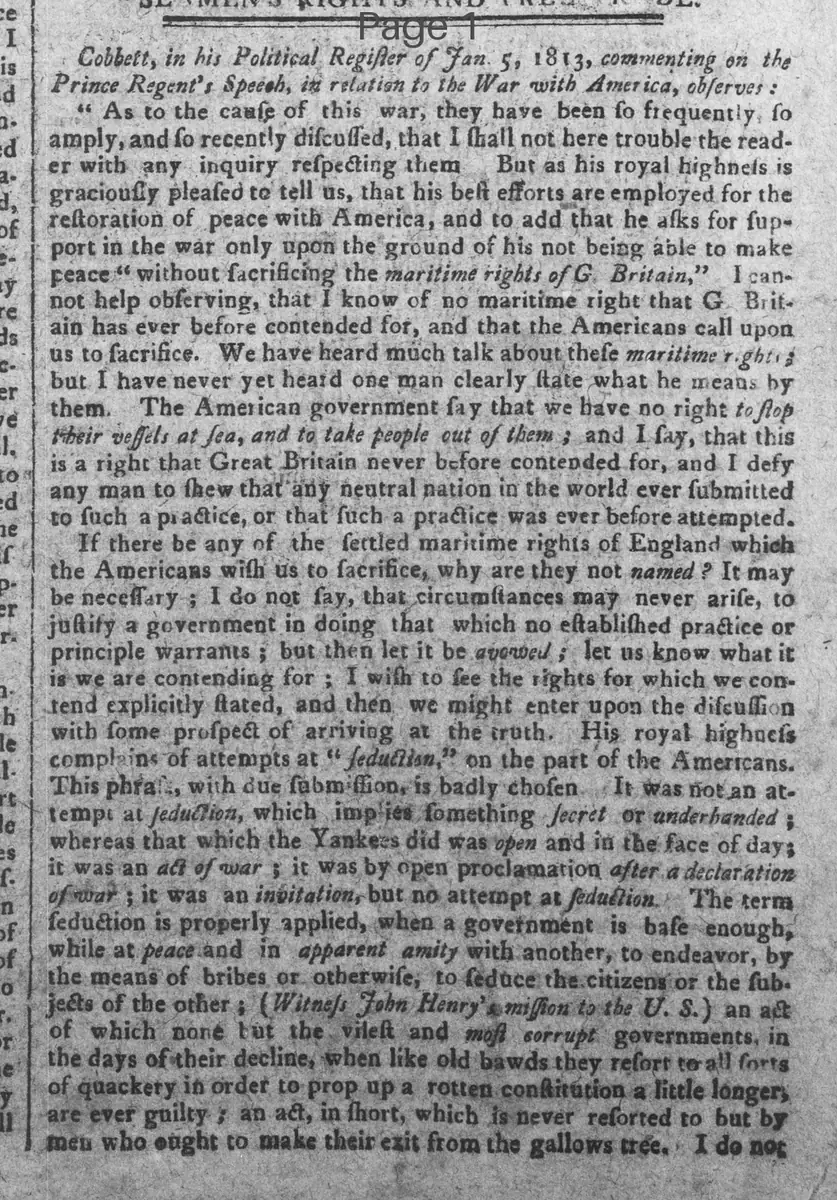
"As to the cause of this war, they have been so frequently, so amply, and so recently discussed, that I shall not here trouble the reader with any inquiry respecting them But as his royal highness is graciously pleased to tell us, that his best efforts are employed for the restoration of peace with America, and to add that he asks for support in the war only upon the ground of his not being able to make peace" without sacrificing the maritime rights of G. Britain," I cannot help observing, that I know of no maritime right that G. Britain has ever before contended for, and that the Americans call upon us to sacrifice. We have heard much talk about these maritime rights; but I have never yet heard one man clearly state what he means by them. The American government say that we have no right to stop their vessels at sea, and to take people out of them ; and I say, that this is a right that Great Britain never before contended for, and I defy any man to shew that any neutral nation in the world ever submitted to such a practice, or that such a practice was ever before attempted. If there be any of the settled maritime rights of England which the Americans wish us to sacrifice, why are they not named? It may be necessary; I do not say, that circumstances may never arise, to justify a government in doing that which no established practice or principle warrants ; but then let it be avowed ; let us know what it is we are contending for ; I wish to see the rights for which we contend explicitly stated, and then, we might enter upon the discussion with some prospect of arriving at the truth. His royal highness complains of attempts at "seduction." on the part of the Americans. This phrase, with due submission, is badly chosen. It was not an attempt at seduction, which implies something secret or underhanded ; whereas that which the Yankees did was open and in the face of day; it was an act of war ; it was by open proclamation after a declaration of war ; it was an invitation, but no attempt at seduction. The term seduction is properly applied, when a government is base enough, while at peace and in apparent amity with another, to endeavor, by the means of bribes or otherwise, to seduce the citizens or the subjects of the other ; (Witness John Henry's mission to the U. S.) an act of which none but the vilest and most corrupt governments, in the days of their decline, when like old bawds they resort to all sorts of quackery in order to prop up a rotten constitution a little longer; are ever guilty ; an act, in short, which is never resorted to but by men who ought to make their exit from the gallows tree. I do not
We commend the invitation of the Americans—but it is very different from acts such as that which I have just been speaking of. The Canadians will not be gained over, I am sure, by invitations. Invitation will weigh very little with them. They will in all likelihood, be influenced by their feelings. If they have a good government they will wish to keep it; and will no doubt fight in its defence."
What sub-type of article is it?
What keywords are associated?
What entities or persons were involved?
Where did it happen?
Foreign News Details
Primary Location
America
Event Date
Jan. 5, 1813
Key Persons
Event Details
Cobbett comments on the Prince Regent's speech regarding the ongoing War with America, noting efforts for peace but inability without sacrificing British maritime rights, questions what those rights are, especially impressment from neutral vessels, criticizes calling American open invitations to Canadians 'seduction' and contrasts with secret acts like John Henry's mission, and asserts Canadians will remain loyal due to good government.