Thank you for visiting SNEWPapers!
Sign up free
Martinsburgh Gazette
Martinsburg, Berkeley County, West Virginia
What is this article about?
Article from the New York Observer by E. Ayres, agent of the American Colonization Society, advocating for colonizing free people of color in Africa to address slavery issues. Details society's formation in 1816, expeditions, challenges like deaths at Sherbro, success at Liberia, and calls for congressional aid and donations for a new expedition.
Clipping
OCR Quality
Full Text
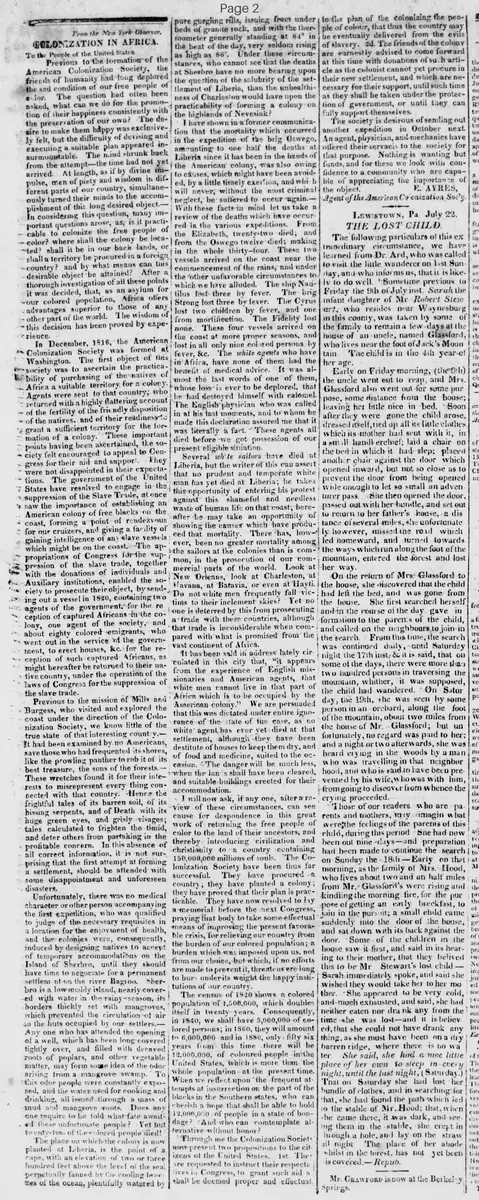
COLONIZATION IN AFRICA.
To the People of the United States
Previous to the formation of the American Colonization Society, the friends of humanity had long deplored the sad condition of our free people of color. The question had often been asked, what can we do for the promotion of their happiness consistently with the preservation of our own? The desire to make them happy was exclusively felt, but the difficulty of devising and executing a suitable plan appeared insurmountable. The mind shrunk back from the attempt—the time had not yet arrived. At length, as if by divine impulse, men of piety and wisdom in different parts of our country, simultaneously turned their minds to the accomplishment of this long desired object.
In considering this question, many important questions arose, as; is it practicable to colonize the free people of color? where shall the colony be located? shall it be in our back lands, or shall a territory be procured in a foreign country? and by what means can this desirable object be attained? After a thorough investigation of all these points it was decided, that, as an asylum for our colored population, Africa offers advantages superior to those of any other part of the world. The wisdom of this decision has been proved by experience.
In December, 1816, the American Colonization Society was formed at Washington. The first object of this society was to ascertain the practicability of purchasing of the natives of Africa a suitable territory for a colony. Agents were sent to that country; who returned with a highly flattering account of the fertility of the soil, of the friendly disposition of the natives, and of their readiness to grant a sufficient territory for the formation of a colony. These important points having been ascertained, the society felt encouraged to appeal to Congress for their aid and support. They were not disappointed in their expectations. The government of the United States saw the importance of establishing an American colony of free blacks on the coast, forming a point of rendezvous for our cruisers, and giving a facility of gaining intelligence of any slave vessels which might be on the coast. The appropriations of Congress for the suppression of the slave trade, together with the donations of individuals and Auxiliary institutions, enabled the society to prosecute their object, by sending out a vessel in 1820, containing two agents of the government, for the reception of captured Africans in the colony, one agent of the society, and about eighty colored emigrants, who went out in the service of the government, to erect houses, &c. for the reception of such captured Africans, as might hereafter be returned to their native country, under the operation of the laws of Congress for the suppression of the slave trade.
Previous to the mission of Mills and Burgess, who visited and explored the coast under the direction of the Colonization Society, we know little of the true state of that interesting country. It had been examined by no Americans, save those who had frequented its shores, like the prowling panther to rob it of its best treasure, the sons of the forests. These wretches found it for their interests to misrepresent every thing connected with that country. Hence the frightful tales of its barren soil, of its hissing serpents, and of Death with its huge green eyes, and grisly visages; tales calculated to frighten the timid, and deter others from partaking in the profitable concern. In this absence of all correct information, it is not surprising that the first attempt at forming a settlement, should be attended with some disappointment and unforeseen disasters.
Unfortunately, there was no medical character or other person accompanying the first expedition, who was qualified to judge of the necessary requisites in a location for the enjoyment of health, and the colonies were, consequently, induced by designing natives to accept of temporary accommodations on the Island of Sherbro, until they should have time to negotiate for a permanent settlement on the river Bagroo. Sherbro is a low muddy island, nearly covered with water in the rainy season, its borders thickly set with mangroves, which prevented the circulation of air in the huts occupied by our settlers. Any one who has attended the opening of a well, which has been long covered tightly over, and filled with decayed roots of poplars, and other vegetable matter, may form some idea of the odor arising from a mangrove swamp. To this odor people were constantly exposed, and the water used for cooking and drinking, all issued through a mass of mud and mangrove roots. Does any one require to be told what fate awaited these unfortunate people? Yet but twenty-two of the colored people died!
The place on which the colony is now planted at Liberia, is the point of a cape, with an elevation of two or three hundred feet above the level of the sea, perpetually fanned by the cooling breezes of the ocean, plentifully watered by pure gurgling rills, issuing from under beds of granite rock, and with the thermometer generally standing at 84 in the heat of the day, very seldom rising as high as 86. Under these circumstances, who cannot see that the deaths at Sherbro have no more bearing upon the question of the salubrity of the settlement of Liberia, than the unhealthiness of Charleston would have upon the practicability of forming a colony on the highlands of Neversink?
I have shown in a former communication that the mortality which occurred in the expedition of the brig Oswego, amounting to one half the deaths at Liberia since it has been in the hands of the American colony, was also owing to causes, which might have been avoided, by a little timely exertion, and which will never, without the most criminal neglect, be suffered to occur again.
With these facts in mind let us take a review of the deaths which have occurred in the various expeditions. From the Elizabeth, twenty-two died; and from the Oswego twelve died; making in the whole thirty-four. These two vessels arrived on the coast near the commencement of the rains, and under the other unfavorable circumstances to which we have alluded. The ship Nautilus lost three by fever. The brig Strong lost three by fever. The Cyrus lost two children by fever, and one from mortification. The Fidelity lost none. These four vessels arrived on the coast at more proper seasons, and lost in all only nine colored persons by fever, &c. The white agents who have been in Africa, have none of them had the benefit of medical advice. It was almost the last words of one of them, whose loss is ever to be deplored, that he had destroyed himself with calomel. The English physician who was called in at his last moments, and to whom he made this declaration assured me that it was literally a fact. These agents all died before we got possession of our present eligible situation.
Several white sailors have died at Liberia, but the writer of this can assert that no prudent and temperate white man has yet died at Liberia; he takes this opportunity of entering his protest against this shameful and needless waste of human life on that coast; hereafter he may take an opportunity of showing the causes which have produced that mortality. There has, however, been no greater mortality among the sailors at the colonies than is common, in the prosecution of our commercial parts of the world. Look at New Orleans, look at Charleston, at Havana, at Batavia, or even at Hayti. Do not white men frequently fall victims to their inclement skies? Yet no one is deterred by this from prosecuting a trade with these countries, although that trade is inconsiderable when compared with what is promised from the vast continent of Africa.
It has been said in address lately circulated in this city that, "it appears from the experience of English missionaries and American agents, that white men cannot live in that part of Africa which is to be occupied by the American colony." We are persuaded that this was dictated under entire ignorance of the state of the case, as no white agent has ever yet died at that settlement, although they have been destitute of houses to keep them dry, and of food and medicine suited to the occasion. The danger will be much less, when the lands shall have been cleared, and suitable buildings erected for their accommodation.
I will now ask, if any one, after a review of these circumstances, can see cause for despondence in this great work of returning the free people of color to the land of their ancestors, and thereby introducing civilization and Christianity to a country containing 150,000,000 millions of souls. The Colonization Society have been thus far successful. They have procured a country; they have planted a colony; they have proved that their plan is practicable. They have now resolved to lay a memorial before the next Congress, praying that body to take some effectual means of improving the present favorable crisis, for relieving our country from the burden of our colored population; a burden which was imposed upon us, not from our choice, but which, if no efforts are made to prevent it, threatens ere long to bury under its weight the happy institutions of our country.
The census of 1820 shows a colored population of 1,500,000, which doubles itself in twenty years. Consequently, in 1840, we shall have 3,000,000 of colored persons; in 1860, they will amount to 6,000,000 and in 1880, only, fifty six years from this time there will be 12,000,000, of coloured people in the United States, which is more than the whole population at the present time. When we reflect upon the frequent attempts at insurrection on the part of the blacks in the Southern states, who can cherish a hope that we shall be able to hold 12,000,000 of people in a state of bondage? and who can contemplate alternative without horror?
Through me the Colonization Society now present two propositions to the citizens of the United States. 1st. The citizens are requested to instruct their respective representatives in Congress, to grant such aid as shall be deemed proper and effectual to the plan of colonizing the people of colour, that thus the country may be eventually delivered from the evils of slavery. 2d. The friends of the colony are earnestly advised to come forward at this time with donations of such articles as the colonists cannot yet procure in their new settlement, and which are necessary for their support, until such time as they shall be taken under the protection of government, or until they can fully support themselves.
The society is desirous of sending out another expedition in October next. An agent, physician, and mechanics have offered their services to the society for that purpose. Nothing is wanting but funds, and for these we look with confidence to a community who are capable of appreciating the importance of the object.
E. AYRES.
Agent of the American Colonization Soc'y
What sub-type of article is it?
What keywords are associated?
What entities or persons were involved?
Where did it happen?
Domestic News Details
Primary Location
United States
Event Date
1820s
Key Persons
Outcome
deaths in expeditions: 22 from elizabeth, 12 from oswego, 3 from nautilus, 3 from strong, 3 from cyrus; total 43 colored persons; several white agents and sailors died due to poor conditions and lack of medical care.
Event Details
The American Colonization Society, formed in 1816, promotes colonizing free people of color in Africa to alleviate slavery burdens. Details expeditions starting 1820, challenges at Sherbro Island leading to deaths, relocation to healthier Liberia site, and calls for congressional support and donations for October expedition.