Thank you for visiting SNEWPapers!
Sign up free
Virginia Argus
Richmond, Virginia
What is this article about?
Detailed anecdotes of the Battle of Lake Erie on September 10, 1813, including preparations to move brigs, the naval engagement between American and British fleets, heavy casualties, treatment of prisoners, and joint funeral for fallen officers at Put-in Bay.
Clipping
OCR Quality
Full Text
OF
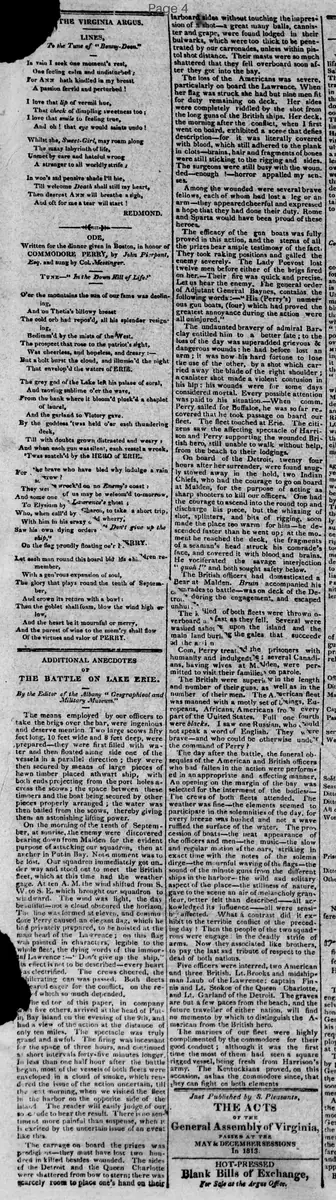
THE BATTLE ON LAKE ERIE.
By the Editor of the Albany "Geographical and
Military Museum."
The means employed by our officers to
take the brigs over the bar, were ingenious
and deserve mention. Two large scows fifty
feet long, 10 feet wide and 8 feet deep, were
prepared-they were first filled with water
and then floated along side one of the
vessels in a parallel direction ; they were
then secured by means of large pieces of
hewn timber placed athwart ship, with
both ends projecting from the port holes a-
cross the scows; the space between these
timbers and the boat being secured by other
pieces properly arranged ; the water was
then bailed from the scows, thereby giving
them an astonishing lifting power.
On the morning of the tenth of September,
at sunrise, the enemy were discovered
bearing down from Malden for the evident
purpose of attacking our squadron, then at
anchor in Put-in Bay. Not a moment was to
be lost. Our squadron immediately got under
way and stood out to meet the British
fleet, which at this time had the weather
gage. At ten A. M. the wind shifted from S.
W. to S. E. which brought our squadron to
windward. The wind was light, the day
beautiful-not a cloud obscured the horizon.
The line was formed at eleven, and commo-
dore Perry caused an elegant flag, which he
had privately prepared, to be hoisted at the
mast head of the Lawrence; on this flag
was painted in characters, legible to the
whole fleet, the dying words of the immor-
tal Lawrence :- "Don't give up the ship."
Its effect is not to be described-every heart
was electrified. The crews cheered, the
exhilarating can was passed, Both fleets
neared eager for the conflict, on the re-
sult of which so much depended.
The editor of this paper, in company
with five others, arrived at the head of Put-
in Bay island on the evening of the 9th, and
had a view of the action at the distance of
only ten miles. The spectacle was truly
grand and awful. The firing was incessant
for the space of three hours, and continued
at short intervals forty-five minutes longer.
In less than one half hour after the battle
began, most of the vessels of both fleets were
enveloped in a cloud of smoke, which ren-
dered the issue of the action uncertain. till
the next morning, when we visited the fleet
in the harbor on the opposite side of the
island The reader will easily judge of our
solicitude to hear the result. There is no sen-
timent more painful than suspense, when it
is excited by the uncertain issue of an event
like this.
The carnage on-board the prizes was
prodigious-they must have lost two hun-
dred in killed besides wounded. The sides
of the Detroit and the Queen Charlotte
were shattered from bow to stern; there was
scarcely room to place one's hand on their
larboard sides without touching the impres-
sion of a shot a great many balls, cannis-
ter and grape, were found lodged in their
bulwarks, which were too thick to be pene-
trated by our carronades, unless within pis-
tol shot distance. Their masts were so much
shattered that they fell overboard soon af-
ter they got into the bay.
The loss of the Americans was severe,
particularly on board the Lawrence. When
her flag was struck she had but nine men fit
for duty remaining on deck. Her sides
were completely riddled-by the shot from
the long guns of the British ships. Her deck,
the morning after the conflict, when I first
went on board, exhibited a scene that defies
description-for it was literally covered
with blood, which still adhered to the plank
in clots--brains, hair and fragments of bones
were still sticking to the rigging and sides.
The surgeons were still busy with the woun-
ded--enough ! horror appalled my sen-
ses.
Among the wounded were several brave
fellows, each of whom had lost a leg or an
arm -they appeared cheerful and expressed
a hope that they had done their duty. Rome
and Sparta would have been proud of these
heroes.
The efficacy of the gun boats was fully
proved in this action, and the sterns of all
the prizes bear ample testimony of the fact.
They took raking positions and galled the
enemy severely. The Lady Prevost lost
twelve men before either of the brigs fired
on her.-Their fire was quick and precise.
Let us hear the enemy. The general order
of Adjutant General Baynes, contains, the
following words:-"His (Perry's) numer-
ous gun boats, (four) which had proved the
greatest annoyance during the action were
all uninjured."
The undaunted bravery of admiral Bar-
clay entitled him to a better fate ; to the
loss of the day was superadded grievous &
dangerous wounds: he had before lost an
arm; it was now his hard fortune to lose
the use of the other, by a shot which car-
ried away the blade of the right shoulder;
a canister shot made a violent contusion in
his hip: his wounds were for some days
considered mortal. Every possible attention
was paid to his situation. When comm.
Perry sailed for Buffalo, he was so far re-
covered that he took passage on board our
fleet. The fleet touched at Erie. The citi-
zens saw the affecting spectacle of Harri-
son and Perry supporting the wounded Bri-
tish hero, still unable to walk without help,
from the beach to their lodgings.
On board of the Detroit, twenty four
hours after her surrender, were found snug-
ly stowed away in the hold, two Indian
Chiefs, who had the courage to go on board
at Malden, for the purpose of acting as
sharp shooters to kill our officers. One had
the courage to ascend into the round top and
discharge his piece, but the whizzing of
shot, splinters, and bits of rigging. soon
made the place too warm for him--he de-
scended faster than he went up; at the mo-
ment he reached the deck, the fragments
of a seaman's head struck his comrade's
face, and covered it with blood and brains.
He vociferated the savage interjection
"guoh !" and both sought safety below.
The British officers had domesticated a
Bear at Malden. Bruin accompanied his
comrades to battle-was on deck of the De-
troit.
during the engagement, and escaped
unhurt.
The killed of both fleets were thrown o-
verboard as fast as they fell. Several were
washed ashore upon the island and the
main land during the gales that succeed-
ed the action.
Com. Perry treated the prisoners with
humanity and indulged them; several Canadi-
ans. having wives at Malden, were permitted to visit their families on parole.
The British were superior in the length
and number of their guns, as well as in the
number of their men. The American fleet
was manned with a motley set of beings, Eu-
ropeans, Africans, Americans from every
part of the United States. Full one fourth
were blacks. I saw one Russian, who could
not speak a word of English. They were
brave--and who could be otherwise under
the command of Perry?
The day after the battle. the funeral ob-
sequies of the American and British officers
who had fallen in the action were perform-
ed in an appropriate and affecting manner.
An opening on the margin of the bay was
selected for the interment of the bodies.
The crews of both fleets attended. The
weather was fine-the elements seemed to
participate in the solemnities of the day. for
every breeze was hushed and not a wave
ruffled the surface of the water. The pro-
cession of boats--the great appearance of
the officers and men-the music--the slow
and regular motion of the oars, striking in
exact time with the notes of the solemn
dirge-the mournful waving of the flags--the
sound of the minute guns from the different
ships in the harbor-- the wild and solitary
aspect of the place-the stillness of nature,
gave to the scene an air of melancholy gran-
deur. better felt than described--all ac-
knowledged its influence-a-all were sensi-
bly affected. What a contrast did it ex-
hibit to the terrible conflict of the preced-
ing day ! Then the people of the two squad-
rons were engaged in the deadly strife of
arms. Now they associated like brothers,
to pay the last sad tribute of respect to the
dead of both nations.
Five officers were interred, two American
and three British. Lt. Brooks and midship-
man Laub of the Lawrence: captain Finnis and Lt. Stokoe of the Queen Charlotte,
and Lt. Garland of the Detroit. The graves
are but a few paces from the beach, and the
future traveller of either nation, will find
no memento by which to distinguish the A-
merican from the British hero.
The marines of our fleet were highly
complimented by the commodore for their
good conduct; although it was the first
time the most of them had seen a square
rigged vessel, being fresh from Harrison's
army. The Kentuckians proved, on this
occasion, as has the commodore since, that
they can fight on both elements.
What sub-type of article is it?
What keywords are associated?
What entities or persons were involved?
Where did it happen?
Domestic News Details
Primary Location
Put In Bay, Lake Erie
Event Date
Tenth Of September
Key Persons
Outcome
british lost around 200 killed plus wounded; american losses severe on lawrence with only 9 fit for duty when flag struck; british ships shattered, masts fell; american victory; joint funeral for 5 officers; prisoners treated humanely.
Event Details
American squadron under Perry engaged British fleet under Barclay on Lake Erie; preparations included using scows to lift brigs over bar; battle began at sunrise September 10, lasted over 3 hours with heavy firing; Perry hoisted flag with 'Don't give up the ship'; gunboats effective; British superior in guns and men but defeated; aftermath included treatment of wounded Barclay, discovery of Indian chiefs, bear on Detroit, bodies thrown overboard.