Thank you for visiting SNEWPapers!
Sign up free
Bisbee Daily Review
Bisbee, Cochise County, Arizona
What is this article about?
In Paris on April 5, 1920, Count Albert Apponyi, head of the Hungarian peace delegation, argues against the Versailles Treaty's dismemberment of Hungary, highlighting its geographic and economic unity, racial mixtures in new states, and calls for plebiscites in disputed regions to ensure self-determination and European stability.
Clipping
OCR Quality
Full Text
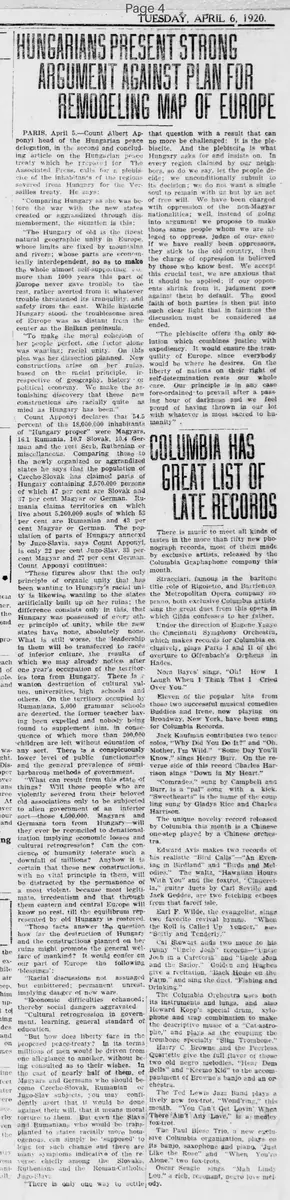
HUNGARIANS PRESENT STRONG ARGUMENT AGAINST PLAN FOR REMODELING MAP OF EUROPE
PARIS, April 5.-Count Albert Apponyi head of the Hungarian peace delegation, in the second and concluding article on the Hungarian peace treaty which he prepared for The Associated Press, calls for a plebiscite of the inhabitants of the regions severed from Hungary for the Versailles treaty. He says:
"Comparing Hungary as she was before the war with the new states created or aggrandized through dismemberment, the situation is this:
"The Hungary of old is the finest natural geographic unity in Europe whose limits are fixed by mountains and rivers; whose parts are economically interdependent, so as to make the whole almost self-supporting. For more than 1000 years this part of Europe never gave trouble to the rest, rather averted from it whatever trouble threatened its tranquility and safety from the east. While historic Hungary stood, the troublesome area of Europe was as distant from the center as the Balkan peninsula.
"To make the moral cohesion of her people perfect, one factor alone was wanting; racial unity. On this plea was her dissection planned. New constructions arise on her ruins, based on the racial principle, irrespective of geography, history or political economy. We make the astonishing discovery that these new constructions are racially quite as mixed as Hungary has been."
Count Apponyi declares that 54.5 percent of the 18,000,000 inhabitants of "Hungary proper" were Magyars, 16.1 Rumanian, 10.7 Slovak, 10.4 German and the rest Serb, Ruthenian or miscellaneous.
Comparing these to the newly organized or aggrandized states he says that the population of Czecho-Slovak has claimed parts of Hungary containing 3,570,000 persons of which 47 per cent are Slovak and 37 per cent Magyar or German. Rumania claims territories on which live about 5,260,000 souls of which 53 per cent are Rumanian and 43 per cent Magyar or German. The population of parts of Hungary annexed by Jugo-Slavia, says Count Apponyi is only 22 per cent Jugo-Slav, 33 per cent Magyar and 27 per cent German.
Count Apponyi continues:
"These figures show that the only principle of organic unity that has been wanting to Hungary's racial unity is likewise wanting to the states artificially built up on her ruins; the difference consists only in this, that Hungary was possessed of every other principle of unity, while the new states have none, absolutely none.
What is still worse, the leadership in them will be transferred to races of inferior culture, the results of which we may already notice, after one year's occupation of the territories torn from Hungary. There is a wanton destruction of cultural values, universities, high schools and others. On the territory occupied by Rumanians, 5,000 grammar schools are deserted, the former teacher having been expelled and nobody being found to supplement him, in consequence of which more than 200,000 children are left without education of any sort. There is a conspicuously lower level of public functionaries and the general prevalence of semi-barbarous methods of government.
"What can result from this state of things? Will those people who are violently severed from their beloved old associations only to be subjected to alien government of an inferior sort-those 4,500,000 Magyars and Germans torn from Hungary-will they ever be reconciled to denationalization implying economic losses and cultural retrogression? Can the conscience of humanity tolerate such a downfall of millions? Anyhow it is certain that those new constructions, with no vital principle in them, will be distracted by the permanence of a most violent, because most legitimate, irredentism and that through them eastern and central Europe will know no rest, till the equilibrium represented by old Hungary is restored.
"Those facts answer the question how far the destruction of Hungary and the constructions planned on her ruins might promote the general welfare of mankind? It would confer on our part of Europe the following 'blessings':
"Racial discussions not assuaged but embittered; permanent unrest, implying danger of new wars.
"Economic difficulties enhanced; thereby social dangers aggravated.
"Cultural retrogression in government, learning, general standard of education.
"But how does liberty fare in the proposed peace-treaty? In its terms millions of men would be driven from one allegiance to another, without being consulted as to their wishes. In the case of nearly half of them, of Magyars and Germans who should become Czecho-Slovak, Rumanian or Jugo-Slav subjects, you may confidently assert that it would be done against their will, that it means moral torture to them. But even the Slavs and Rumanians who would be transplanted to states racially more homogeneous, can simply be 'supposed' to long for such change and there are many symptoms indicative of the reverse, chiefly among the Slovaks, Ruthenians and the Roman-Catholic Jugo-Slav.
"There is only one way to settle that question with a result that can no more be challenged: it is the plebiscite. And the plebiscite is what Hungary asks for and insists on. In every region claimed by our neighbors, so do we say, let the people decide; we unconditionally submit to its decision: we do not want a single soul to remain with us but by an act of free will. We have been charged with oppression of the non-Magyar nationalities; well, instead of going into argument we propose to make those same people whom we are alleged to oppress, judge of our case. If we have really been oppressors, they stick to the old country, then the charge of oppression is believed by those who know best. We accept this crucial test, we are anxious that it should be applied: if our opponents shrink from it, judgment goes against them by default. The good faith of both parties is then put into such clear light that in fairness the discussion must be considered as ended.
"The plebiscite offers the only solution which combines justice with expediency. It would ensure the tranquility of Europe, since everybody would be where he desires. On the liberty of nations on their right of self-determination rests our whole case. Our principle is in any case fore-ordained to prevail after a passing hour of darkness and we feel proud of having thrown in our lot with whatever is most sacred to humanity"
What sub-type of article is it?
What keywords are associated?
What entities or persons were involved?
Where did it happen?
Foreign News Details
Primary Location
Hungary
Event Date
April 5, 1920
Key Persons
Outcome
calls for plebiscite in regions severed from hungary to determine borders based on self-determination; warns of unrest, economic difficulties, and cultural retrogression in new states without it.
Event Details
Count Albert Apponyi, head of the Hungarian peace delegation, publishes an article arguing against the dismemberment of Hungary under the Versailles Treaty. He emphasizes Hungary's geographic, economic, and historical unity, critiques the racial basis of new states like Czecho-Slovakia, Rumania, and Jugo-Slavia for lacking unity and imposing inferior governance, and insists on plebiscites for disputed territories to ensure justice and prevent future conflicts in Europe.