Thank you for visiting SNEWPapers!
Sign up free
The Enquirer
Richmond, Henrico County, Virginia
What is this article about?
An anonymous letter disputes an editor's interpretation of George Canning's letter to William Pinkney, arguing that the U.S. government was aware of impending British Orders in Council through rumors and news reports before President Jefferson proposed the Embargo in December 1807. The writer criticizes Canning and the British Ministry for their role in trade disruptions and anticipates their downfall.
Clipping
OCR Quality
Full Text
Sir,
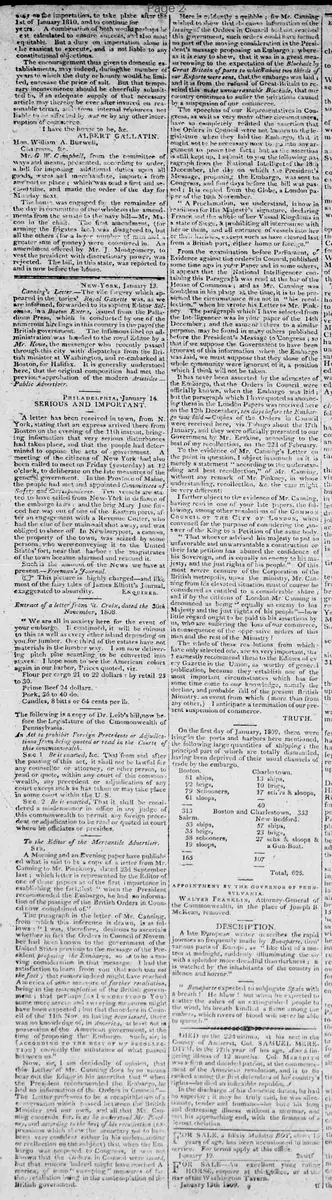
A Morning and an Evening paper have published what is said to be a copy of a letter from Mr. Canning to Mr. Pinckney, dated 23d September last; which letter is represented by the Editor of one of those papers as of the first importance in establishing the fact, that "when the President recommended the Embargo, he had no information of the passage of the British Orders in Council now complained of."
The paragraph in the letter of Mr. Canning, from which this inference is drawn, is as follows: "I was, therefore, desirous to ascertain whether in fact the Orders in Council of November had been known to the government of the United States previous to the message of the President proposing the Embargo, so as to be a moving consideration in that message. I had the satisfaction to learn from you that such was not the fact: that rumors indeed might have reached America of some measure of further retaliation, being in the contemplation of the British government; that perhaps (as I understood you) some more severe and sweeping measures might have been expected; but that the orders in Council of the 11th Nov. as having been issued, there was no knowledge of, in America, at least not in possession of the American government, at the time of proposing the Embargo. Such, sir, is (ACCORDING TO THE BEST OF MY RECOLLECTION) correctly the substance of what passed between us."
Now, sir, I am decidedly of opinion, that this Letter of Mr. Canning does by no means bear out the Editor in his assertion that "when the President recommended the Embargo, he had no information of the Orders in Council."
The letter professes to be a recapitulation of a conversation which passed between the British Minister and our own; and all that Mr. Canning contends for, is as he understood Mr. Pinckney, and according to the best of his recollection (expressions which shew the secretary not to have been very confident either in his understanding or recollection on the subject) that when the Embargo was proposed to Congress, it was not known that the Orders in Council were passed, but that rumors indeed might have reached America, of some "sweeping" measures of further retaliation being in the contemplation of the British government.
Here is evidently a quibble: or Mr. Canning wished to shew that because information of the issuing of the Orders in Council had not reached this government, such orders could have formed no part of the moving consideration in the President's message proposing an Embargo: whereas it is easy to shew, that it was in a great measure owing to the expectation of the Blockade by Great Britain of ports to which about two thirds of our Exports were sent, that the embargo was laid: and it is from the refusal of Great-Britain to rescind this most unwarrantable Blockade, that our country continues to suffer the privations caused by a suspension of our commerce.
The speeches of our Representatives in Congress, as well as very many other circumstances, have so completely refuted the assertion that the Orders in Council were not known to the legislature when they laid the Embargo, that it ought not to be necessary now to go into any argument to prove the fact; but as the assertion is still kept up, I submit to you the following paragraph from the National Intelligencer of the 18th December, the day on which the President's Message, proposing the Embargo, was sent to Congress, and four days before the bill was passed; It is copied from the Globe, a London paper of the 10th November.
"A Proclamation, we understand, is now in readiness for His Majesty's signature, declaring France and the whole of her Vassal Kingdoms in a state of Siege, & prohibiting all intercourse with her or them, and all entrance of vessels into her or their harbors, except such as have cleared last from a British port, either home or foreign."
From the examination before Parliament, of Evidence against the orders in Council, published some time ago in your Paper and in some others, it appears that the National Intelligencer containing this Paragraph was read at the bar of the House of Commons; and as Mr. Canning was doubtless in his place at the time, it is to be presumed the circumstance was not in "his recollection," when he wrote his Letter to Mr. Pinkney. The paragraph which I have selected from the Intelligencer was in your paper of the 14th December; and the same or others to a similar purpose, may be found in many others published before the President's Message to Congress; so that if we suppose the Government to have been ignorant of this information when the Embargo was laid, we must suppose that they alone of the whole community were ignorant of it, a position which I think will not be taken.
It has never been asserted by the advocates of the Embargo, that the Orders in Council were officially known, when the Embargo was laid; but the paragraph which I have quoted as announcing them in the London Papers was received here on the 12th December, ten days before the Embargo was laid—Copies of the Orders in Council were received here, via Tobago about the 17th January, and they were officially presented to our Government by Mr. Erskine, according to the best of my recollection, on the 22d of February.
To the evidence of Mr. Canning's Letter on the point in question, I object inasmuch as it is merely a statement "according to the understanding and best recollection," of Mr. Canning, without any remark of Mr. Pinkney, in whose understanding, recollection, &c. the case might be very different:
I further object to the evidence of Mr. Canning, having read in one of your late papers, the following, among other resolutions of the Common Council of the City of London, when convened for the purpose of considering the answer of the King to a Petition of the same body.
"That whoever advised his majesty to put so unfavorable and unwarrantable a construction on their late petition has abused the confidence of his Sovereign, and is equally an enemy to his majesty, and the just rights of his people." Of this most severe censure of the Corporation of the British metropolis, upon the ministry, Mr. Canning from his elevated situation must of course be considered as entitled to a considerable share; and if by the citizens of London Mr. Canning is denounced as being "equally an enemy to his Majesty and the just rights of his people"—how little regard ought to be paid to his assertions by us, who are suffering the loss of our commerce, in consequence of the oppressive orders of this man and the rest of the Ministry?
The whole of these resolutions from which I have only selected one, are so very important, that I earnestly recommend them to the Editors of every Gazette in the Union, as worthy of general publication, because they establish one of the most important circumstances which has for some time come to our knowledge, namely the decline, and probable fall of the present British Ministry, an event from which (more than from any other,) I anticipate a termination of our present suspension of commerce.
What sub-type of article is it?
What themes does it cover?
What keywords are associated?
What entities or persons were involved?
Letter to Editor Details
Recipient
Editor Of The Mercantile Advertiser
Main Argument
canning's letter does not prove the u.s. president lacked information on british orders in council when proposing the embargo, as rumors and news reports of such measures reached america beforehand; the writer urges dismissal of canning's claims due to his unreliable recollection and criticism from london's common council.
Notable Details