Thank you for visiting SNEWPapers!
Sign up free
Literary
April 29, 1905
The Evening World
New York, New York County, New York
What is this article about?
Philosophical essay drawing on spring's renewal, Solomon's Song, and Epictetus to advocate accepting life's deals, utilizing opportunities, reflecting on character, and living purposefully with moral virtue and cheerfulness.
Clipping
OCR Quality
98%
Excellent
Full Text
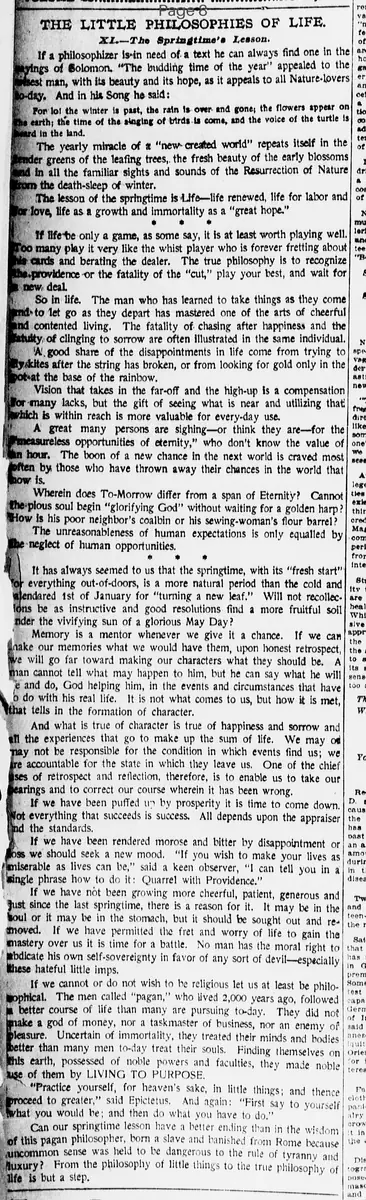
THE LITTLE PHILOSOPHIES OF LIFE.
XL.—The Springtime’s Lesson.
If a philosophizer is in need of a text he can always find one in the sayings of Solomon. “The budding time of the year” appealed to the best man, with its beauty and its hope, as it appeals to all Nature-lovers to-day. And in his Song he said:
For lo! the winter is past, the rain is over and gone; the flowers appear on the earth; the time of the singing of birds is come, and the voice of the turtle is heard in the land.
The yearly miracle of a “new-created world” repeats itself in the tender greens of the leafing trees, the fresh beauty of the early blossoms and in all the familiar sights and sounds of the Resurrection of Nature from the death-sleep of winter.
The lesson of the springtime is Life—life renewed, life for labor and for love; life as a growth and immortality as a “great hope.”
If life be only a game, as some say, it is at least worth playing well.
Too many play it very like the whist player who is forever fretting about his cards and berating the dealer. The true philosophy is to recognize the providence—or the fatality of the “cut,” play your best, and wait for new deal.
So in life. The man who has learned to take things as they come and to let go as they depart has mastered one of the arts of cheerful and contented living. The fatality of chasing after happiness and the stupidity of clinging to sorrow are often illustrated in the same individual.
A good share of the disappointments in life come from trying to fly kites after the string has broken, or from looking for gold only at the foot of the rainbow.
Vision that takes in the far-off and the high-up is a compensation for many lacks, but the gift of seeing what is near and utilizing that which is within reach is more valuable for every-day use.
A great many persons are sighing—or think they are—for the “measureless opportunities of eternity,” who don’t know the value of an hour. The boon of a new chance in the next world is craved most often by those who have thrown away their chances in the world that now is.
Wherein does To-Morrow differ from a span of Eternity? Cannot the pious soul begin “glorifying God” without waiting for a golden harp?
How is his poor neighbor’s coalbin or his sewing-woman’s flour barrel?
The unreasonableness of human expectations is only equalled by the neglect of human opportunities.
It has always seemed to us that the springtime, with its “fresh start” for everything out-of-doors, is a more natural period than the cold and calendar 1st of January for “turning a new leaf.” Will not recollections be as instructive and good resolutions find a more fruitful soil under the vivifying Sun of a glorious May Day?
Memory is a mentor whenever we give it a chance. If we can make our memories what we would have them, upon honest retrospect we will go far toward making our characters what they should be. A man cannot tell what may happen to him, but he can say what he will be and do, God helping him, in the events and circumstances that have to do with his real life. It is not what comes to us, but how it is met, that tells in the formation of character.
And what is true of character is true of happiness and sorrow and in the experiences that go to make up the sum of life. We may or may not be responsible for the condition in which events find us; we are accountable for the state in which they leave us. One of the chief uses of retrospect and reflection, therefore, is to enable us to take our bearings and to correct our course wherein it has been wrong.
If we have been puffed up by prosperity it is time to come down. Not everything that succeeds is success. All depends upon the appraiser and the standards.
If we have been rendered morose and bitter by disappointment or loss we should seek a new mood. “If you wish to make your lives as miserable as lives can be,” said a keen observer, “I can tell you in a single phrase how to do it: Quarrel with Providence.”
If we have not been growing more cheerful, patient, generous and just since the last springtime, there is a reason for it. It may be in the soul or it may be in the stomach, but it should be sought out and removed. If we have permitted the fret and worry of life to gain the mastery over us it is time for a battle. No man has the moral right to abdicate his own self-sovereignty in favor of any sort of devil—especially these hateful little imps.
If we cannot or do not wish to be religious let us at least be philosophical. The men called “pagan,” who lived 2,000 years ago, followed a better course of life than many are pursuing to-day. They did not make a god of money, nor a taskmaster of business, nor an enemy of pleasure. Uncertain of immortality, they treated their minds and bodies better than many men to-day treat their souls. Finding themselves on this earth, possessed of noble powers and faculties, they made noble use of them by LIVING TO PURPOSE.
“Practice yourself, for heaven’s sake, in little things; and thence proceed to greater,” said Epictetus. And again: “First say to yourself what you would be; and then do what you have to do.”
Can our springtime lesson have a better ending than in the wisdom of this pagan philosopher, born a slave and banished from Rome because his uncommon sense was held to be dangerous to the rule of tyranny and luxury? From the philosophy of little things to the true philosophy of life is but a step.
XL.—The Springtime’s Lesson.
If a philosophizer is in need of a text he can always find one in the sayings of Solomon. “The budding time of the year” appealed to the best man, with its beauty and its hope, as it appeals to all Nature-lovers to-day. And in his Song he said:
For lo! the winter is past, the rain is over and gone; the flowers appear on the earth; the time of the singing of birds is come, and the voice of the turtle is heard in the land.
The yearly miracle of a “new-created world” repeats itself in the tender greens of the leafing trees, the fresh beauty of the early blossoms and in all the familiar sights and sounds of the Resurrection of Nature from the death-sleep of winter.
The lesson of the springtime is Life—life renewed, life for labor and for love; life as a growth and immortality as a “great hope.”
If life be only a game, as some say, it is at least worth playing well.
Too many play it very like the whist player who is forever fretting about his cards and berating the dealer. The true philosophy is to recognize the providence—or the fatality of the “cut,” play your best, and wait for new deal.
So in life. The man who has learned to take things as they come and to let go as they depart has mastered one of the arts of cheerful and contented living. The fatality of chasing after happiness and the stupidity of clinging to sorrow are often illustrated in the same individual.
A good share of the disappointments in life come from trying to fly kites after the string has broken, or from looking for gold only at the foot of the rainbow.
Vision that takes in the far-off and the high-up is a compensation for many lacks, but the gift of seeing what is near and utilizing that which is within reach is more valuable for every-day use.
A great many persons are sighing—or think they are—for the “measureless opportunities of eternity,” who don’t know the value of an hour. The boon of a new chance in the next world is craved most often by those who have thrown away their chances in the world that now is.
Wherein does To-Morrow differ from a span of Eternity? Cannot the pious soul begin “glorifying God” without waiting for a golden harp?
How is his poor neighbor’s coalbin or his sewing-woman’s flour barrel?
The unreasonableness of human expectations is only equalled by the neglect of human opportunities.
It has always seemed to us that the springtime, with its “fresh start” for everything out-of-doors, is a more natural period than the cold and calendar 1st of January for “turning a new leaf.” Will not recollections be as instructive and good resolutions find a more fruitful soil under the vivifying Sun of a glorious May Day?
Memory is a mentor whenever we give it a chance. If we can make our memories what we would have them, upon honest retrospect we will go far toward making our characters what they should be. A man cannot tell what may happen to him, but he can say what he will be and do, God helping him, in the events and circumstances that have to do with his real life. It is not what comes to us, but how it is met, that tells in the formation of character.
And what is true of character is true of happiness and sorrow and in the experiences that go to make up the sum of life. We may or may not be responsible for the condition in which events find us; we are accountable for the state in which they leave us. One of the chief uses of retrospect and reflection, therefore, is to enable us to take our bearings and to correct our course wherein it has been wrong.
If we have been puffed up by prosperity it is time to come down. Not everything that succeeds is success. All depends upon the appraiser and the standards.
If we have been rendered morose and bitter by disappointment or loss we should seek a new mood. “If you wish to make your lives as miserable as lives can be,” said a keen observer, “I can tell you in a single phrase how to do it: Quarrel with Providence.”
If we have not been growing more cheerful, patient, generous and just since the last springtime, there is a reason for it. It may be in the soul or it may be in the stomach, but it should be sought out and removed. If we have permitted the fret and worry of life to gain the mastery over us it is time for a battle. No man has the moral right to abdicate his own self-sovereignty in favor of any sort of devil—especially these hateful little imps.
If we cannot or do not wish to be religious let us at least be philosophical. The men called “pagan,” who lived 2,000 years ago, followed a better course of life than many are pursuing to-day. They did not make a god of money, nor a taskmaster of business, nor an enemy of pleasure. Uncertain of immortality, they treated their minds and bodies better than many men to-day treat their souls. Finding themselves on this earth, possessed of noble powers and faculties, they made noble use of them by LIVING TO PURPOSE.
“Practice yourself, for heaven’s sake, in little things; and thence proceed to greater,” said Epictetus. And again: “First say to yourself what you would be; and then do what you have to do.”
Can our springtime lesson have a better ending than in the wisdom of this pagan philosopher, born a slave and banished from Rome because his uncommon sense was held to be dangerous to the rule of tyranny and luxury? From the philosophy of little things to the true philosophy of life is but a step.
What sub-type of article is it?
Essay
What themes does it cover?
Seasonal Cycle
Moral Virtue
Religious
What keywords are associated?
Springtime Lesson
Life Philosophy
Moral Reflection
Solomon Song
Epictetus Wisdom
Literary Details
Title
The Little Philosophies Of Life. Xl.—The Springtime’s Lesson.
Subject
The Springtime’s Lesson
Key Lines
For Lo! The Winter Is Past, The Rain Is Over And Gone; The Flowers Appear On The Earth; The Time Of The Singing Of Birds Is Come, And The Voice Of The Turtle Is Heard In The Land.
The Lesson Of The Springtime Is Life—Life Renewed, Life For Labor And For Love; Life As A Growth And Immortality As A “Great Hope.”
Practice Yourself, For Heaven’s Sake, In Little Things; And Thence Proceed To Greater.
First Say To Yourself What You Would Be; And Then Do What You Have To Do.
From The Philosophy Of Little Things To The True Philosophy Of Life Is But A Step.