Thank you for visiting SNEWPapers!
Sign up free
Letter to Editor
March 29, 1843
The North Carolina Standard
Raleigh, Wake County, North Carolina
What is this article about?
A letter to the North Carolina Standard urges the Democratic Party to hold its national convention in Baltimore in May 1844, rather than November, citing party traditions, state representations, congressional timing, travel conditions, and the need for unity against Whig opponents. Signed by MACON.
Clipping
OCR Quality
98%
Excellent
Full Text
For the North Carolina Standard.
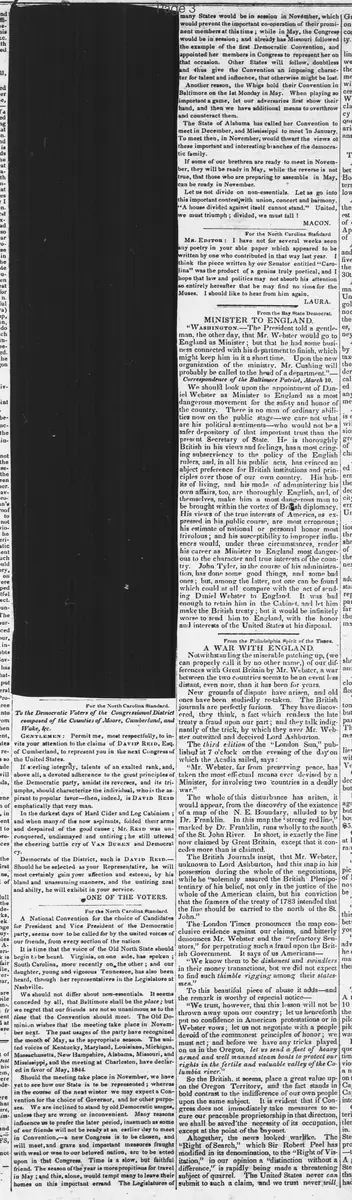
A National Convention for the choice of Candidates for President and Vice President of the Democratic party, seems now to be called for by the united voices of our friends, from every section of the nation.
It is time that the voice of the Old North State should begin to be heard. Virginia, on one side, has spoken; South Carolina, more recently on the other; and our daughter, young and vigorous Tennessee, has also been heard, through her representatives in the Legislature at Nashville.
We should not differ about non-essentials. It seems conceded by all, that Baltimore shall be the place; but we regret that our friends are not so unanimous as to the time that the Convention should meet. The Old Dominion wishes that the meeting take place in November next. The past usages of the party have recognized the month of May, as the appropriate season. The united voices of Kentucky, Maryland, Louisiana, Michigan, Massachusetts, New Hampshire, Alabama, Missouri, and Mississippi, and the meeting at Charleston, have declared in favor of May, 1844.
Should the meeting take place in November, we have yet to see how our State is to be represented; whereas in the course of the next winter we may expect a Convention for the choice of Governor, and for other purposes.
We are inclined to stand by old Democratic usages, unless they are wrong or inconvenient. Many reasons influence us to prefer the later period, inasmuch as some of our friends will not be ready at an earlier day to meet in Convention,—a new Congress is to be chosen, and will meet, and grave and important measures fraught with weal or woe to our beloved nation, are to be acted upon in that Congress. Time is a slow, but faithful friend. The season of the year is more propitious for travel in May; and this, alone, would tempt many to leave their homes on this important errand. The Legislatures of many States would be in session in November, which would prevent the important co-operation of their prominent members at this time; while in May, the Congress would be in session; and already has Missouri followed the example of the first Democratic Convention, and appointed her members in Congress to represent her on that occasion. Other States will follow, doubtless and thus give the Convention an imposing character for talent and influence, that otherwise might be lost.
Another reason, the Whigs hold their Convention in Baltimore on the 1st Monday in May. When playing so important a game, let our adversaries first show their hand, and then we have additional means to overthrow and counteract them.
The State of Alabama has called her Convention to meet in December, and Mississippi to meet in January. To meet then, in November; would thwart the views of these important and interesting branches of the democratic family.
If some of our brethren are ready to meet in November, they will be ready in May, while the reverse is not true, that those who are preparing to assemble in May, can be ready in November.
Let us not divide on non-essentials. Let us go into this important contest with union, concert and harmony.
"A house divided against itself cannot stand."
United, we must triumph; divided, we must fall!
MACON.
A National Convention for the choice of Candidates for President and Vice President of the Democratic party, seems now to be called for by the united voices of our friends, from every section of the nation.
It is time that the voice of the Old North State should begin to be heard. Virginia, on one side, has spoken; South Carolina, more recently on the other; and our daughter, young and vigorous Tennessee, has also been heard, through her representatives in the Legislature at Nashville.
We should not differ about non-essentials. It seems conceded by all, that Baltimore shall be the place; but we regret that our friends are not so unanimous as to the time that the Convention should meet. The Old Dominion wishes that the meeting take place in November next. The past usages of the party have recognized the month of May, as the appropriate season. The united voices of Kentucky, Maryland, Louisiana, Michigan, Massachusetts, New Hampshire, Alabama, Missouri, and Mississippi, and the meeting at Charleston, have declared in favor of May, 1844.
Should the meeting take place in November, we have yet to see how our State is to be represented; whereas in the course of the next winter we may expect a Convention for the choice of Governor, and for other purposes.
We are inclined to stand by old Democratic usages, unless they are wrong or inconvenient. Many reasons influence us to prefer the later period, inasmuch as some of our friends will not be ready at an earlier day to meet in Convention,—a new Congress is to be chosen, and will meet, and grave and important measures fraught with weal or woe to our beloved nation, are to be acted upon in that Congress. Time is a slow, but faithful friend. The season of the year is more propitious for travel in May; and this, alone, would tempt many to leave their homes on this important errand. The Legislatures of many States would be in session in November, which would prevent the important co-operation of their prominent members at this time; while in May, the Congress would be in session; and already has Missouri followed the example of the first Democratic Convention, and appointed her members in Congress to represent her on that occasion. Other States will follow, doubtless and thus give the Convention an imposing character for talent and influence, that otherwise might be lost.
Another reason, the Whigs hold their Convention in Baltimore on the 1st Monday in May. When playing so important a game, let our adversaries first show their hand, and then we have additional means to overthrow and counteract them.
The State of Alabama has called her Convention to meet in December, and Mississippi to meet in January. To meet then, in November; would thwart the views of these important and interesting branches of the democratic family.
If some of our brethren are ready to meet in November, they will be ready in May, while the reverse is not true, that those who are preparing to assemble in May, can be ready in November.
Let us not divide on non-essentials. Let us go into this important contest with union, concert and harmony.
"A house divided against itself cannot stand."
United, we must triumph; divided, we must fall!
MACON.
What sub-type of article is it?
Persuasive
Political
What themes does it cover?
Politics
What keywords are associated?
Democratic Convention
Baltimore May 1844
Party Unity
North Carolina
Whig Convention
Congressional Representation
What entities or persons were involved?
Macon.
North Carolina Standard
Letter to Editor Details
Author
Macon.
Recipient
North Carolina Standard
Main Argument
the democratic national convention should convene in baltimore in may 1844, adhering to party traditions, allowing better state representation, aligning with congressional sessions, facilitating travel, and enabling strategic response to the whig convention, to maintain party unity.
Notable Details
Quotes 'A House Divided Against Itself Cannot Stand.'
References Preferences Of States Like Virginia, South Carolina, Tennessee, Kentucky, Maryland, Louisiana, Michigan, Massachusetts, New Hampshire, Alabama, Missouri, Mississippi.
Mentions Whig Convention On 1st Monday In May.
Notes Alabama's State Convention In December And Mississippi's In January.