Thank you for visiting SNEWPapers!
Sign up free
Gazette Of The United States, & Philadelphia Daily Advertiser
Philadelphia, Philadelphia County, Pennsylvania
What is this article about?
In the U.S. House of Representatives on December 30, members debated a committee report on collecting unsettled balances owed by states like New York to the federal government from the Revolutionary War. Speakers including Smith, Williams, Harper, and others argued over the fairness of the 1790 settlement, payment methods, and whether to demand payment now, amid concerns of irritation and enforcement challenges.
Merged-components note: Continuation of the congressional debate on state balances, indicated by '[Continued.]' across pages.
Clippings
1 of 2
OCR Quality
Full Text
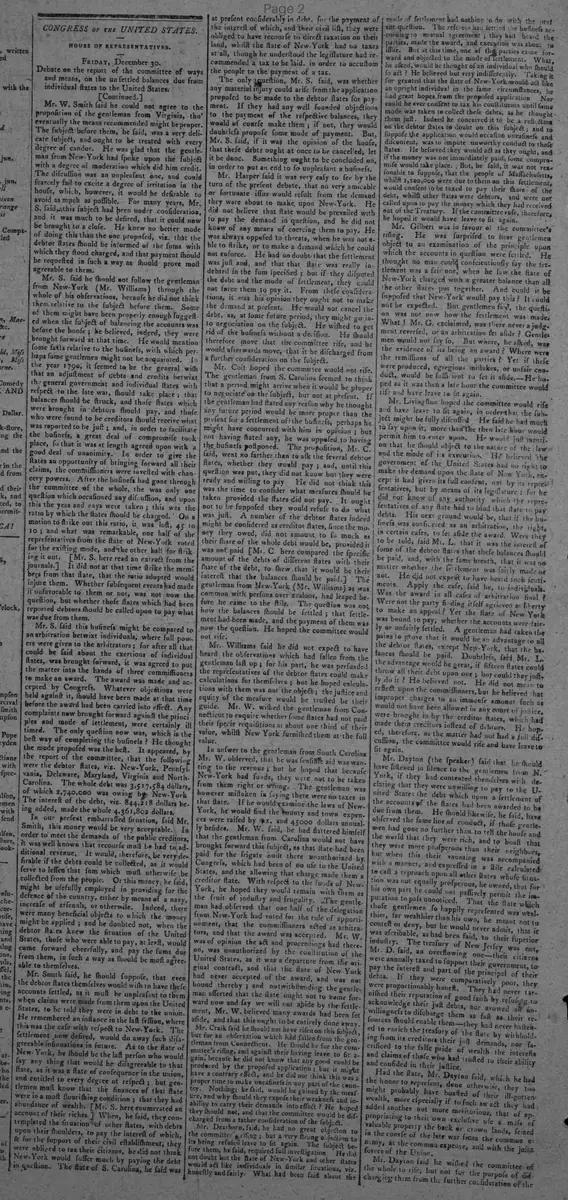
HOUSE OF REPRESENTATIVES.
Friday, December 30.
Debate on the report of the committee of ways and means, on the unsettled balances due from individual states to the United States.
[Continued.]
Mr. W. Smith said he could not agree to the proposition of the gentleman from Virginia, tho eventually the means recommended might be proper. The subject before them, he said, was a very delicate subject, and ought to be treated with every degree of candor. He was glad that the gentleman from New-York had spoke upon the subject with a degree of moderation which did him credit. The discussion was an unpleasant one, and could scarcely fail to excite a degree of irritation in the house, which, however, it would be desirable to avoid as much as possible. For many years, Mr. S. said, this subject had been under consideration, and it was much to be desired, that it could now be brought to a close. He knew no better mode of doing this than the one proposed, viz. that the debtor states should be informed of the sums with which they stood charged, and that payment should be requested in such a way as should prove most agreeable to them.
Mr. S. said he should not follow the gentleman from New-York (Mr. Williams) through the whole of his observations, because he did not think them relative to the subject before them. Some of them might have been properly enough suggested when the subject of balancing the accounts was before the house; he believed, indeed, they were brought forward at that time. He would mention some facts relative to the business, with which perhaps some gentlemen might not be acquainted. In the year 1790, it seemed to be the general wish that an adjustment of debts and credits betwixt the general government and individual states with respect to the late war, should take place; that balances should be struck, and those states which were brought in debtors, should pay, and those who were found to be creditors should receive what was reported to be just; and, in order to facilitate the business, a great deal of compromise took place, so that it was at length agreed upon with a good deal of unanimity. In order to give the states an opportunity of bringing forward all their claims, the commissioners were invested with chancery powers. After the business had gone through the committee of the whole, there was only one question which occasioned any discussion, and upon this the yeas and nays were taken; this was the ratio by which the states should be charged. On a motion to strike out this ratio, it was lost, 45 to 10; and what was remarkable, one half of the representatives from the state of New-York voted for the existing mode, and the other half for striking it out. [Mr. S. here read an extract from the journals.] It did not at that time strike the members from that state, that the ratio adopted would injure them. Whether subsequent events had made it unfavorable to them or not, was not now the question, but whether those states which had been reported debtors should be called upon to pay what was due from them.
Mr. S. said this business might be compared to an arbitration betwixt individuals, where full powers were given to the arbitrators; for after all that could be said about the exertions of individual states, was brought forward, it was agreed to put the matter into the hands of three commissioners to make an award. The award was made and accepted by Congress. Whatever objections were held against it, should have been made at that time before the award had been carried into effect. Any complaints now brought forward against the principles and mode of settlement, were certainly ill timed. The only question now was, which is the best way of completing the business? He thought the mode proposed was the best. It appeared, by the report of the committee, that the following were the debtor states, viz. New-York, Pennsylvania, Delaware, Maryland, Virginia and North-Carolina. The whole debt was 3,517,584 dollars, of which 2,740,000 was owing by New-York. The interest of the debt, viz. 844,218 dollars being added, made the whole 4,361,802 dollars.
In our present embarrassed situation, said Mr. Smith, this money would be very acceptable. In order to meet the demands of the public creditors, it was well known that recourse must be had to additional revenue. It would, therefore, be very desirable if the debts could be collected, as it would serve to lessen that sum which must otherwise be collected from the people. Of this money, he said, might be usefully employed in providing for the defence of the country, either by means of a navy, increase of arsenals, or otherwise. Indeed, there were many beneficial objects to which the money might be applied; and he doubted not, when the debtor states knew the situation of the United States, those who were able to pay, at least, would come forward cheerfully, and pay the sums due from them, in such a way as should be most agreeable to themselves.
Mr. Smith said, he should suppose, that even the debtor states themselves would wish to have these accounts settled, as it must be unpleasant to them when claims were made from them upon the United States, to be told they were in debt to the union. He remembered an instance in the last session, where this was the case with respect to New-York. The settlement now desired, would do away such disagreeable insinuations in future. As to the State of New-York, he should be the last person who would say any thing that would be disagreeable to that state, as it was a state of consequence in the union, and entitled to every degree of respect; but gentlemen must know that the finances of that state were in a most flourishing condition; that they had abundance of wealth. Mr. S. here enumerated an account of their riches. When, he said, they contemplated the situation of other states, with debts upon their shoulders, to pay the interest of which, & for the support of their civil establishment; they were obliged to tax their citizens, he did not think New-York would suffer much by paying the debt in question. The state of S. Carolina, he said was at present considerably in debt, for the payment of the interest of which, and their civil list, they were obliged to have recourse to direct taxation on their land, whilst the state of New-York had no taxes at all, though he understood the legislature had recommended a tax to be laid, in order to accustom the people to the payment of a tax.
The only question, Mr. S. said, was whether any material injury could arise from the application proposed to be made to the debtor states for payment. If they had any well founded objections to the payment of the respective balances, they would of course make them; if not, they would doubtless propose some mode of payment. But, Mr. S. said, if it was the opinion of the house, that these debts ought at once to be cancelled, let it be done. Something ought to be concluded on, in order to put an end to so unpleasant a business.
Mr. Harper said it was very easy to see by the turn of the present debate, that no very amicable or fortunate issue would result from the demand they were about to make upon New-York. He did not believe that state would be prevailed with to pay the demand in question, and he did not know of any means of coercing them to pay. He was always opposed to threats, when he was not able to strike, or to make a demand which he could not enforce. He had no doubt. that the settlement was just and, and that that state was really indebted in the sum specified; but if they disputed the debt and the mode of settlement, they could not force them to pay it. From these considerations, it was his opinion they ought not to make the demand at present. He would not cancel the debt, as, at some future period, they might go into negociation on the subject. He wished to get rid of the business without a decision. He should therefore move that the committee rise, and he would afterwards move, that it be discharged from a further consideration on the subject.
Mr. Coit hoped the committee would not rise. The gentleman from S. Carolina seemed to think that a period might arrive when it would be proper to negociate on the subject, but not at present. If the gentleman had stated any reason why he thought any future period would be more proper than the present for a settlement of the business, perhaps he might have concurred with him in opinion; but not having stated any, he was opposed to having the business postponed. The proposition, Mr. C. said, went no farther than to ask the several debtor states, whether they would pay; and, until this question was put, they did not know but they were ready and willing to pay. He did not think this was the time to consider what measures should be taken provided the states did not pay. It ought not to be supposed they would refuse to do what was just. A number of the debtor states indeed might be considered as creditor states, since the money they owed, did not amount to so much as their share of the whole debt would be, provided it was not paid Mi. C bere compared the specific amount of the debts of different states with their share of the debt, to shew that it would be their interest that the balances should be paid.7 The gentleman from New-York (Mr. Williams) as was common with persons over zealous, had leaped before he came to the stile. The question was not hoiv the balances should be settled ; that settlement had been made, and the payment of them was now the question. He hoped the committee would not rise:
Mr. Williams said he did not expect to have heard the observations which had fallen from the gentleman last up ; for his part, he was persuaded the representatives of the debtor states could make calculations for themselves ; but he hoped calculations with them was not the object; the justice and equity of the measure would he trusted be their guide. Mr. W. wished the gentleman from Connecticut to enquire whether some states had not paid their specie requisitions at about one third of their value, whilst New York furnished them at the full value.
In answer to the gentleman from South Carolina Mr. W. observed, that he was sensible said was wanting to the revenue; but he hoped that because New-York had funds, they were not to be taken from them right or wrong. . The gentleman 'was however mistaken in saying there were no taxes in that state. If he would examine the laws of New.York, he would find the county and town expences were raised by tax, and 45000 dollars annually besides. Mr. W. said, he had flattered himself that the gentleman from Carolina would not have brought forward this subject, as that state had been paid for the frigate built there unauthorized by Congress, which had been of no use to the United States, and the allowing that charge made them a creditor state. With respect to the funds of New-York, he hoped they would remain with them as the fruit of industry and frugality. The gentleman had observed that one half of the delegation from New-York had voted for the rule of apportionment, that the commissioners acted as arbitrators, and that the award was accepted. Mr. W. was of opinion the act and proceedings had thereon, was unauthorized by the constitution of the, United States, as it was a departure from the original contract, and that the state of New.York had never accepted of the award, and was not bound thereby ; and notwithstanding the gentleman asserted that the state ought not to come forward now and say we will not abide by the settlement, Mr. W. believed many awards had been set aside, and that this ought to be entirely done away.
Mr. Craik said he should not have risen on this subject, but for an observation which had fallen from the gentleman from Connecticut. He should be for the committee's rising, and against their having leave to sit again, because he did not know that any good could be produced by the proposed application; but it might have a contrary effect, and he did not think this was a proper time to make uneasiness in any part of the country. Nothing; he said, would be gained by the measure, and why should they expose their weakness and inability to carry their demands into effect ? He hoped they should not, and that the committee would be discharged from a further consideration of the subject.
Mr. Dearborn, said, he had no great objection to the committee rising; but a very strong objection to its being refused leave to sit again. The subject before them, he said, required full investigation. He did not doubt but the state of New-York and other states would act like individuals in similar situations, viz. honestly and fairly. What had been said about the mode of settlement had nothing to do with the present question. The referees had settled the business according to mutual agreement ; they had heard the parties, made the award, and execution was about to issue. But at this time, one of the parties came forward and objected to the mode of settlement. What, he asked, would be thought of an individual who should so act ? He believed but very indifferently. Taking it for granted that the state of New-York would act like an upright individual in the same circumstances, he had great hopes from the proposed application Nor could he ever consent to tax his constituents until one mode was taken to collect these debts, as he thought them just. Indeed he conceived it to be a reflection on the debtor states to doubt on this subject; and to suppose the application would occasion uneasiness and discontent, was to impute unworthy conduct to those states. He believed they would act as they ought, and if the money was not immediately paid, some compromise would take place. But, he said, it was not reasonable to suppose, that the people of Massachusetts, whilst 1,200,000 were due to them on this settlement, would consent to be taxed to pay their share of the debt, whilst other states were debtors, and were not called upon to pay the money which they had received out of the Treasury. If the committee rose, therefore, he hoped it would have leave to sit again.
Mr. Gilbert was in favour of the committee's rising. He was surprised to hear gentlemen object to an examination of the principle upon which the accounts in question were settled. He thought no man could conscientiously say the settlement was a fair one, when he saw the state of New-York charged with a greater balance than all the other states put together. And could it be supposed that New-York would pay this ? It could not be expected. But gentlemen said, the question was not now how the settlement was made. What ! Mr. G. exclaimed, was there never a judgment reversed, or an arbitration set aside ? Gentlemen would not say so. But where, he asked, was the evidence of its being an award ? Where were the remissions of all the parties ? Yet if these were produced, egregious mistakes, or unfair conduct, would be sufficient to set it aside.-He hoped as it was then a late hour the committee would rise and have leave to sit again.
Mr. Livingston hoped the committee would rise and have leave to sit again, in order that the subject might be fully discussed He said he had much to say upon it, more than the then late hour would permit him to enter upon. He would just mention that he should object to the nature of the law make the demand upon the state of New York, except it had given its full consent, not by its representatives, but by means of its legislature : for he did not know of any authority which the representatives of any state had to bind that state to pay debts. His next ground would be, that if the business was considered as an arbitration, the right, in certain cases, to set aside the award. Were they to be told, said Mr. L. that it was the interest of some of the debtor states that these balances should be paid, and, with the same breath, that it was no matter whether the settlement was fairly made or not. He did not expect to have heard such sentiments. 'Apply the case, said he, to individuals. Was the award in all cases of arbitration final ? Were not the party finding itself aggrieved at liberty to make an appeal? Yet the state of New York was bound to pay, whether the accounts were fairly or unfairly settled. A gentleman had taken the pains to prove that it would be an advantage to all the debtor states, except New-York, that the balances should be paid. Doubtless, said Mr. L. the advantage would be great, if fifteen states could throw all their debt upon one; but could they justly do it ? He believed not. He did not mean to reflect upon the commissioners, but he believed that improper charges to an immense amount such as would not have been allowed in any court of justice, were brought in by the creditor states, which had made them creditors instead of debtors. He hoped, therefore, as the matter had not had a full discussion, the committee would rise and have leave to sit again.
Mr. Dayton (the speaker) said that he should have listened in silence to the gentlemen from N.-York, if they had contented themselves with declaring that they were unwilling to pay to the United States the debt which upon a settlement of the accounts of the states had been awarded to be due from them. He should likewise, he said. have observed the same line of conduct, if those gentlemen had gone no further than to tell the house and the world that they were rich, and to boast that they were more prosperous than their neighbors, but when this their vaunting was accompanied with a manner, and expressed in a stile calculated to cast a reproach upon all other states whose situation was not equally prosperous, he owned, that for his own part he could not passively permit the imputation to pass unnoticed. That the state which those gentlemen so happily represented was wealthier, far wealthier than his own, he meant not to contest or deny, but he would never admit, that it was ascribable, as had been said, to their superior industry. The treasury of New Jersey was not, Mr. D. said, an overflowing one--their. citizens were annually taxed to support their government, to pay the interest and part of the principal of their debts. If they were comparatively poor, they were proportionably honest. They had never tarnished their reputation of good faith by refusing to acknowledge their just debts, nor avowed an unwillingness to discharge them as fast as their resources should enable them-they had never hastened to enrich the treasury of the state by withholding from its creditors their just demands, nor sacrificed to the false pride of wealth the interests and claims of those who had trusted to their ability and confided in their justice.
Had the state, Mr. Dayton said, which he had the honor to represent, done otherwise, they too might probably have boasted of their ill-gotten wealth, more especially if to such an act they had added another not more meritorious, that of appropriating to their own exclusive use a mass of valuable property the back or crown lands, seized in the course of the late war from the common enemy, at the common expense, and with the joint forces of the Union.
Mr. Dayton said he wished the committee of the whole to rise, but not for the purpose of discharging them from the further consideration of the Subject. He hoped they would have leave to sit again and decide upon the resolutions that had been offered to them, for he seriously believed if ever they were to call upon the debtor states to pay what they owed to the Union, this was the proper season for doing it. Every week's delay, whilst it seemed to give new strength to the unwillingness of those states to discharge their balances, weakened the ability of the general government to enforce them.
[To be continued.]
What sub-type of article is it?
What keywords are associated?
What entities or persons were involved?
Where did it happen?
Domestic News Details
Primary Location
United States
Event Date
Friday, December 30
Key Persons
Outcome
debate continued without resolution; motions to rise and discharge the committee discussed but not decided.
Event Details
Members of the House debated the committee report on collecting unsettled Revolutionary War balances from debtor states (New-York, Pennsylvania, Delaware, Maryland, Virginia, North-Carolina), totaling over 4 million dollars, primarily owed by New-York. Arguments focused on the 1790 settlement's fairness, arbitration validity, state finances, and whether to demand payment now or negotiate later.