Thank you for visiting SNEWPapers!
Sign up free
The Virginia Gazette
Richmond, Williamsburg, Richmond County, Virginia
What is this article about?
A letter to the clergy and laity of the former established church in Virginia urges maintaining episcopal ordination through free elections by clergy and people, citing scriptural warrant, historical precedents from Blackstone, Magna Carta, and Saxon church practices to preserve church order and morality amid post-revolutionary challenges.
Clipping
OCR Quality
Full Text
GENTLEMEN,
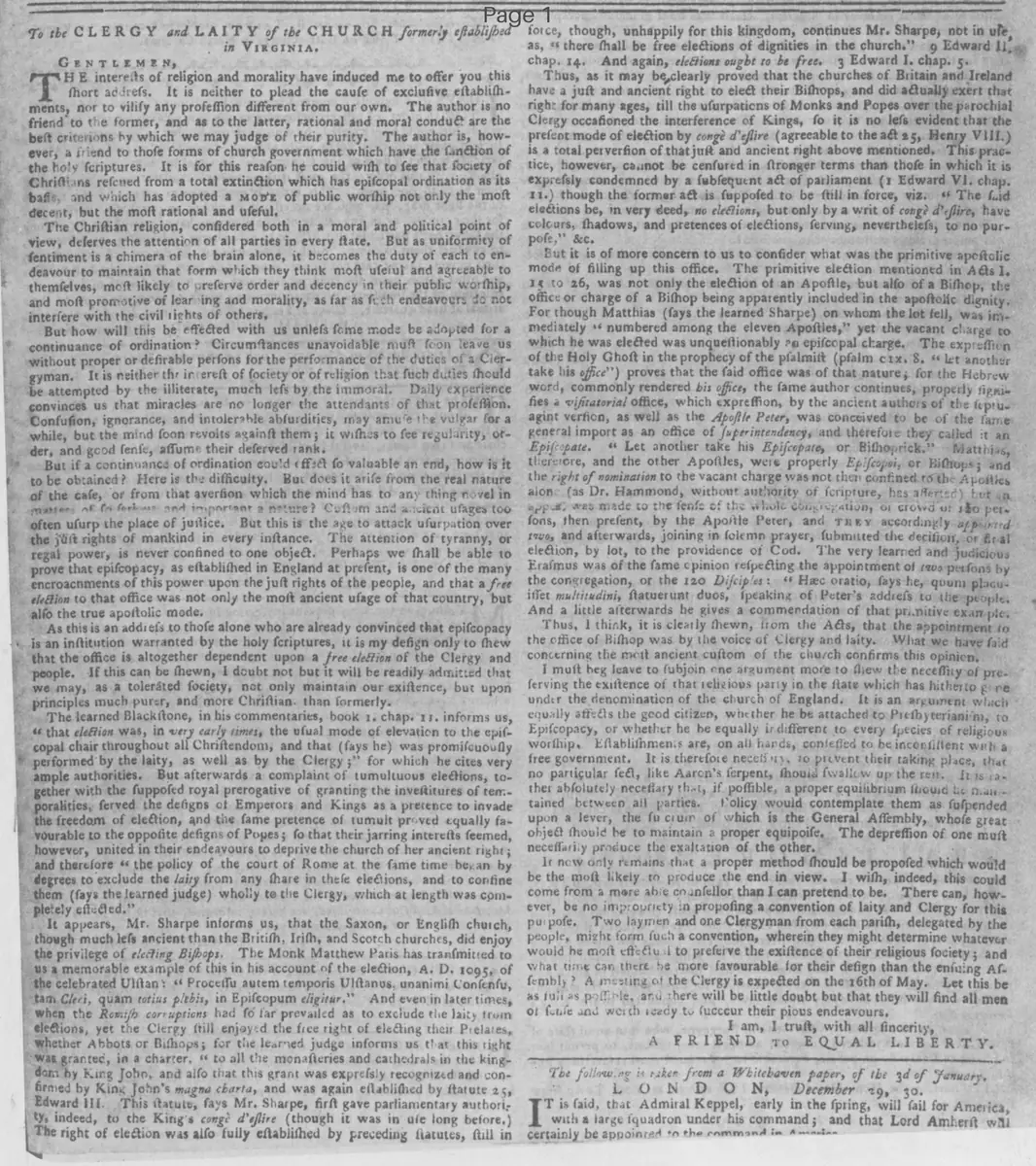
The interests of religion and morality have induced me to offer you this short address. It is neither to plead the cause of exclusive establishments, nor to vilify any profession different from our own. The author is no friend to the former, and as to the latter, rational and moral conduct are the best criterions by which we may judge of their purity. The author is, however, a friend to those forms of church government which have the sanction of the holy scriptures. It is for this reason he could wish to see that society of Christians rescued from a total extinction which has episcopal ordination as its basis, and which has adopted a mode of public worship not only the most decent, but the most rational and useful.
The Christian religion, considered both in a moral and political point of view, deserves the attention of all parties in every state. But as uniformity of sentiment is a chimera of the brain alone, it becomes the duty of each to endeavour to maintain that form which they think most useful and agreeable to themselves, most likely to preserve order and decency in their public worship, and most promotive of learning and morality, as far as such endeavours do not interfere with the civil rights of others.
But how will this be effected with us unless some mode be adopted for a continuance of ordination? Circumstances unavoidable must soon leave us without proper or desirable persons for the performance of the duties of a Clergyman. It is neither the interest of society or of religion that such duties should be attempted by the illiterate, much less by the immoral. Daily experience convinces us that miracles are no longer the attendants of that profession. Confusion, ignorance, and intolerable absurdities, may amuse the vulgar for a while, but the mind soon revolts against them; it wishes to see regularity, order, and good sense, assume their deserved rank.
But if a continuance of ordination could effect so valuable an end, how is it to be obtained? Here is the difficulty. But does it arise from the real nature of the case, or from that aversion which the mind has to any thing novel in matters of so serious and important a nature? Custom and ancient usages too often usurp the place of justice. But this is the age to attack usurpation over the just rights of mankind in every instance. The attention of tyranny, or regal power, is never confined to one object. Perhaps we shall be able to prove that episcopacy, as established in England at present, is one of the many encroachments of this power upon the just rights of the people, and that a free election to that office was not only the most ancient usage of that country, but also the true apostolic mode.
As this is an address to those alone who are already convinced that episcopacy is an institution warranted by the holy scriptures, it is my design only to show that the office is altogether dependent upon a free election of the Clergy and people. If this can be shown, I doubt not but it will be readily admitted that we may, as a tolerated society, not only maintain our existence, but upon principles much purer, and more Christian, than formerly.
The learned Blackstone, in his commentaries, book I. chap. II. informs us, that election was, in very early times, the usual mode of elevation to the episcopal chair throughout all Christendom, and that, says he, was promiscuously performed by the laity, as well as by the Clergy; for which he cites very ample authorities. But afterwards a complaint of tumultuous elections, together with the supposed royal prerogative of granting the investitures of temporality, served the designs of Emperors and Kings as a pretence to invade the freedom of election, and the same pretence of tumult proved equally favourable to the opposite designs of Popes; so that their jarring interests seemed, however, united in their endeavours to deprive the church of her ancient right; and therefore the policy of the court of Rome at the same time began by degrees to exclude the laity from any share in these elections, and to confine them, says the learned judge, wholly to the Clergy, which at length was completely effected.
It appears, Mr. Sharpe informs us, that the Saxon, or English church, though much less ancient than the British, Irish, and Scotch churches, did enjoy the privilege of electing Bishops. The Monk Matthew Paris has transmitted to us a memorable example of this in his account of the election, A. D. 1065, of the celebrated Wulfstan: Procedu autem temporis Wulfstanus, unanimi Consensu, tam Cleri, quam totius plebis, in Episcopum eligitur. And even in later times, when the Romish corruptions had so far prevailed as to exclude the laity from elections, yet the Clergy still enjoyed the free right of electing their Prelates, whether Abbots or Bishops; for the learned judge informs us that this right was granted, in a charter, to all the monasteries and cathedrals in the kingdom by King John, and also that this grant was expressly recognized and confirmed by King John's magna carta, and was again established by statute 25, Edward III. This statute, says Mr. Sharpe, first gave parliamentary authority, indeed, to the King's congè d'élire (though it was in use long before.) The right of election was also fully established by preceding statutes, till in
What sub-type of article is it?
What themes does it cover?
What keywords are associated?
What entities or persons were involved?
Letter to Editor Details
Recipient
To The Clergy And Laity Of The Church Formerly Established In Virginia
Main Argument
advocates for continuing episcopal ordination in virginia's church through free elections by clergy and laity, arguing it aligns with scriptural and ancient practices, counters royal encroachments, and preserves religious order and morality.
Notable Details