Thank you for visiting SNEWPapers!
Sign up free
Story
September 5, 1821
The Hillsborough Recorder
Hillsboro, Orange County, North Carolina
What is this article about?
The article establishes spontaneous combustion as a proven cause of factory fires, once blamed on arson or British sabotage. It details a near-fire at Crocker & Richmond's Taunton stone factory from ignited waste cotton and lists substances prone to it, quoting chemist Henry on oil-related risks.
Clipping
OCR Quality
95%
Excellent
Full Text
SPONTANEOUS COMBUSTION.
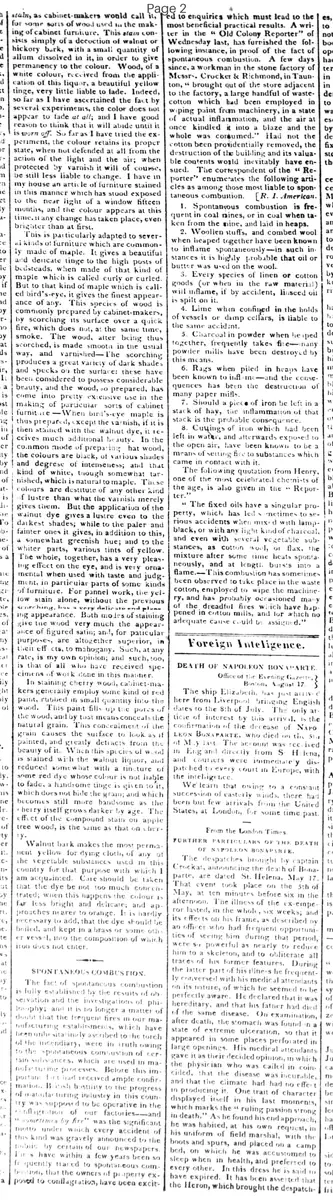
The fact of spontaneous combustion is fully established by the results of observation and the investigations of philosophy; and it is no longer a matter of doubt that the frequent fires in our manufacturing establishments, which have been unhesitatingly ascribed to the torch of the incendiary, were in truth owing to the spontaneous combustion of certain substances, which are used in manufacturing processes. Before this important fact had received ample confirmation, British hostility to the progress of manufacturing industry in this country was supposed to be operative in the conflagration of our factories—and "sometimes by fire" was the significant motto under which every accident of this kind was gravely announced to the public by certain of our newspapers.
Inquiries have within a few years been so frequently directed to spontaneous combustion, that the owners of property exposed to conflagration, have been excited to inquiries which must lead to the most beneficial practical results. A writer in the "Old Colony Reporter" of Wednesday last, has furnished the following instance, in proof of the fact of spontaneous combustion. A few days since, a workman in the stone factory of Messrs. Crocker & Richmond, in Taunton, brought out of the store adjacent to the factory, a large handful of waste cotton which had been employed in wiping paint from machinery, in a state of actual inflammation, and the air at once kindled it into a blaze and the whole was consumed. Had not the cotton been providentially removed, the destruction of the building and its valuable contents would inevitably have ensued.
The correspondent of the "Reporter" enumerates the following articles as among those most liable to spontaneous combustion. N. I. American.
1. Spontaneous combustion is frequent in coal mines, or in coal when taken from the mine, and laid in heaps.
2. Woollen stuffs, and combed wool when heaped together have been known to inflame spontaneously—in such instances it is highly probable that oil or butter was used on the wool.
3. Every species of linen or cotton goods (or when in the raw material) will inflame, if by accident, linseed oil is spilt on it.
4. Lime when confined in the holds of vessels or damp cellars, is liable to the same accident.
5. Charcoal in powder when heaped together, frequently takes fire—many powder mills have been destroyed by this means.
6. Rags when piled in heaps have been known to inflame—and the consequences has been the destruction of many paper mills.
7. Should a piece of iron be left in a stack of hay, the inflammation of that stack is the probable consequence.
8. Cuttings of iron which had been left in water, and afterwards exposed to the open air, have been known to be a means of setting fire to substances which came in contact with it.
The following quotation from Henry, one of the most celebrated chemists of the age, is also given in the "Reporter."
"The fixed oils have a singular property, which has led sometimes to serious accidents when mixed with lamp-black, or with any light kind of charcoal, and even with several vegetable substances, as cotton wool, or flax, the mixture after some time heats spontaneously, and at length bursts into a flame. This combustion has sometimes been observed to take place in the waste cotton, employed to wipe the machinery, and has probably occasioned many of the dreadful fires which have happened in cotton mills, and for which no adequate cause could be assigned."
The fact of spontaneous combustion is fully established by the results of observation and the investigations of philosophy; and it is no longer a matter of doubt that the frequent fires in our manufacturing establishments, which have been unhesitatingly ascribed to the torch of the incendiary, were in truth owing to the spontaneous combustion of certain substances, which are used in manufacturing processes. Before this important fact had received ample confirmation, British hostility to the progress of manufacturing industry in this country was supposed to be operative in the conflagration of our factories—and "sometimes by fire" was the significant motto under which every accident of this kind was gravely announced to the public by certain of our newspapers.
Inquiries have within a few years been so frequently directed to spontaneous combustion, that the owners of property exposed to conflagration, have been excited to inquiries which must lead to the most beneficial practical results. A writer in the "Old Colony Reporter" of Wednesday last, has furnished the following instance, in proof of the fact of spontaneous combustion. A few days since, a workman in the stone factory of Messrs. Crocker & Richmond, in Taunton, brought out of the store adjacent to the factory, a large handful of waste cotton which had been employed in wiping paint from machinery, in a state of actual inflammation, and the air at once kindled it into a blaze and the whole was consumed. Had not the cotton been providentially removed, the destruction of the building and its valuable contents would inevitably have ensued.
The correspondent of the "Reporter" enumerates the following articles as among those most liable to spontaneous combustion. N. I. American.
1. Spontaneous combustion is frequent in coal mines, or in coal when taken from the mine, and laid in heaps.
2. Woollen stuffs, and combed wool when heaped together have been known to inflame spontaneously—in such instances it is highly probable that oil or butter was used on the wool.
3. Every species of linen or cotton goods (or when in the raw material) will inflame, if by accident, linseed oil is spilt on it.
4. Lime when confined in the holds of vessels or damp cellars, is liable to the same accident.
5. Charcoal in powder when heaped together, frequently takes fire—many powder mills have been destroyed by this means.
6. Rags when piled in heaps have been known to inflame—and the consequences has been the destruction of many paper mills.
7. Should a piece of iron be left in a stack of hay, the inflammation of that stack is the probable consequence.
8. Cuttings of iron which had been left in water, and afterwards exposed to the open air, have been known to be a means of setting fire to substances which came in contact with it.
The following quotation from Henry, one of the most celebrated chemists of the age, is also given in the "Reporter."
"The fixed oils have a singular property, which has led sometimes to serious accidents when mixed with lamp-black, or with any light kind of charcoal, and even with several vegetable substances, as cotton wool, or flax, the mixture after some time heats spontaneously, and at length bursts into a flame. This combustion has sometimes been observed to take place in the waste cotton, employed to wipe the machinery, and has probably occasioned many of the dreadful fires which have happened in cotton mills, and for which no adequate cause could be assigned."
What sub-type of article is it?
Curiosity
Extraordinary Event
What themes does it cover?
Misfortune
Moral Virtue
What keywords are associated?
Spontaneous Combustion
Factory Fires
Waste Cotton
Industrial Hazards
Linseed Oil
Coal Mines
What entities or persons were involved?
Messrs. Crocker & Richmond
Henry
Where did it happen?
Taunton
Story Details
Key Persons
Messrs. Crocker & Richmond
Henry
Location
Taunton
Event Date
A Few Days Since
Story Details
A workman discovers waste cotton spontaneously combusting in a Taunton factory store, preventing potential destruction; article lists substances prone to spontaneous combustion and quotes chemist Henry on oil-induced fires in mills.