Thank you for visiting SNEWPapers!
Sign up free
Editorial
August 31, 1797
Gazette Of The United States, & Philadelphia Daily Advertiser
Philadelphia, Philadelphia County, Pennsylvania
What is this article about?
An anonymous writer argues that republican government demands public virtue supported by morality and religion, which the French lack due to their corrupt nature and turbulent passions, making them unfit for liberty unlike potentially the United States.
Clipping
OCR Quality
95%
Excellent
Full Text
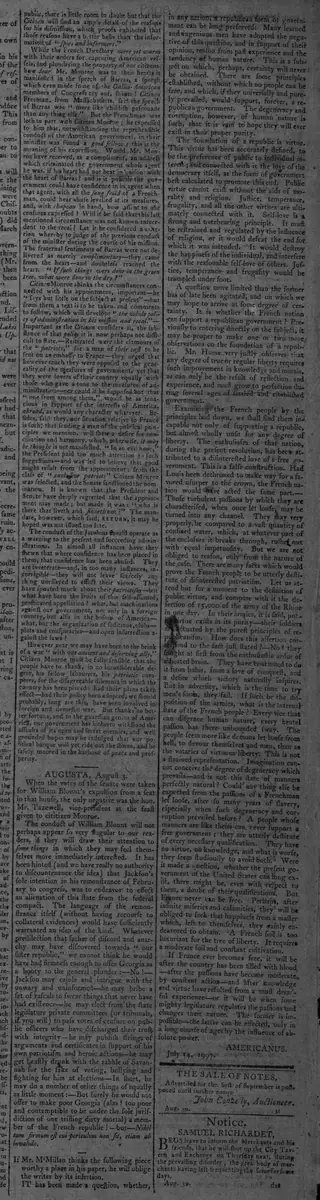
If Mr. M'Millan thinks the following piece worthy a place in his paper, he will oblige the writer by its insertion.
IT has been made a question, whether in any nation, a republican form of government can be long preserved: Many learned and ingenious men have adopted the negative of this question, and in support of their opinion, reason from past experience and the tendency of human nature. This is a subject on which, perhaps, certainty will never be obtained. There are some principles established, without which no people can be free, and which, if they universally and purely prevailed, would support, forever, a republican government. The degeneracy and corruption, however, of human nature is such, that it is vain to hope they will ever exist in their proper purity.
The foundation of a republic is virtue. This virtue has been accurately defined, to be the preference of public to individual interest; and connected with it the love of the democracy itself, as the form of government best calculated to promote this end. Public virtue cannot exist without the aids of morality and religion. Justice, temperance, frugality, and all the other virtues are ultimately connected with it. Self-love is a strong and overbearing principle. It must be restrained and regulated by the influence of religion, or it would defeat the end for which it was intended. It would destroy the happiness of the individual, and interfere with the reasonable self-love of others. Justice, temperance and frugality would be trampled under foot.
A question more limited than the former has of late been agitated, and on which we may hope to arrive at some degree of certainty. It is whether the French nation can support a republican government? Previously to entering directly on the subject, it may be proper to make one or two more observations on the foundation of a republic. Mr. Hume very justly observes that any degree of true or regular liberty requires such improvement in knowledge and morals, as can only be the result of reflection and experience, and must grow to perfection during several ages of settled and established government.
Examining the French people by the principles laid down, we shall find them incapable not only of supporting a republic. but almost wholly unfit for any degree of liberty. The enthusiasm of that nation, during the present revolution, has been attributed to a disinterested love of a free government. This is a false construction. Had Louis been dethroned to make way for a favored usurper to the crown, the French nation would have acted the same part.—Those turbulent passions by which they are characterized, when once let loose, may be turned into any channel. They may very properly, be compared to a vast quantity of confined water, which, at whatever part of the enclosure it breaks through, rushes out with equal impetuosity. But we are not obliged to reason, only from the nature of the case. There are many facts which would prove the French people to be utterly destitute of disinterested patriotism. Let us attend but for a moment to the definition of public virtue, and compare with it the desertion of 15,000 of the army of the Rhine in one day. In their armies, it is said, public virtue exists in its purity--their soldiers are actuated by the purest principles of republicanism. How does this assertion correspond to the fact just stated? No! they fought at first from the enthusiastick ardor of a heated brain. They have continued to do it from habit, from a love of conquest, and a desire which victory naturally inspires. But in adversity, which is the time to try men's souls, they fail. If such be the disposition of the armies, what is the internal state of the French people? Every vice that can disgrace human nature, every brutal passion has there unbounded sway. The people seem more like demons let loose from hell, to devour themselves and men, than as the votaries of virtuous liberty. This is not a strained representation. 'Imagination cannot conceive the degree of degeneracy which prevails—and is not this state of manners perfectly natural? Could any thing else be expected from the passions of a Frenchman let loose, after so many years of slavery, especially when such degeneracy and corruption prevailed before? A people whose manners are like theirs can never support a free government; they are utterly destitute of every necessary qualification. They have no virtue, no knowledge, and what is worse, they seem studiously to avoid both. Were it made a question, whether the present government of the United States can long exist, there might be, even with respect to them, a doubt of their qualifications. But France never can be free. Perhaps, after infinite miseries and calamities, they will be obliged to seek that happiness from a master which, left to themselves, they vainly endeavored to obtain. A French soil is too luxuriant for the tree of liberty. It requires a moderate soil and constant cultivation. If France ever becomes free, it will be after the country has been filled with blood -after the passions have become moderate by constant action-and after knowledge and virtue have resulted from a most dreadful experience-or it will be when some mighty legislature regulates the passions and changes their nature. The former is impossible-the latter can be effected, only in a long course of ages by the influence of absolute power.
AMERICANUS.
IT has been made a question, whether in any nation, a republican form of government can be long preserved: Many learned and ingenious men have adopted the negative of this question, and in support of their opinion, reason from past experience and the tendency of human nature. This is a subject on which, perhaps, certainty will never be obtained. There are some principles established, without which no people can be free, and which, if they universally and purely prevailed, would support, forever, a republican government. The degeneracy and corruption, however, of human nature is such, that it is vain to hope they will ever exist in their proper purity.
The foundation of a republic is virtue. This virtue has been accurately defined, to be the preference of public to individual interest; and connected with it the love of the democracy itself, as the form of government best calculated to promote this end. Public virtue cannot exist without the aids of morality and religion. Justice, temperance, frugality, and all the other virtues are ultimately connected with it. Self-love is a strong and overbearing principle. It must be restrained and regulated by the influence of religion, or it would defeat the end for which it was intended. It would destroy the happiness of the individual, and interfere with the reasonable self-love of others. Justice, temperance and frugality would be trampled under foot.
A question more limited than the former has of late been agitated, and on which we may hope to arrive at some degree of certainty. It is whether the French nation can support a republican government? Previously to entering directly on the subject, it may be proper to make one or two more observations on the foundation of a republic. Mr. Hume very justly observes that any degree of true or regular liberty requires such improvement in knowledge and morals, as can only be the result of reflection and experience, and must grow to perfection during several ages of settled and established government.
Examining the French people by the principles laid down, we shall find them incapable not only of supporting a republic. but almost wholly unfit for any degree of liberty. The enthusiasm of that nation, during the present revolution, has been attributed to a disinterested love of a free government. This is a false construction. Had Louis been dethroned to make way for a favored usurper to the crown, the French nation would have acted the same part.—Those turbulent passions by which they are characterized, when once let loose, may be turned into any channel. They may very properly, be compared to a vast quantity of confined water, which, at whatever part of the enclosure it breaks through, rushes out with equal impetuosity. But we are not obliged to reason, only from the nature of the case. There are many facts which would prove the French people to be utterly destitute of disinterested patriotism. Let us attend but for a moment to the definition of public virtue, and compare with it the desertion of 15,000 of the army of the Rhine in one day. In their armies, it is said, public virtue exists in its purity--their soldiers are actuated by the purest principles of republicanism. How does this assertion correspond to the fact just stated? No! they fought at first from the enthusiastick ardor of a heated brain. They have continued to do it from habit, from a love of conquest, and a desire which victory naturally inspires. But in adversity, which is the time to try men's souls, they fail. If such be the disposition of the armies, what is the internal state of the French people? Every vice that can disgrace human nature, every brutal passion has there unbounded sway. The people seem more like demons let loose from hell, to devour themselves and men, than as the votaries of virtuous liberty. This is not a strained representation. 'Imagination cannot conceive the degree of degeneracy which prevails—and is not this state of manners perfectly natural? Could any thing else be expected from the passions of a Frenchman let loose, after so many years of slavery, especially when such degeneracy and corruption prevailed before? A people whose manners are like theirs can never support a free government; they are utterly destitute of every necessary qualification. They have no virtue, no knowledge, and what is worse, they seem studiously to avoid both. Were it made a question, whether the present government of the United States can long exist, there might be, even with respect to them, a doubt of their qualifications. But France never can be free. Perhaps, after infinite miseries and calamities, they will be obliged to seek that happiness from a master which, left to themselves, they vainly endeavored to obtain. A French soil is too luxuriant for the tree of liberty. It requires a moderate soil and constant cultivation. If France ever becomes free, it will be after the country has been filled with blood -after the passions have become moderate by constant action-and after knowledge and virtue have resulted from a most dreadful experience-or it will be when some mighty legislature regulates the passions and changes their nature. The former is impossible-the latter can be effected, only in a long course of ages by the influence of absolute power.
AMERICANUS.
What sub-type of article is it?
Constitutional
Moral Or Religious
Foreign Affairs
What keywords are associated?
Republican Government
Public Virtue
French Revolution
Morality Religion
Liberty Foundation
What entities or persons were involved?
French Nation
Louis
Mr. Hume
United States
Editorial Details
Primary Topic
Viability Of Republican Government In France
Stance / Tone
Skeptical Of French Capacity For Republicanism Due To Lack Of Virtue
Key Figures
French Nation
Louis
Mr. Hume
United States
Key Arguments
Republican Government Requires Public Virtue Preferring Public Over Individual Interest
Virtue Needs Support From Morality And Religion To Restrain Self Love
French People Lack Necessary Virtue And Knowledge For Liberty, Shown By Army Desertions And Vices
French Enthusiasm Stems From Turbulent Passions, Not Disinterested Patriotism
France Cannot Sustain Freedom Without Miseries Leading To Moderation Or Absolute Power Over Ages