Thank you for visiting SNEWPapers!
Sign up free
Editorial
January 20, 1807
Virginia Argus
Richmond, Virginia
What is this article about?
Editorial criticizes Representatives Dana and Quincy for opposing the repeal of salt duties under the guise of aiding the poor, arguing that salt is a necessity unlike luxury imports like tea. It supports repealing the tax on salt, noting its importance to agriculture and fisheries, and downplays revenue from tea duties.
Clipping
OCR Quality
95%
Excellent
Full Text
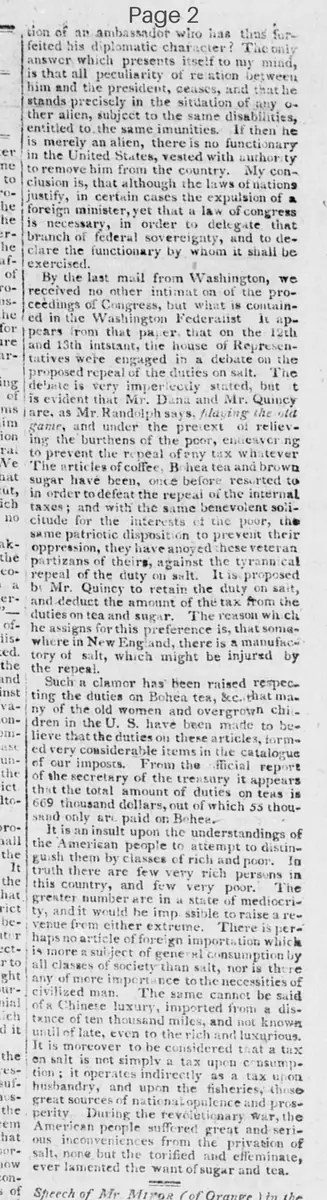
By the last mail from Washington, we received no other information of the proceedings of Congress, but what is contained in the Washington Federalist. It appears from that paper that on the 12th and 13th instant, the house of Representatives were engaged in a debate on the proposed repeal of the duties on salt. The debate is very imperfectly stated, but it is evident that Mr. Dana and Mr. Quincy are, as Mr. Randolph says, playing the old game, and under the pretext of relieving the burthens of the poor, endeavouring to prevent the repeal of any tax whatever. The articles of coffee, Bohea tea and brown sugar have been, once before resorted to in order to defeat the repeal of the internal taxes; and with the same benevolent solicitude for the interests of the poor, the same patriotic disposition to prevent their oppression, they have moved these veteran partizans of theirs, against the tyrannical repeal of the duty on salt. It is proposed by Mr. Quincy to retain the duty on salt, and deduct the amount of the tax from the duties on tea and sugar. The reason which he assigns for this preference is, that somewhere in New England, there is a manufactory of salt, which might be injured by the repeal.
Such a clamor has been raised respecting the duties on Bohea tea, &c. that many of the old women and overgrown children in the U. S. have been made to believe that the duties on these articles, formed very considerable items in the catalogue of our imposts. From the official report of the secretary of the treasury it appears that the total amount of duties on teas is 669 thousand dollars, out of which 55 thousand only are paid on Bohea.
It is an insult upon the understandings of the American people to attempt to distinguish them by classes of rich and poor. In truth there are few very rich persons in this country, and few very poor. The greater number are in a state of mediocrity, and it would be impossible to raise a revenue from either extreme. There is perhaps no article of foreign importation which is more a subject of general consumption by all classes of society than salt, nor is there any of more importance to the necessities of civilized man. The same cannot be said of a Chinese luxury, imported from a distance of ten thousand miles, and not known until of late, even to the rich and luxurious. It is moreover to be considered that a tax on salt is not simply a tax upon consumption: it operates indirectly as a tax upon husbandry, and upon the fisheries, those great sources of national opulence and prosperity. During the revolutionary war, the American people suffered great and serious inconveniences from the privation of salt, none but the torified and effeminate, ever lamented the want of sugar and tea.
Such a clamor has been raised respecting the duties on Bohea tea, &c. that many of the old women and overgrown children in the U. S. have been made to believe that the duties on these articles, formed very considerable items in the catalogue of our imposts. From the official report of the secretary of the treasury it appears that the total amount of duties on teas is 669 thousand dollars, out of which 55 thousand only are paid on Bohea.
It is an insult upon the understandings of the American people to attempt to distinguish them by classes of rich and poor. In truth there are few very rich persons in this country, and few very poor. The greater number are in a state of mediocrity, and it would be impossible to raise a revenue from either extreme. There is perhaps no article of foreign importation which is more a subject of general consumption by all classes of society than salt, nor is there any of more importance to the necessities of civilized man. The same cannot be said of a Chinese luxury, imported from a distance of ten thousand miles, and not known until of late, even to the rich and luxurious. It is moreover to be considered that a tax on salt is not simply a tax upon consumption: it operates indirectly as a tax upon husbandry, and upon the fisheries, those great sources of national opulence and prosperity. During the revolutionary war, the American people suffered great and serious inconveniences from the privation of salt, none but the torified and effeminate, ever lamented the want of sugar and tea.
What sub-type of article is it?
Economic Policy
Partisan Politics
What keywords are associated?
Salt Duty Repeal
Congressional Debate
Taxation Pretext
Poor Relief
Tea Duties
New England Salt Manufactory
Revolutionary War Salt Shortage
What entities or persons were involved?
Mr. Dana
Mr. Quincy
Mr. Randolph
House Of Representatives
Washington Federalist
Secretary Of The Treasury
Editorial Details
Primary Topic
Opposition To Retaining Salt Duties
Stance / Tone
Critical Of Tax Retention Pretext, Supportive Of Salt Duty Repeal
Key Figures
Mr. Dana
Mr. Quincy
Mr. Randolph
House Of Representatives
Washington Federalist
Secretary Of The Treasury
Key Arguments
Opponents Use Poor Relief As Pretext To Block Tax Repeals
Salt Duty Harms Poor More Than Luxury Taxes Like Tea
Salt Is Essential For All Classes, Unlike Imported Tea
Tax On Salt Burdens Agriculture And Fisheries
Revenue From Bohea Tea Is Minimal (55 Thousand Dollars Out Of 669 Thousand For Teas)
Few Rich Or Poor In America; Most In Mediocrity