Thank you for visiting SNEWPapers!
Sign up free
The New Hampshire Gazette And General Advertiser
Portsmouth, Exeter, Rockingham County, New Hampshire
What is this article about?
Letters from Dublin outline a political strategy permitting the Irish parliament to declare rights without opposition, to be met by the English parliament, including detailed Irish claims brought by Mr. Eden on legislative independence, peer voting, offices, trade protection, militia, and bishoprics.
Clipping
OCR Quality
Full Text
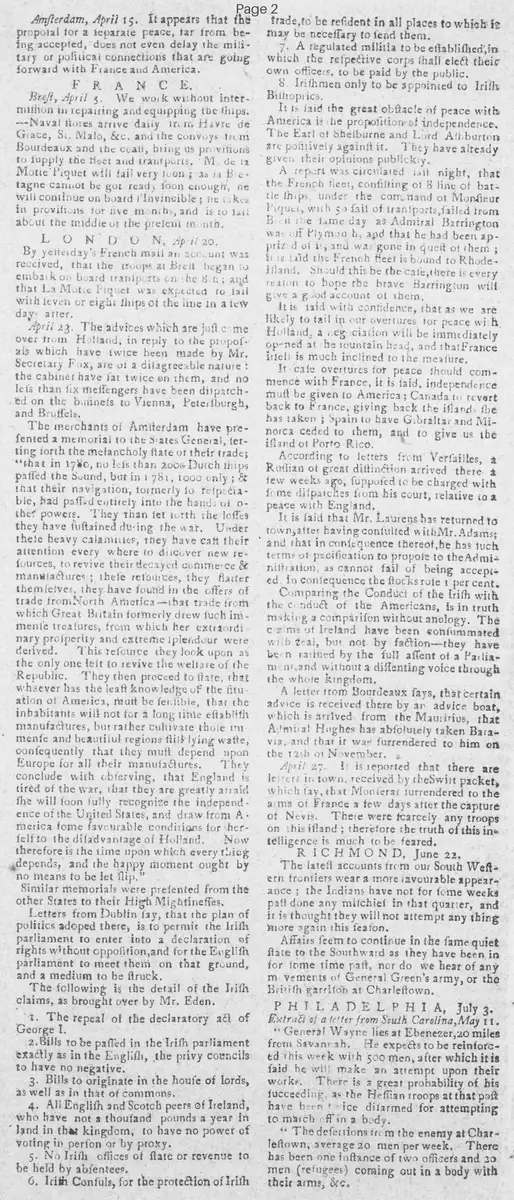
The following is the detail of the Irish claims, as brought over by Mr. Eden.
1. The repeal of the declaratory act of George I.
2. Bills to be passed in the Irish parliament exactly as in the English, the privy councils to have no negative.
3. Bills to originate in the house of lords, as well as in that of commons.
4. All English and Scotch peers of Ireland, who have not a thousand pounds a year in land in that kingdom, to have no power of voting in person or by proxy.
5. No Irish offices of state or revenue to be held by absentees.
6. Irish Consuls, for the protection of Irish trade, to be resident in all places to which it may be necessary to send them.
7. A regulated militia to be established, in which the respective corps shall elect their own officers, to be paid by the public.
8. Irishmen only to be appointed to Irish Bishoprics.
What sub-type of article is it?
What keywords are associated?
What entities or persons were involved?
Where did it happen?
Foreign News Details
Primary Location
Dublin
Key Persons
Event Details
Letters from Dublin describe a political plan to allow the Irish parliament to declare rights without opposition, with the English parliament meeting them on that ground and striking a medium. Details of Irish claims brought by Mr. Eden include: repeal of the declaratory act of George I; bills passed as in England without privy council negative; bills originating in house of lords or commons; English and Scotch peers without 1000 pounds a year in Irish land unable to vote; no absentees in Irish offices; resident Irish consuls for trade protection; regulated militia with elected officers paid publicly; Irishmen only for Irish bishoprics.