Thank you for visiting SNEWPapers!
Sign up free
Poem
April 22, 1828
Lancaster Gazette
Lancaster, Worcester County, Massachusetts
What is this article about?
Mrs. Hemans' poem meditates on the physical decay of ancient cities, tombs, and glories overtaken by nature, then contrasts this with the more profound sorrow of emotional changes in the human heart, such as scorn replacing love and pride supplanting tenderness.
Clipping
OCR Quality
95%
Excellent
Full Text
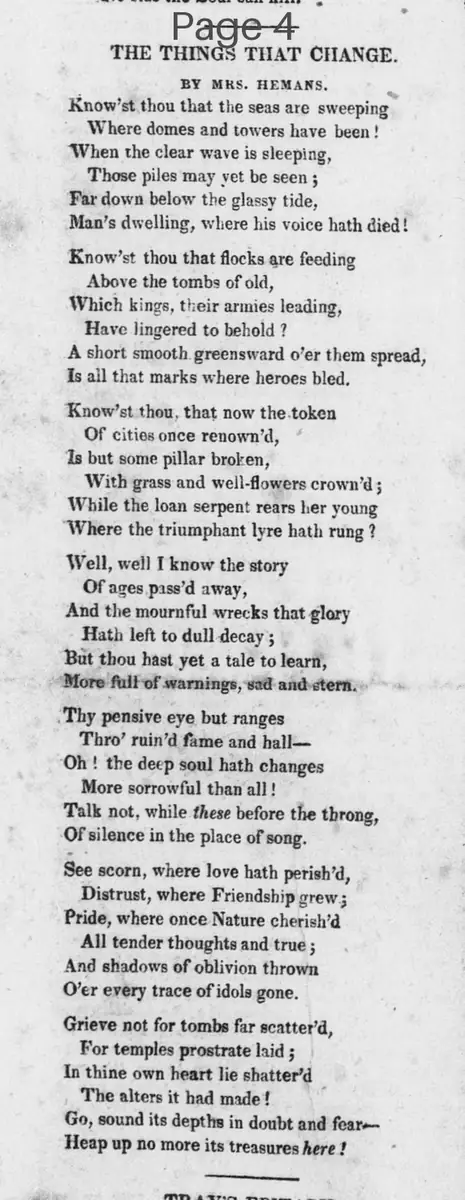
THE THINGS THAT CHANGE.
BY MRS. HEMANS.
Know'st thou that the seas are sweeping
Where domes and towers have been!
When the clear wave is sleeping,
Those piles may yet be seen;
Far down below the glassy tide,
Man's dwelling, where his voice hath died!
Know'st thou that flocks are feeding
Above the tombs of old,
Which kings, their armies leading,
Have lingered to behold?
A short smooth greensward o'er them spread
Is all that marks where heroes bled.
Know'st thou, that now the token
Of cities once renown'd,
Is but some pillar broken,
With grass and wild-flowers crown'd;
While the lone serpent rears her young
Where the triumphant lyre hath rung?
Well, well I know the story
Of ages pass'd away,
And the mournful wrecks that glory
Hath left to dull decay;
But thou hast yet a tale to learn,
More full of warnings, sighs and tears.
Thy pensive eye but ranges
Thro' ruin'd fane and hall-
Oh! the deep soul hath changes
More sorrowful than all!
Talk not, while these before the throng,
Of silence in the place of song.
See scorn, where love hath perish'd,
Distrust, where Friendship grew;
Pride, where once Nature cherish'd
All tender thoughts and true;
And shadows of oblivion throw
O'er every trace of idols gone.
Grieve not for tombs far scatter'd,
For temples prostrate laid;
In thine own heart lie shatter'd
The altars it had made!
Go, sound its depths in doubt and fear-
Heap up no more its treasures here!
BY MRS. HEMANS.
Know'st thou that the seas are sweeping
Where domes and towers have been!
When the clear wave is sleeping,
Those piles may yet be seen;
Far down below the glassy tide,
Man's dwelling, where his voice hath died!
Know'st thou that flocks are feeding
Above the tombs of old,
Which kings, their armies leading,
Have lingered to behold?
A short smooth greensward o'er them spread
Is all that marks where heroes bled.
Know'st thou, that now the token
Of cities once renown'd,
Is but some pillar broken,
With grass and wild-flowers crown'd;
While the lone serpent rears her young
Where the triumphant lyre hath rung?
Well, well I know the story
Of ages pass'd away,
And the mournful wrecks that glory
Hath left to dull decay;
But thou hast yet a tale to learn,
More full of warnings, sighs and tears.
Thy pensive eye but ranges
Thro' ruin'd fane and hall-
Oh! the deep soul hath changes
More sorrowful than all!
Talk not, while these before the throng,
Of silence in the place of song.
See scorn, where love hath perish'd,
Distrust, where Friendship grew;
Pride, where once Nature cherish'd
All tender thoughts and true;
And shadows of oblivion throw
O'er every trace of idols gone.
Grieve not for tombs far scatter'd,
For temples prostrate laid;
In thine own heart lie shatter'd
The altars it had made!
Go, sound its depths in doubt and fear-
Heap up no more its treasures here!
What sub-type of article is it?
Elegy
What themes does it cover?
Death Mourning
Moral Virtue
What keywords are associated?
Change
Decay
Ruins
Heart
Love
Glory
Transience
What entities or persons were involved?
By Mrs. Hemans.
Poem Details
Title
The Things That Change.
Author
By Mrs. Hemans.
Subject
Reflections On Mutability And Inner Sorrow
Form / Style
Rhymed Stanzas
Key Lines
Know'st Thou That The Seas Are Sweeping
Where Domes And Towers Have Been!
When The Clear Wave Is Sleeping,
Those Piles May Yet Be Seen;
Far Down Below The Glassy Tide,
Man's Dwelling, Where His Voice Hath Died!
Grieve Not For Tombs Far Scatter'd,
For Temples Prostrate Laid;
In Thine Own Heart Lie Shatter'd
The Altars It Had Made!
Go, Sound Its Depths In Doubt And Fear
Heap Up No More Its Treasures Here!