Thank you for visiting SNEWPapers!
Sign up free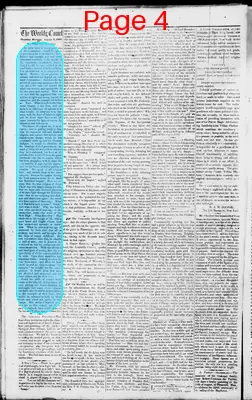
Editorial
August 12, 1855
The Weekly Comet
Baton Rouge, East Baton Rouge County, Louisiana
What is this article about?
This editorial urges good men to uphold community morals through personal example and critiques how education shapes right and wrong, dismisses original sin, portrays religion as an obstacle to reason, blames faith for skepticism, and faults the educated elite for promoting vices like gambling and drinking in society.
Clipping

OCR Quality
95%
Excellent
Full Text
The Moral Tone of Society.
The daily labor of every good man in the community, should be given to prevent as far as in him lies, by influence and example, any and every downward tendency of the morals of the community in which he lives—
And if his life be once enlisted in the good work; instead of its being labor: it is pleasure not to be computed in figures. Because all our pleasure is inward, and does not depend on outward circumstance: therefore the approval of one's own conscience for every act, is the only real reward the mind can receive, and appropriate to its own quiet and comfort. Here we are met with the argument that our notions of right and wrong depend on education, and the example set before us. True. What is right in the Cannibal Islands, is not here, and yet there is no difference of opinion as to what is right: for whatever is in harmony with the laws of nature is right and we know these laws as we advance towards the light of reason, by education and refinement.
The theory of original sin, is an allegory; man is getting ready to disdain his reason on this and kindred subjects, and remove this serious and blasphemous charge, which he has voluntarily made against his Creator.
Religion, to which we attribute all the blessings of civil government, instead of being the source from whence they have emanated, has been at all periods of the world's history the great drawback—the foe to reason which has been struggling with it, since the very nativity of man and his appearance on this beautiful flower-garden of creation. We speak of all religion here: and include them in the same category, because the system having the least common sense for its basis has flourished longest. Here we assume that the true religion of Jesus Christ was only taught during his life, that we have only received glimpses of its pure light through the Reformation—that we are relapsing into darkness and skepticism again; the result of a false system of theocracy. What is it that holds such systems? "Faith."
And what is faith? Why, the belief that what one set of men say—is the immaculate truth—the word of the Most High! What absurdity!! Man starts out on the voyage of life, with a pure heart and bright visions, lead him onward and upward; in usefulness. When he arrives at the age of manhood, he finds, alas! that all is trickery and deceit, and he sighs for the days of happy childhood. Errors everywhere meet him, in church as well as state: and it is not to be wondered at, that he settles into universal skepticism. With the educated and intelligent of society, does the responsibility of all the evils complained of lie. Upon their shoulders rest important trusts. Society receives its tone from them; and when we look about us and see their teaching "by example," we tremble for the consequences. It would seem that men are elevated and respected, not for their virtues, but for their vices.
Could the walls of certain back rooms in this city tell all they know, of card playing and liquor drinking, at mid-night, how many of our citizens are there, who should be shining lights in the example of their lives: who would be ashamed to hold up their heads and plead not guilty to the charge. The wives of married men, who are in this respect, out of the path of rectitude, have a full share of the burden of these sins to answer for.
The daily labor of every good man in the community, should be given to prevent as far as in him lies, by influence and example, any and every downward tendency of the morals of the community in which he lives—
And if his life be once enlisted in the good work; instead of its being labor: it is pleasure not to be computed in figures. Because all our pleasure is inward, and does not depend on outward circumstance: therefore the approval of one's own conscience for every act, is the only real reward the mind can receive, and appropriate to its own quiet and comfort. Here we are met with the argument that our notions of right and wrong depend on education, and the example set before us. True. What is right in the Cannibal Islands, is not here, and yet there is no difference of opinion as to what is right: for whatever is in harmony with the laws of nature is right and we know these laws as we advance towards the light of reason, by education and refinement.
The theory of original sin, is an allegory; man is getting ready to disdain his reason on this and kindred subjects, and remove this serious and blasphemous charge, which he has voluntarily made against his Creator.
Religion, to which we attribute all the blessings of civil government, instead of being the source from whence they have emanated, has been at all periods of the world's history the great drawback—the foe to reason which has been struggling with it, since the very nativity of man and his appearance on this beautiful flower-garden of creation. We speak of all religion here: and include them in the same category, because the system having the least common sense for its basis has flourished longest. Here we assume that the true religion of Jesus Christ was only taught during his life, that we have only received glimpses of its pure light through the Reformation—that we are relapsing into darkness and skepticism again; the result of a false system of theocracy. What is it that holds such systems? "Faith."
And what is faith? Why, the belief that what one set of men say—is the immaculate truth—the word of the Most High! What absurdity!! Man starts out on the voyage of life, with a pure heart and bright visions, lead him onward and upward; in usefulness. When he arrives at the age of manhood, he finds, alas! that all is trickery and deceit, and he sighs for the days of happy childhood. Errors everywhere meet him, in church as well as state: and it is not to be wondered at, that he settles into universal skepticism. With the educated and intelligent of society, does the responsibility of all the evils complained of lie. Upon their shoulders rest important trusts. Society receives its tone from them; and when we look about us and see their teaching "by example," we tremble for the consequences. It would seem that men are elevated and respected, not for their virtues, but for their vices.
Could the walls of certain back rooms in this city tell all they know, of card playing and liquor drinking, at mid-night, how many of our citizens are there, who should be shining lights in the example of their lives: who would be ashamed to hold up their heads and plead not guilty to the charge. The wives of married men, who are in this respect, out of the path of rectitude, have a full share of the burden of these sins to answer for.
What sub-type of article is it?
Moral Or Religious
Social Reform
What keywords are associated?
Moral Tone
Society Morals
Religion Critique
Reason Vs Faith
Social Vices
Personal Example
Original Sin
Skepticism
Educated Class
Hypocrisy
What entities or persons were involved?
Educated And Intelligent Of Society
Wives Of Married Men
Editorial Details
Primary Topic
Moral Tone Of Society And Critique Of Religion
Stance / Tone
Critical Of Organized Religion And Societal Hypocrisy, Exhortative On Personal Morality
Key Figures
Educated And Intelligent Of Society
Wives Of Married Men
Key Arguments
Individuals Should Prevent Moral Decline Through Influence And Example
Conscience Approval Provides True Inward Pleasure
Notions Of Right And Wrong Depend On Education But Align With Natural Laws
Original Sin Is An Allegory To Be Rejected
Religion Has Historically Hindered Reason And Civil Progress
True Christianity Was Only Taught During Jesus' Life, With Glimpses Via Reformation
Faith Is Blind Belief In Men's Words, Leading To Skepticism
Educated Class Sets Poor Examples, Promoting Vices Like Card Playing And Liquor Drinking
Men Are Respected For Vices Rather Than Virtues
Wives Share Burden For Husbands' Moral Failings