Thank you for visiting SNEWPapers!
Sign up free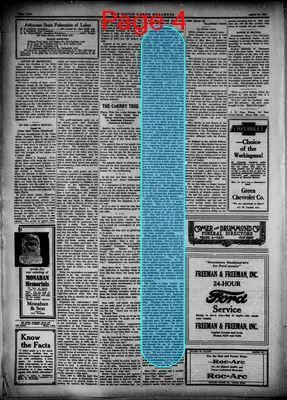
Story
August 21, 1925
Union Labor Bulletin
Little Rock, Pulaski County, Arkansas
What is this article about?
William Green, President of the American Federation of Labor, argues that effective collective bargaining requires organized workers and educated representatives. He highlights labor's historical support for public education, child labor laws, and the role of education in advancing labor's economic and intellectual strength to foster public understanding.
Clipping

OCR Quality
98%
Excellent
Full Text
EDUCATION.
(By William Green, President American Federation of Labor.)
Labor fully understands that collective bargaining could not be successful unless supported by and through the mobilization of labor's economic power. This involves organization of the workers. The more complete and thorough the organization becomes the more effective become the principles of collective bargaining. It's easy to understand how much more effective the leaders of labor can be and how much more authoritatively they can speak when the workers whom they represent are thoroughly and completely organized.
This leads to the consideration of a new development growing out of collective bargaining. I refer to the diverse requirements which the spokesmen and advocates of labor must possess. The trade union representative must know his case and his cause and must be qualified to present the facts in a logical and convincing way. This qualification is acquired only through experience, training and education. It is an unwritten law of trade unionism that the workers be represented in wage scale conferences and in all negotiations with employers by men who work with them, who speak their language, who know the trade, who have been active in trade unionism, who possess an abundance of natural ability and who have a standing with their fellows which invites confidence and trust. The operation of this rule serves a double purpose in that it affords opportunity for individual advancement and encourages the workers to study and master their problems, inspiring them to greater endeavor. The trade union is the direct beneficiary of this operating process for it receives the services of its most able and best-equipped members.
Invariably the discussion in the conference room covers a wide range. Trade terms are used and the technical features of industry are discussed. Management and managerial problems often become involved in the discussion. Efficiency in production, together with the problems of human welfare and human interests, are all covered in the general review and discussions which take place. Mere reference to these matters directs attention to the practical and technical qualifications which the present-day representative of organized labor must possess.
Labor stands upon the threshold of the third definite period of accomplishment. This is every indication that the organizations of labor are entering upon a new era, one which education is going to play a greater part. This will involve not only an understanding of the way in which to present the demands of the workers in the conference room, but also the successful way in which the economic strength of the workers can be consolidated, centralized and efficiently used when occasion requires.
Quite early the membership of organized labor properly appraised the value of education. This is shown by their early declarations and stand in favor of and in support of free public schools and compulsory education. Trade unions demand that every child should be afforded an opportunity to acquire an education. They fought for child labor legislation, for the widest, fullest and freest opportunity for school attendance and for legislation which would compel children to attend school. After this principle was established, the workers realized more than ever that education is not a process ending with common school experience.
The worker is being taught the value of his economic strength and the importance of joining with his fellowmen in wisely directing the use of their intellectual and organized powers along constructive lines in the furtherance of the work of organized labor. Through this work of education much latent ability is being developed into active use and service.
The net result is that the cause of the worker is being intelligently strengthened educationally and economically.
We want the public to understand organized labor, its creed, its philosophy and its principles. We do not want these principles to be confused with principles advocated by the spokesmen of other alleged organizations who constantly insist upon speaking about labor and aver they speak in the name of labor. We propose to bring about such understanding through the use of literature, through education and through information which is available for public use. We are confident that much of the hostility directed toward organized labor can be overcome through a proper understanding of the high and patriotic purposes which organized labor enunciates and champions.
(By William Green, President American Federation of Labor.)
Labor fully understands that collective bargaining could not be successful unless supported by and through the mobilization of labor's economic power. This involves organization of the workers. The more complete and thorough the organization becomes the more effective become the principles of collective bargaining. It's easy to understand how much more effective the leaders of labor can be and how much more authoritatively they can speak when the workers whom they represent are thoroughly and completely organized.
This leads to the consideration of a new development growing out of collective bargaining. I refer to the diverse requirements which the spokesmen and advocates of labor must possess. The trade union representative must know his case and his cause and must be qualified to present the facts in a logical and convincing way. This qualification is acquired only through experience, training and education. It is an unwritten law of trade unionism that the workers be represented in wage scale conferences and in all negotiations with employers by men who work with them, who speak their language, who know the trade, who have been active in trade unionism, who possess an abundance of natural ability and who have a standing with their fellows which invites confidence and trust. The operation of this rule serves a double purpose in that it affords opportunity for individual advancement and encourages the workers to study and master their problems, inspiring them to greater endeavor. The trade union is the direct beneficiary of this operating process for it receives the services of its most able and best-equipped members.
Invariably the discussion in the conference room covers a wide range. Trade terms are used and the technical features of industry are discussed. Management and managerial problems often become involved in the discussion. Efficiency in production, together with the problems of human welfare and human interests, are all covered in the general review and discussions which take place. Mere reference to these matters directs attention to the practical and technical qualifications which the present-day representative of organized labor must possess.
Labor stands upon the threshold of the third definite period of accomplishment. This is every indication that the organizations of labor are entering upon a new era, one which education is going to play a greater part. This will involve not only an understanding of the way in which to present the demands of the workers in the conference room, but also the successful way in which the economic strength of the workers can be consolidated, centralized and efficiently used when occasion requires.
Quite early the membership of organized labor properly appraised the value of education. This is shown by their early declarations and stand in favor of and in support of free public schools and compulsory education. Trade unions demand that every child should be afforded an opportunity to acquire an education. They fought for child labor legislation, for the widest, fullest and freest opportunity for school attendance and for legislation which would compel children to attend school. After this principle was established, the workers realized more than ever that education is not a process ending with common school experience.
The worker is being taught the value of his economic strength and the importance of joining with his fellowmen in wisely directing the use of their intellectual and organized powers along constructive lines in the furtherance of the work of organized labor. Through this work of education much latent ability is being developed into active use and service.
The net result is that the cause of the worker is being intelligently strengthened educationally and economically.
We want the public to understand organized labor, its creed, its philosophy and its principles. We do not want these principles to be confused with principles advocated by the spokesmen of other alleged organizations who constantly insist upon speaking about labor and aver they speak in the name of labor. We propose to bring about such understanding through the use of literature, through education and through information which is available for public use. We are confident that much of the hostility directed toward organized labor can be overcome through a proper understanding of the high and patriotic purposes which organized labor enunciates and champions.
What sub-type of article is it?
Labor Advocacy
Educational Essay
What themes does it cover?
Moral Virtue
Justice
Triumph
What keywords are associated?
Collective Bargaining
Labor Education
Trade Unions
Worker Organization
Public Schools
What entities or persons were involved?
William Green
Story Details
Key Persons
William Green
Story Details
William Green discusses the importance of education and organization in strengthening collective bargaining for labor unions, emphasizing the need for trained representatives, support for public education, and public understanding of labor's principles to overcome hostility.