Thank you for visiting SNEWPapers!
Sign up free
Domestic News
February 18, 1797
Gazette Of The United States, & Philadelphia Daily Advertiser
Philadelphia, Philadelphia County, Pennsylvania
What is this article about?
A demographic projection from the Dublin Gazette estimates the US territory, spanning 920,313 square miles, can support 151,851,645 inhabitants based on European densities. Starting from 3.5 million, doubling every 25 years, it will reach capacity in less than 120 years.
Clipping
OCR Quality
95%
Excellent
Full Text
From the Dublin Gazette
QUESTION.
What number of inhabitants is the Territory of the United States capable of subsisting, and at what probable period will our population reach that number?
ANSWER.
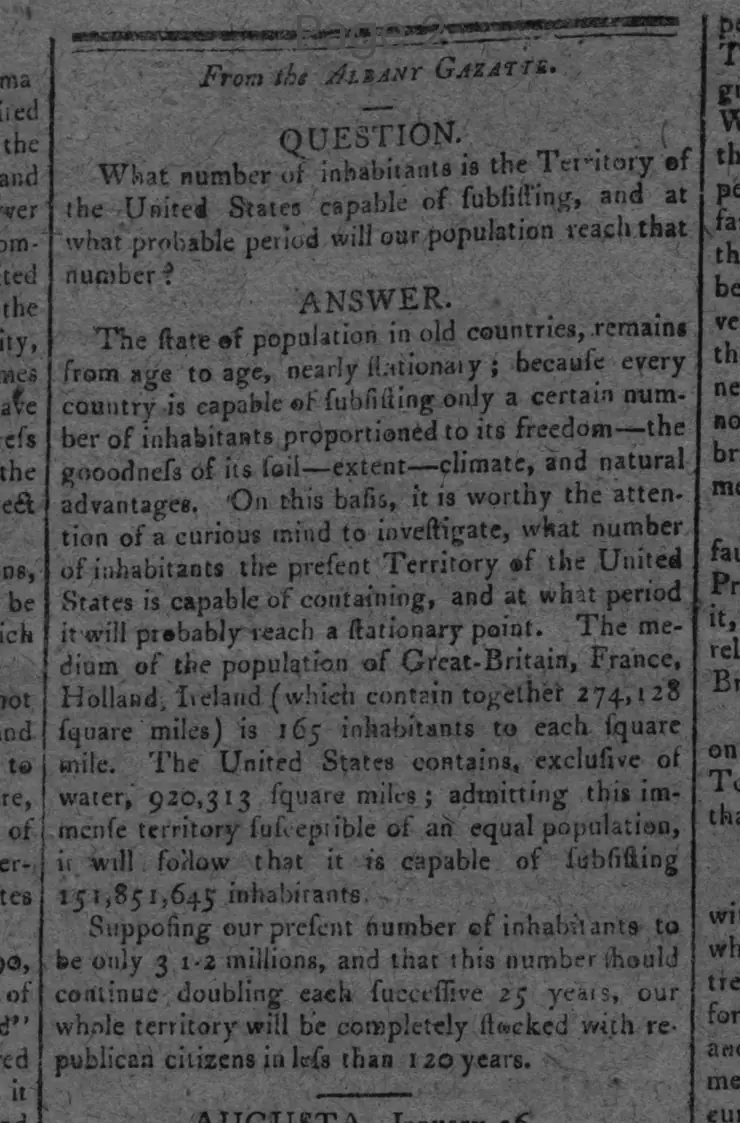
The state of population in old countries, remains from age to age, nearly stationary; because every country is capable of subsisting only a certain number of inhabitants proportioned to its freedom--the goodness of its soil--extent--climate, and natural advantages. On this basis, it is worthy the attention of a curious mind to investigate, what number of inhabitants the present Territory of the United States is capable of containing, and at what period it will probably reach a stationary point. The medium of the population of Great-Britain, France, Holland, Ireland (which contain together 274,128 square miles) is 165 inhabitants to each square mile. The United States contains, exclusive of water, 920,313 square miles; admitting this immense territory susceptible of an equal population, it will follow that it is capable of subsisting 151,851,645 inhabitants.
Supposing our present number of inhabitants to be only 3 1-2 millions, and that this number should continue doubling each successive 25 years, our whole territory will be completely stocked with republican citizens in less than 120 years.
QUESTION.
What number of inhabitants is the Territory of the United States capable of subsisting, and at what probable period will our population reach that number?
ANSWER.
The state of population in old countries, remains from age to age, nearly stationary; because every country is capable of subsisting only a certain number of inhabitants proportioned to its freedom--the goodness of its soil--extent--climate, and natural advantages. On this basis, it is worthy the attention of a curious mind to investigate, what number of inhabitants the present Territory of the United States is capable of containing, and at what period it will probably reach a stationary point. The medium of the population of Great-Britain, France, Holland, Ireland (which contain together 274,128 square miles) is 165 inhabitants to each square mile. The United States contains, exclusive of water, 920,313 square miles; admitting this immense territory susceptible of an equal population, it will follow that it is capable of subsisting 151,851,645 inhabitants.
Supposing our present number of inhabitants to be only 3 1-2 millions, and that this number should continue doubling each successive 25 years, our whole territory will be completely stocked with republican citizens in less than 120 years.
What sub-type of article is it?
Economic
What keywords are associated?
Us Population
Demographic Projection
Territory Capacity
Population Doubling
Where did it happen?
United States
Domestic News Details
Primary Location
United States
Event Details
Projection calculates US territory's capacity at 151,851,645 inhabitants based on 165 per square mile from European examples. From 3.5 million, doubling every 25 years, reaches capacity in under 120 years.